Quick answer: No one can tell you from a utility report, because none of the local reports publish a hardness figure. Apalachicola, Eastpoint and Carrabelle draw groundwater from wells in the Floridan Aquifer, a limestone formation, while Port St. Joe treats surface water from the Chipola River Canal, and inland homes in Liberty and Wakulla counties often run on private wells. Hardness depends on which of those sources reaches your house and on what happens in the pipes along the way. A free in-home test from Culligan of Apalachicola gives you your home’s number in about 20 minutes.
Hard water is water carrying dissolved calcium and magnesium. Those minerals are not a health hazard, so they are not part of the compliance tables that utilities must publish, and that is why the question keeps coming up along the Forgotten Coast. Below is what we know about the water serving Apalachicola, Eastpoint, Carrabelle, Lanark Village, Port St. Joe and the towns inland, how hardness shows itself in a home, and how to get a real answer for your address.
Four water systems, four different starting points
The City of Apalachicola runs three wells, numbered 5, 6 and 7, that tap the Floridan Aquifer. According to an engineering study prepared for the city, the raw water rises through a packed-tower aerator sitting on top of a ground storage tank, which strips naturally occurring hydrogen sulfide before high-service pumps send it into town. The city’s annual report describes chlorine as the only treatment the water requires. It covers lead, disinfection byproducts, sodium and a short list of minerals, but no hardness figure. You can read every recent report on the City of Apalachicola Water & Sewer page.
Across the John Gorrie Memorial Bridge, the Eastpoint Water and Sewer District serves about 4,800 people from two 350-foot wells, also in the Floridan Aquifer, according to the Florida Department of Environmental Protection’s source water assessment. Farther east, Carrabelle pumps from two Floridan Aquifer wells, and its 2024 report says treatment uses ion exchange along with chlorine. Neither of those sources gives a hardness number we could cite.
Port St. Joe is different. The city treats surface water from the Chipola River Canal, using lime, coagulation, clarification and submerged membrane microfiltration before disinfection and pH adjustment, according to its 2025 water quality report. River water and aquifer water start out with different mineral profiles, and treatment changes them again, so a Port St. Joe tap and an Apalachicola tap can behave very differently even though they sit only a short drive apart.
Then there are private wells. The USGS county water-use report counts about 7.5 percent of Franklin County residents and about 8 percent of Gulf County residents on their own wells, but the share climbs to about 60 percent in Liberty County and more than half in Wakulla County. That puts a lot of homes in Bristol, Hosford, Sopchoppy and Panacea outside any utility report. Well hardness depends on the depth of the well and the formation it reaches, and here it frequently arrives together with iron or sulfur.
The honest summary is that hardness on the Forgotten Coast varies by source and by property. If you want system-level information, contact your utility or read its annual report. If you want your own number, test at the tap.
Signs of hard water in Apalachicola-area homes
When calcium and magnesium are present, they announce themselves in a few predictable ways. Here is what our technicians look for when they visit a home in the historic district, a cottage in Lanark Village or a newer build near Cape San Blas.
1. Spots, film and crust on glass and fixtures
Hard water leaves minerals behind as it dries. That shows up as cloudy spots on drinking glasses straight out of the dishwasher, a chalky haze on shower doors and a white ring around faucet bases and showerheads. Over time the crust narrows the openings in aerators and spray heads, so water pressure at a single fixture drops while the rest of the house seems fine. Vinegar dissolves the deposit for a while, but it returns as long as the minerals keep arriving.
Be aware that not every stain is hardness. Orange or brown marks usually point to iron, and gray or black marks to manganese, both of which turn up in Floridan Aquifer water. A Florida Department of Health review of Apalachicola samples taken June 12, 2025 measured iron at about 0.5 mg/L and manganese at about 0.23 mg/L during a period when the city’s aerators were offline. White, chalky residue is the classic hardness signature; color means something else is going on, and the treatment is different.
2. Soap that will not lather, and skin that feels tight
Calcium and magnesium react with soap and shampoo to form a sticky curd instead of a clean rinse. People notice it as needing more product to get a lather, a squeaky or tight feeling after a shower, hair that looks flat, and towels that turn stiff after a few washes. Laundry detergent gets used up neutralizing minerals instead of cleaning, so whites can look gray sooner. In a vacation rental on St. George Island where guests comment on the shower, hardness is one of the first things we check.
3. Scale inside water heaters and appliances
The most expensive effect of hardness is the one you cannot see. Heat drives minerals out of solution, so scale collects in the bottom of tank water heaters, on heating elements and inside tankless heat exchangers. A heater that pops or rumbles as it heats is often sitting on a layer of sediment. Scale also builds up inside dishwashers, coffee makers, ice makers and washing machines, shortening their working life and making them run less efficiently. If you have replaced a water heater sooner than expected, that is worth mentioning when we test.
What a water softener does when hardness is present
A softener passes incoming water through a bed of resin that swaps calcium and magnesium for sodium or potassium. When the resin is full, the unit regenerates with a salt brine and flushes the minerals away. The result is water that rinses clean, leaves no crust and stops scale from forming in your plumbing and appliances. The Aquasential Smart High Efficiency Water Softener regenerates based on actual water use and sends alerts when salt is low; the Aquasential Select Series and the Aquasential Advantage Whole Home Water Softener cover other budgets and household sizes.
On private wells where hardness travels with iron, Softener-Cleer handles both in one tank. If the water also smells of sulfur, a Sulfur-Cleer or Sulfur-OX3 filter goes ahead of the softener so each stage does its own job. Learn more about our water softeners in Apalachicola or our well water solutions. Rental and purchase are both available, and we deliver salt throughout the service area.
How to check your home’s water hardness in Apalachicola
Start with your utility. If you are on Apalachicola, Eastpoint, Carrabelle or Port St. Joe water, the annual report is the place to look for system data. None of the recent reports we reviewed include a hardness value, so you can also call the utility and ask whether it has finished-water hardness results.
Look at your fixtures. White, chalky scale on faucets, spotted glassware and a rumbling water heater are strong clues. Rust-colored or black stains point to iron or manganese instead.
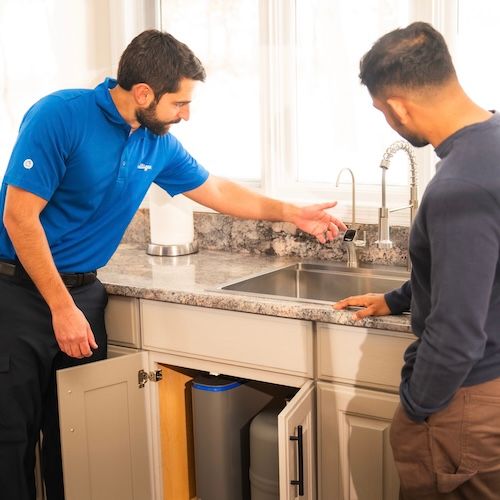
Get a free in-home test. A Culligan of Apalachicola technician measures hardness, chlorine, total dissolved solids, pH and iron at your sink in about 20 minutes and explains what the numbers mean for your home. If you want lab confirmation of anything else, we can send a sample to a certified laboratory. See our water testing services for details.
FAQs about Apalachicola water hardness
Does Apalachicola publish a water hardness number?
Not in its annual report. The 2023, 2024 and 2025 reports cover the city’s three Floridan Aquifer wells, chlorine levels, disinfection byproducts and several minerals, but not hardness. A home test is the quickest way to get a figure.
Is Port St. Joe water different from Apalachicola water?
Yes. Port St. Joe treats surface water from the Chipola River Canal through membrane microfiltration, while Apalachicola, Eastpoint and Carrabelle pump groundwater from the Floridan Aquifer. Different sources mean different mineral content, so test results can vary noticeably between the two towns.
Will a softener fix the orange stains in my sink?
Not by itself in most cases. Orange stains come from iron rather than hardness. A standard softener can handle small amounts of iron, but higher levels need Softener-Cleer or an Iron-Cleer filter. Testing tells us which one fits.
Can I rent a water softener in Apalachicola?
Yes. Rentals include installation and service, and salt delivery can be added or included. Purchase is also available. Your free test comes with a written quote showing both options.
Start with a free water test from Culligan of Apalachicola
Culligan of Apalachicola has served the Forgotten Coast for decades, working on city water from Floridan Aquifer wells, Port St. Joe’s river water and private wells from Bristol to Sopchoppy. When you schedule a free in-home water test, a local technician tests at your tap, explains the results in plain language and, if a softener makes sense, shows you rental and purchase options with a written quote.
Ready for better water? Schedule your free in-home water test and consultation with Culligan of Apalachicola today.