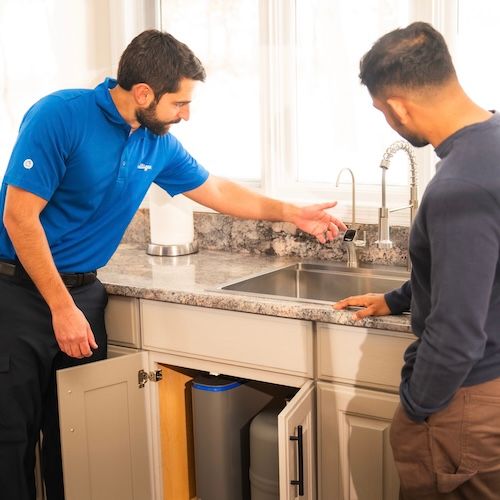
Quick answer: Well water around Apalachicola can be safe, but only testing shows whether yours is. Private wells are not regulated like public systems, so the homeowner carries the responsibility for checking quality. In this part of Florida, the most common problems are hydrogen sulfide odor, iron and manganese staining, low pH, hardness, bacteria after storms and, near the coast, salt. The Florida Department of Health recommends testing for bacteria and nitrate at least once a year. Culligan of Apalachicola offers free in-home well testing and arranges certified lab analysis when you need it.
Within Apalachicola, Eastpoint, Carrabelle and Port St. Joe, most homes are on public water. Drive inland, toward Bristol, Hosford, Wewahitchka, Sopchoppy and Panacea, and private wells become the norm. This guide covers what makes local well water different, the problems we see most often, how to test and how to treat what you find.
Municipal water vs. private well water: what’s the difference?
Public systems such as the City of Apalachicola must test on a federal schedule, publish an annual report and notify customers of violations. A private well has no such oversight. Nobody samples it unless you do, and problems can develop without any visible warning. The Florida Department of Health private well guidance puts it plainly: about 88 percent of Floridians are on public systems, and the rest are responsible for their own testing.
How common are wells here? The USGS county water-use report reports that about 7.5 percent of Franklin County residents, roughly 900 people, and about 8 percent of Gulf County residents supplied their own water. In Liberty County the share was about 60 percent, and in Wakulla County it was more than half, about 18,000 people. If you live outside town water lines, odds are good you are on a well.
Local wells generally draw from the same Floridan Aquifer that supplies the municipal systems. Apalachicola, Eastpoint and Carrabelle all pump from it, and the city’s own engineering data gives a useful preview of what aquifer water carries before treatment. Two wells a mile apart can still test very differently, because depth, casing condition, nearby septic systems and distance from salt water all play a part. That is why a neighbor’s results are a hint, not an answer, and why we test each well on its own.
Common well water problems in the Apalachicola area
1. Hydrogen sulfide (rotten-egg odor)
Sulfur odor is the complaint we hear most. Hydrogen sulfide occurs naturally in Floridan Aquifer groundwater here; a January 2025 study for the City of Apalachicola measured 3.9 to 5.7 mg/L of sulfide in the raw water from its wells, and one city well was rehabilitated because of sulfur-reducing bacteria. The city runs aerators specifically to remove the gas. A private well usually has nothing comparable, so the full odor reaches the tap.
A simple check helps narrow it down. If only the hot water smells, sulfur-reducing bacteria in the water heater are the likely cause, and changing the anode or disinfecting the tank may solve it. If hot and cold both smell, the source is the well. Sulfur-Cleer and Sulfur-OX3 systems remove hydrogen sulfide before it enters the house.
2. Iron and manganese
Iron leaves orange and brown stains on sinks, toilets and laundry; manganese leaves gray or black marks. Both can give water a metallic taste and clog fixtures. The UF/IFAS household water testing guide advises testing for iron, manganese and copper whenever water stains fixtures or laundry. For a local point of reference, Florida Department of Health testing of Apalachicola city water on June 12, 2025, during a period without aeration, found iron at about 0.5 mg/L and manganese at about 0.23 mg/L. Private wells vary widely. Iron-Cleer and Iron-OX5 systems remove both metals, and Softener-Cleer handles iron and hardness together.
3. Low pH and corrosive water
Water with low pH can slowly dissolve copper pipes and brass fittings, producing blue-green stains, pinhole leaks and, in some homes, lead or copper in the water. UF/IFAS recommends testing for corrosivity, pH and lead whenever plumbing shows signs of corrosion. A neutralizing filter raises pH and protects plumbing, and our in-home test measures pH on the spot.
4. Hardness
Water moving through limestone picks up calcium and magnesium, and well water hardness depends on the well’s depth and the formation it reaches. It varies from one property to the next, so we do not assume a number; we measure it. Where hardness is present, it leaves scale in water heaters and on fixtures and makes soap harder to rinse. A softener, or Softener-Cleer where iron is present, solves both problems.
5. Bacteria after storms and flooding
Coliform bacteria can enter a well through a damaged casing, a loose cap or floodwater around the wellhead. Total coliform was even detected in Apalachicola’s city system during June 2025, which shows how easily bacteria can appear in this climate. The Florida Department of Health recommends annual bacteria testing, and UF/IFAS advises testing a flooded well immediately. After a hurricane or heavy flooding, use bottled water until a lab confirms the well is clear, then disinfect the well if needed. UV disinfection provides continuous protection for wells that keep testing positive.
6. Salt near the coast, and nitrate inland
Wells close to Apalachicola Bay, St. George Sound or the Gulf can pick up chloride and sodium, giving water a salty taste and speeding corrosion. UF/IFAS recommends testing for chloride, total dissolved solids and sodium if your well is near seawater. Inland, nitrate is the concern, particularly near septic systems and farmland. Nitrate has no taste or smell and requires a lab test; UF/IFAS advises testing during pregnancy and the first six months of a baby’s life. A Nitrate Reduction Conditioner or reverse osmosis addresses it.
7. PFAS: the lab-only question
PFAS cannot be detected by taste, smell or an in-home test. None of the local utility reports we reviewed include PFAS results yet, and private wells are not monitored at all. If you want to know, a certified lab test is the only way. The Whole Home PFAS Water Filter reduces PFAS by more than 99 percent, and reverse osmosis with Total Defense reduces total PFAS by more than 99.99 percent.
How we put a well treatment system together
Well water rarely has just one issue. A typical inland well near Hosford or Sopchoppy might show sulfur odor, a little iron and some hardness at the same time, and each one affects how the others are treated. Order matters. Oxidizing filters such as Sulfur-OX3 or Iron-OX5 usually go first, because they convert dissolved sulfur and iron into particles the filter bed can trap. A softener or Softener-Cleer follows to handle hardness and any remaining iron. If bacteria have shown up in testing, UV disinfection sits last in line, after the water is clear enough for the light to work. For drinking and cooking, an under-sink reverse osmosis system can add another layer of reduction for nitrate, lead and PFAS.
We size each stage to your household’s water use and your test results, not to a standard package. A two-person weekend cottage near Carrabelle needs a different setup than a family of five on a well in Bristol. We also check the condition of your pressure tank and the plumbing near the wellhead, since a clogged sediment screen or a failing check valve can look like a water quality problem when it is really a mechanical one.
Maintenance is part of the plan. Oxidizing filters backwash on their own, softeners need salt, UV lamps need annual replacement, and RO cartridges have scheduled change intervals. With a rental plan we handle all of that, and with a purchase we can set you up on a service schedule.
How to check your well water quality
Follow the state schedule. The Florida Department of Health private well guidance recommends testing for bacteria and nitrate at least once a year and lead every three years. Test right away after flooding or any change in taste, odor or color.
Start with a free in-home test. We measure hardness, iron, pH, chlorine and total dissolved solids at your sink in about 20 minutes and explain what each result means.
Add a certified lab test. For bacteria, nitrate, lead, arsenic and PFAS, we collect samples and send them to a certified laboratory. Results tell us exactly which treatment, if any, your well needs. Learn more about our water testing services.
Get local well water expertise from Culligan of Apalachicola
For decades, Culligan of Apalachicola has tested and treated wells across Franklin, Gulf, Liberty and Wakulla counties. Our technicians know the sulfur and iron patterns of Floridan Aquifer water and the difference between a coastal well near Eastpoint and an inland well near Hosford. We design systems around your results, often combining stages such as Sulfur-Cleer, Iron-Cleer, a softener and UV disinfection. See our well water solutions, our water filtration systems and our water softeners. Rental and purchase are both available.
Frequently asked questions about private wells around Apalachicola
Who is responsible for testing my well near Apalachicola?
You are. Private wells are not regulated like public systems, so the owner decides when to test. The Florida Department of Health recommends bacteria and nitrate testing every year and lead every three years.
Why does my well water smell like rotten eggs?
Hydrogen sulfide, which is common in Floridan Aquifer groundwater here. If only hot water smells, check the water heater. If both hot and cold smell, a Sulfur-Cleer or Sulfur-OX3 system treats it at the source.
What causes orange stains from my well water?
Iron. Black or gray stains usually mean manganese. Both can be removed with an Iron-Cleer or Iron-OX5 system, and Softener-Cleer handles iron along with hardness.
Should I test my well after a hurricane?
Yes, especially if floodwater reached the wellhead. Use bottled water until certified lab results confirm the well is free of bacteria, and disinfect it if needed.
Is my well at risk from salt water?
Wells near Apalachicola Bay, St. George Sound or the Gulf can pick up chloride and sodium. A test for chloride, total dissolved solids and sodium shows whether salt is a concern.
Ready for better water? Schedule your free in-home water test and consultation with Culligan of Apalachicola today.