Quick answer: Yes, Apalachicola’s tap water meets federal health-based standards, but it comes with issues worth understanding. The city’s 2025 annual report shows lead well under the action level and no health-based violations, yet total trihalomethanes, a family of disinfection byproducts, averaged 77.25 ppb against an 80 ppb limit, and naturally occurring hydrogen sulfide has caused odor complaints and a secondary-standard violation. In June 2025 the city also issued a precautionary boil water notice. Many households add filtration for taste, odor and peace of mind, and a free test from Culligan of Apalachicola shows what is reaching your own faucet.
The City of Apalachicola serves about 5,233 people from three Floridan Aquifer wells. Its neighbors draw from their own sources: Eastpoint and Carrabelle from separate Floridan wells, and Port St. Joe from the Chipola River Canal. This guide walks through what the reports show, where the real concerns are and how to check your own water.
What a utility report can and cannot tell you
Every public water system publishes an annual report, also called a Consumer Confidence Report, listing the regulated contaminants it detected and whether any results broke federal limits. You can find Apalachicola’s reports, along with weekly water updates the city has posted since mid-2025, on the City of Apalachicola Water & Sewer page. These reports are the best starting point, and we encourage everyone to read them.
They do have limits. Results are system averages taken at specific sampling points, such as the Roberts Fish Dock and Bay City Lodge sites the city uses for disinfection byproducts, so they do not show what happens inside your building’s plumbing. Some figures are years old; Apalachicola’s latest lead results come from 2023 sampling. And unregulated characteristics, including hardness, are often left out entirely. A home test fills in those gaps.
City water vs. private wells around Apalachicola
Most homes in Apalachicola, Eastpoint, Carrabelle and Port St. Joe are on public water. Inland, the picture changes. The USGS county water-use report counts about 7.5 percent of Franklin County and about 8 percent of Gulf County residents on private wells, but about 60 percent in Liberty County and more than half in Wakulla County. Statewide, the Florida Department of Health private well guidance notes that about 88 percent of residents are on public systems. Well water is the owner’s responsibility to test and treat, which we cover in our well water solutions and in our separate well water guide.
Where Apalachicola’s water comes from
Apalachicola’s wells pull groundwater from the Floridan Aquifer. A January 2025 engineering memorandum by Dewberry for the city describes the process: water from wells 5, 6 and 7 flows through a packed-tower forced-draft aerator atop a ground storage tank, picks up sodium hypochlorite for disinfection, and is pumped into the distribution system. The plant can produce up to 1.66 million gallons per day, and average demand in 2023 was about 0.62 million gallons per day. The same memo measured 3.9 to 5.7 mg/L of sulfide and 3.0 to 4.1 mg/L of total organic carbon in the raw well water. Those two numbers explain most of what follows.
Nearby, Eastpoint’s two Floridan wells were rated low susceptibility to contamination in the state’s 2024 source water assessment. Carrabelle’s two wells use ion exchange and chlorine, and its 2024 report showed trihalomethanes at 42.12 ppb and a lead 90th-percentile of 2.4 ppb. Port St. Joe’s Chipola River Canal water goes through lime treatment, coagulation, clarification and membrane microfiltration, and its 2025 water quality report reported no MCL violations, with trihalomethanes averaging 63.10 ppb.
Common tap water concerns in Apalachicola
1. Disinfection byproducts (TTHMs and HAA5)
When chlorine reacts with natural organic matter in water, it forms trihalomethanes (TTHMs) and haloacetic acids (HAA5). Apalachicola’s 2025 report lists TTHMs at a 77.25 ppb average, ranging from 27.93 to 126.54 ppb, and notes that ten individual samples taken from June through October 2025, five at each sampling site, came in above the 80 ppb limit. Because compliance is based on a running annual average, those samples did not count as a violation. The 2024 report showed a 66.4 ppb average with four samples above 80, and 2023 showed 60.36 ppb with three. The city’s April 2026 update reported that one site’s running average for January through March 2026, 80.3 ppb at Roberts Fish Dock, had slightly exceeded the limit, while Bay City Lodge stood at 75.5 ppb. HAA5 has stayed well under its 60 ppb limit, at 24.72 ppb in 2025.
The report notes that people who drink water above the TTHM limit for many years may experience liver, kidney or nervous system problems and an increased cancer risk. The city has responded by sampling monthly rather than quarterly, and its engineers have recommended sulfide removal and carbon or ion exchange treatment for organic carbon before chlorine is added. At home, an under-sink reverse osmosis system with carbon stages, or a whole-home activated carbon filter, reduces TTHMs at the tap.
2. Sulfur odor and the aerators
Hydrogen sulfide is a colorless gas with a rotten-egg smell, and the Florida Department of Health notes that people can detect it at very low concentrations. The city’s aerators are there to remove it. According to the city’s water FAQ, odor and discoloration in 2025 were “primarily due to the City’s aeration treatment systems being offline” since October 2024, following a structural failure; the Dewberry memo notes the aerator structure was damaged by Hurricane Helene. The city increased flushing, raised chlorine dosing, brought Well 7 back online and ordered replacement aeration equipment. Separately, its annual reports list a secondary-standard odor violation from a December 2023 sample, with a threshold odor number of 8 against a limit of 3.
Hydrogen sulfide also consumes chlorine, and the Dewberry memo notes that feeding chlorine ahead of the aerator increased chlorine demand. The city’s residual averaged 1.26 ppm in 2025 and ranged from 0.97 to 2.74 ppm at the plant between September 19 and October 23, 2026. A whole-home carbon filter or a Sulfur-Cleer system removes sulfur and chlorine taste before water reaches any faucet.
3. Discoloration, the 2025 boil water notice and storm resilience
During the June 2025 problems, the city issued a precautionary boil water notice and rescinded it on June 28, 2025, after flushing the distribution system, stabilizing chlorine and receiving acceptable bacteria results. A Florida Department of Health letter dated the same day reviewed samples collected June 12: iron at about 0.5 mg/L, manganese at about 0.23 mg/L, chloride at about 67 mg/L and sulfate at 125 mg/L, all below health-based guidelines, with total coliform detected and E. coli not detected. Iron and manganese at those levels can tint water and leave stains even when they pose no health concern.
More recent updates are encouraging. By October 2026 the city reported all three wells operational and no total coliform or E. coli in samples from the wells and six community locations. Still, storms are a fact of life on this coast, and the city has said it is pursuing funding for a plant upgrade, a new well-treatment system and an emergency backup well. Keeping a supply of bottled water on hand during hurricane season is sensible, and we deliver it.
4. PFAS (forever chemicals)
PFAS results do not appear in Apalachicola’s 2025 report, Carrabelle’s 2024 report or Port St. Joe’s 2025 report. According to the Florida Department of Environmental Protection, public systems must complete initial PFAS monitoring by April 26, 2027, and meet 4.0 ppt limits for PFOA and PFOS by April 26, 2029; EPA has proposed extending that date to 2031. Until results are published, a certified lab test is the only way to know. The Aquasential Smart Reverse Osmosis system with Total Defense reduces total PFAS by more than 99.99 percent, and the Whole Home PFAS Water Filter reduces PFAS by more than 99 percent.
5. Lead and copper from household plumbing
Apalachicola’s lead 90th-percentile was 3 ppb, with none of 20 sampled homes above the 15 ppb action level, and copper was 0.12 ppm with no sites over its limit. Port St. Joe reported lead at 1.8 ppb with none of 33 sites over. Those are good results, but lead usually comes from older fixtures, solder and service lines inside individual properties, and historic homes are the ones to check. The Aquasential Smart Reverse Osmosis system reduces lead by 99.7 percent.
How to check your home’s water quality in Apalachicola
Read the reports. Start with the city’s annual report and recent weekly updates. In Port St. Joe, Carrabelle or Eastpoint, look for your own system’s report.
Notice the signs. A rotten-egg smell, a strong chlorine taste, discolored water after flushing or stains in the sink all point to specific causes we can test for.
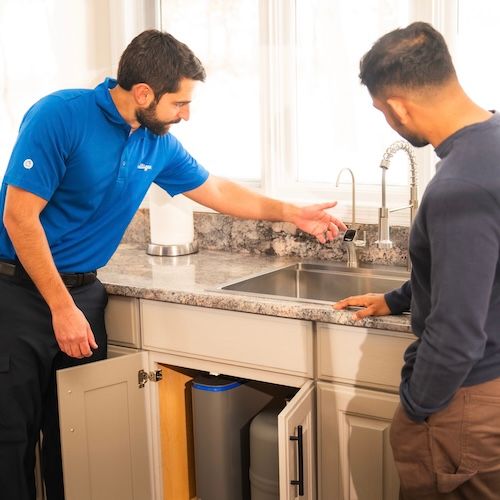
Get a free in-home test. We measure hardness, chlorine, total dissolved solids, pH and iron on the spot in about 20 minutes, and arrange certified lab testing for bacteria, nitrate, lead, arsenic and PFAS. Then we match any filtration to what the results show. Learn more about our water testing and water filtration options.
Frequently asked questions about Apalachicola tap water
Can I drink Apalachicola tap water?
The city’s water meets federal health-based standards, and lead results are low. Disinfection byproducts run close to the limit, and sulfur odor can be noticeable. Many households drink filtered water from a reverse osmosis system for taste and added reduction.
Does Apalachicola use chlorine or chloramine?
Chlorine, added as sodium hypochlorite. The 2025 average residual was 1.26 ppm. Because chloramine is not used, standard activated carbon removes the taste and smell.
Why does my water smell like rotten eggs?
Hydrogen sulfide occurs naturally in the city’s Floridan Aquifer wells, and odor has been more noticeable when the aerators were not operating fully. If only your hot water smells, your water heater may be the source.
Is Apalachicola still under a boil water notice?
The June 2025 precautionary notice was rescinded June 28, 2025. Check the city’s Water & Sewer page for current notices and weekly updates.
Does Culligan deliver bottled water in Apalachicola?
Yes. We deliver bottled water and install coolers and dispensers for homes and businesses across our service area, which is useful during storms or any time you want a backup supply.
Schedule your free water test with Culligan of Apalachicola
For decades, Culligan of Apalachicola has helped homes and businesses from Apalachicola and Eastpoint to Carrabelle, Port St. Joe and Wewahitchka get water they trust. Our technicians know these systems and can tell you which filtration option, if any, makes sense for your home. Rentals and purchases are both available, and every recommendation comes with a written quote.
Ready for better water? Schedule your free in-home water test and consultation with Culligan of Apalachicola today.