Quick answer: Private well water in Pinellas County can be safe to drink, but no utility tests it for you. Only about 4,569 of the county’s 944,971 residents, roughly 1 in 200, were on their own wells in the USGS 2015 Florida water-use survey. The wells that remain draw from limestone aquifers that are hard, often carry hydrogen sulfide, and in a coastal county face saltwater. The Florida Department of Health recommends testing for bacteria and nitrate every year and lead every three years.
Pinellas County is almost entirely on public water, so private wells here are the exception: typically older properties, often in north county around Tarpon Springs and Palm Harbor, that were never connected to a water main. If you own one of them, or are buying one, you are the water utility. That means you decide when to test, what to test for and how to treat what you find.
This guide covers how well water differs from city water here, the problems that show up most often in Pinellas County wells, how to test, and what treatment works.
Municipal water vs. private well water: what’s the difference?
Public systems such as Pinellas County Utilities, St. Petersburg and Clearwater are regulated under the Safe Drinking Water Act. They treat, disinfect and test continuously, the county alone collecting at least 210 bacteria samples a month, and they publish annual reports. If a result exceeds a limit, they must fix it and notify customers.
A private well has none of that. No one tests it unless you do, and no one notices a change unless you do. Groundwater quality can shift over time, especially in a coastal area where heavy pumping, drought and storm surge all affect the aquifer. A well that tested fine when the house was bought may not test the same ten years later.
Where does Pinellas County’s well water come from?
Deeper wells in the county tap the Upper Floridan Aquifer, the limestone formation that underlies all of west-central Florida. Its fresh water is a calcium-bicarbonate type, which is why it is hard, and it becomes more mineralized with depth and near the coast as it mixes with deeper and saline water. Some shallow wells draw from the surficial sands above the limestone; those are more exposed to surface contamination.
The freshwater layer here is thin and sits on salt water. In a USGS study of the Dunedin area of northern Pinellas County, water quality changed rapidly below about 400 feet, and chloride in production wells showed a consistently increasing pattern. Another USGS study of the Eldridge-Wilde well field found chloride rising over time in wells within and near the field, with the greatest increases closest to the saltwater interface.
Common well water problems in Pinellas County
1. Saltwater intrusion (chloride and sodium)
This is the defining issue for wells on a peninsula. When pumping lowers the freshwater level, salt water from below or from the Gulf moves in. Signs include a salty or brackish taste, corrosion on fixtures and pipes, and white crust that does not respond like ordinary hardness. UF/IFAS recommends testing for chloride, total dissolved solids and sodium if your well is near seawater and the water tastes salty or the plumbing is corroding. Reverse osmosis at the kitchen sink is the practical fix for drinking water; whole-house desalination is rarely worth it for a small well.
2. Hydrogen sulfide (rotten-egg odor)
Floridan groundwater in this region often contains hydrogen sulfide, a naturally occurring gas. Pinellas County Utilities removes it during treatment at its Eldridge-Wilde Wellfield, which tells you how common it is in local groundwater. In a private well, the smell is often worse in hot water and can tarnish silver and fixtures. Low levels can be handled with carbon; higher levels call for an oxidizing system such as Sulfur-Cleer® or Sulfur-OX3.
3. Hard water
Because the aquifer is limestone, well water here is typically hard. For context, the county’s public water, much of which also starts as Floridan groundwater, averaged 217 mg/L of total hardness in 2025, about 12.7 grains per gallon. A private well’s number can be higher or lower, and you will only know by testing. A softener solves it, provided iron is addressed first.
4. Iron and manganese
Iron shows up as orange or brown stains on fixtures, laundry and the pool deck, and sometimes as a metallic taste. Manganese leaves darker stains. UF/IFAS recommends testing for both before buying a softener, because they reduce how well ion-exchange softeners work. Iron-Cleer® and Iron-OX5 oxidize and filter iron before the water reaches the softener.
5. Bacteria (total coliform and E. coli)
Bacteria can reach a well through a cracked casing, a loose cap, flooding or a nearby septic system, and shallow wells are the most exposed. You cannot taste or smell them. The Florida Department of Health recommends testing for bacteria at least once a year. If a test is positive, the well needs to be disinfected and retested, and UV disinfection provides continuous protection afterward.
6. Nitrate
Nitrate comes from fertilizer, septic systems and animal waste, and it matters most for infants. It is part of the annual test the Department of Health recommends. Where nitrate is elevated, reverse osmosis or a Nitrate Reduction Conditioner can reduce it.
7. Arsenic and naturally occurring radioactivity
Limestone aquifers can carry small amounts of arsenic and radium. The public systems give a sense of local levels: Clearwater’s 2025 report, which tests water from its own Floridan wells, shows arsenic up to 3.5 ppb against a 10 ppb limit, and radium 226 and 228 at up to 1.15 pCi/L. Tampa Bay Water’s results show radium up to 2.1 pCi/L against a limit of 5. Those are treated-water numbers from utilities, not private wells, and an untreated well can differ. Arsenic has no taste or smell, so it takes a lab test to know; reverse osmosis reduces it at the kitchen sink.
How to check your well water quality
Test every year. The baseline is bacteria and nitrate annually and lead every three years, per the Florida Department of Health. UF/IFAS adds pH to the annual list and recommends iron and manganese before installing a softener, hydrogen sulfide if the water smells, and chloride, TDS and sodium near the coast.
Test after anything changes. That includes flooding, storm surge, well repairs, a new pump, a change in taste or odor, or a home that has sat empty.
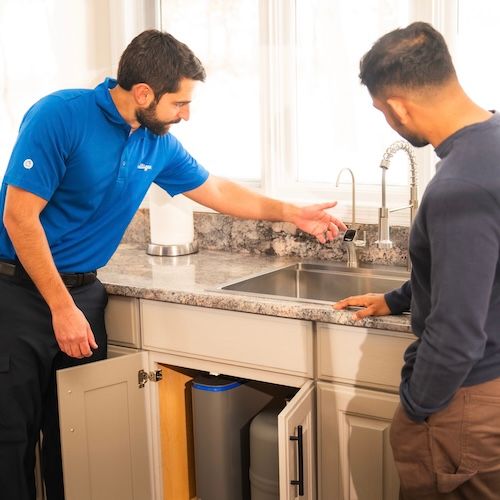
Start with a free in-home test. We measure hardness, iron, pH, total dissolved solids and chlorine at your tap in about 20 minutes, then arrange certified lab testing for bacteria, nitrate, lead, arsenic and PFAS as needed. Visit our water testing page or our well water solutions to learn more.
Putting a well treatment system together
Most Pinellas County wells need more than one piece of equipment, and the order matters. Water usually passes first through any sediment filter, then an iron or sulfur system, then the softener, with UV disinfection near the point of entry if bacteria are a concern and reverse osmosis at the kitchen sink for drinking water. Putting the softener ahead of the iron filter, for example, fouls the resin and shortens its life.
Sizing depends on your well’s flow rate and your household’s water use as much as on the test results. A pump that delivers a few gallons a minute calls for different equipment than one serving a large home with an irrigation system. We check both before recommending anything, and we explain what each component does so you can decide what is worth adding now and what can wait.
Well water after hurricanes and flooding
Pinellas County’s low elevation means storm surge and heavy rain reach places wells do not normally see water. If floodwater surrounded or covered your wellhead, UF/IFAS advises testing right away. Until results come back clean, use bottled water or boil water for drinking and cooking. The Florida Department of Health and your county health department publish guidance on disinfecting a flooded well. After a surge event, also test for chloride and sodium; salt water can linger in a coastal well after the flood recedes.
Frequently asked questions about private wells in Pinellas County
How many people in Pinellas County use private wells?
Very few. The USGS counted about 4,569 residents on domestic self-supplied water in 2015, out of 944,971 people, roughly 1 in 200. Neighboring Pasco County had nearly 70,000 that year.
Is my Tarpon Springs well at risk from saltwater?
Coastal wells in north Pinellas can be. USGS studies near Dunedin and the Eldridge-Wilde well field documented rising chloride in the Upper Floridan Aquifer. A test for chloride, TDS and sodium tells you whether your well is affected.
Why does my Palm Harbor well water stain the tub orange?
That is iron. It is common in Florida groundwater and shows up as orange or brown staining on fixtures, laundry and pavers. An iron filter such as Iron-Cleer or Iron-OX5 removes it, ideally before the water reaches a softener.
Should I switch my well to county water?
If county water is available on your street, it is an option worth comparing. Public water is tested continuously, but in Pinellas County it is also very hard and carries chloramine, so many homes still treat it. We can test your well and give you an honest comparison.
How often should I test my well in Pinellas County?
At least once a year for bacteria and nitrate, and every three years for lead, per the Florida Department of Health. Test again after flooding, storm surge, well repairs or any change in taste, smell or color.
Get local well water expertise from Culligan of Largo
Culligan of Largo has worked on wells and water treatment across Pinellas County for decades, from Tarpon Springs and Palm Harbor through Dunedin, Clearwater, Largo and Seminole. We test first, explain what your well actually needs and size iron, sulfur, softening, UV and reverse osmosis equipment to your water and your well’s output. We offer rental and purchase options and deliver softener salt and bottled water throughout the county.
Ready for better water? Schedule your free in-home water test and consultation with Culligan of Largo today.