Quick answer: Yes. Most of Pinellas County gets hard to very hard water. Pinellas County Utilities reported total hardness averaging 217 mg/L in 2025, a range of 189 to 244 mg/L, which the utility translates into a softener setting of 11.1 to 14.3 grains per gallon. St. Petersburg reported an average of 158 mg/L, about 9.2 gpg. Clearwater does not publish a hardness figure. By the USGS classification, county water lands in the very hard range and St. Petersburg’s in the hard range.
Most people in Largo or Seminole do not need a lab report to suspect it. The glass shower door clouds over a few days after it is cleaned. A chalky ring forms around the base of the kitchen faucet. The dishwasher leaves a haze on every glass, and a newer tankless water heater starts throwing scale error codes. Those are all signs of calcium and magnesium carried in from the source and left behind wherever water dries or gets heated.
Below we cover where Pinellas County’s hardness comes from, how it differs from one utility to the next, what it does to a house, and how to find out the exact number at your own tap.
Where Pinellas County’s hard water comes from
Pinellas is a peninsula with little fresh water of its own, so most of the county drinks water that starts somewhere else. Tampa Bay Water, the regional wholesale supplier, blends groundwater pumped from Floridan Aquifer wellfields with treated water from the Alafia River, the Hillsborough River, the C. W. Bill Young Regional Reservoir and the Tampa Bypass Canal, along with desalinated seawater from Hillsborough Bay. Pinellas County Utilities and St. Petersburg both buy from Tampa Bay Water, and the county also draws on its own Eldridge-Wilde Wellfield.
The Floridan Aquifer is limestone. Rainwater soaking through it dissolves calcium carbonate, and that is the main source of the hardness in the region’s groundwater. The county’s 2025 report makes the point in its mineral table: calcium averaged 75 ppm and magnesium only 5.6 ppm. In other words, nearly all of Pinellas County’s hardness is calcium, which is the mineral responsible for most visible scale.
St. Petersburg’s Cosme Water Treatment Plant uses lime softening as part of its process, which helps explain why the city’s average is lower than the county’s. Lime softening at a treatment plant is meant to protect pipes and meters across a large system. It is not the same as a household softener, and the city’s water still arrives with 158 mg/L of hardness on average.
Is municipal or well water harder in Pinellas County?
Almost everyone here is on public water. The USGS counted 940,402 of the county’s 944,971 residents on public supply in 2015, leaving about 4,569 people on private wells. So the more useful comparison is between utilities:
Pinellas County Utilities serves Largo, Seminole, Palm Harbor and the unincorporated county, and the county notes its water also reaches Clearwater, Pinellas Park, Safety Harbor and Tarpon Springs. Its 2025 average was 217 mg/L, about 12.7 gpg, with readings as high as 244 mg/L.
St. Petersburg reported 158 mg/L for 2025 and 165 mg/L for 2024, roughly 9 to 10 gpg.
Clearwater gets about 60 percent of its water from its own Floridan wells, treated at two reverse osmosis plants and a third plant that blends well water with county water, and buys the rest from Pinellas County Utilities. The city does not publish a finished-water hardness figure. Because the mix changes with demand and with which plant serves your neighborhood, hardness varies from home to home; the city’s annual report and the utility itself are the place to ask about system data, and a free in-home test gives your home’s number.
Private wells in north Pinellas draw from the same limestone aquifer and are typically hard as well, often with sulfur odor or salt in the mix. We cover those in our well water guide.
Hard water problems Pinellas County homes deal with
1. Scale in water heaters, tankless units and appliances
Heat drives calcium out of solution, so the worst buildup happens wherever water gets hot. A tank water heater collects a layer of sediment on the bottom that insulates the burner or element and makes the unit work harder; the popping or rumbling sound many owners hear is water boiling under that layer. Tankless heaters have narrow heat exchangers that scale up quickly at 12 or more grains per gallon and often need regular descaling. Dishwashers, coffee makers, ice makers and washing machine valves suffer the same way.
2. Spots, film and crust on fixtures and glass
When hard water evaporates it leaves calcium carbonate behind. That is the white crust on faucet aerators and shower heads, the cloudy film on shower glass and the spots on a car washed in the driveway. Pool screens and lanai glass show it too. Vinegar and descaling cleaners remove what you can see, but the film comes back with the next shower.
3. Soap, laundry and skin
Calcium reacts with soap to form a sticky curd instead of lather. You use more detergent, towels come out stiff, whites go gray, and a residue stays on skin and hair after rinsing. People who move to St. Petersburg or Seminole from softer-water areas often notice it first as dry, itchy skin or hair that will not rinse clean.
How to check your home’s water hardness in Pinellas County
Read your utility’s annual report. Pinellas County Utilities lists total hardness in its 2025 Consumer Confidence Report, including the softener setting in grains per gallon. St. Petersburg lists a monthly average in its 2025 Water Quality Report. Clearwater’s 2025 annual report does not include hardness, so call the city’s utility department if you want system data. Remember that these are system averages, not your tap.
Do the math if you see mg/L. Divide mg/L by 17.1 to get grains per gallon. The county’s 217 mg/L average works out to about 12.7 gpg, and St. Petersburg’s 158 mg/L to about 9.2 gpg.
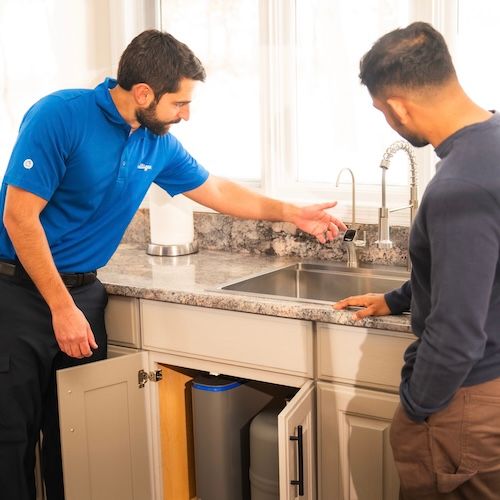
Get a free in-home test. Our technicians measure hardness, chlorine, total dissolved solids, pH and iron at your tap in about 20 minutes. That number is what we use to size a softener, so you are not paying for capacity you do not need. Visit our water softener page to see the systems we install, or browse water filtration and water testing options.
What a water softener does with Pinellas County water
A softener uses ion exchange: resin beads trade sodium or potassium for the calcium and magnesium in your water as it enters the house. The result is water that no longer scales up heaters, spots glass or fights with soap. When the resin fills with hardness minerals, the softener rinses it with a brine solution and starts again.
For most homes on county water we recommend the Aquasential® Smart High Efficiency Water Softener, which tracks your household’s actual water use and regenerates only when it needs to, so it uses less salt and water than a timer-based unit. Larger homes or households with higher demand may be a better fit for the Aquasential® Select Series Water Softeners. Because every utility in the county disinfects with chlorine or chloramine, many customers pair the softener with a carbon filter to improve taste and odor at the same time.
We offer both rental and purchase, and we deliver softener salt throughout Pinellas County so nobody has to haul bags from the store.
FAQs about Pinellas County water hardness
Is Largo water hard?
Yes. Largo is served by Pinellas County Utilities, which reported total hardness averaging 217 mg/L in 2025, or about 12.7 grains per gallon. That is above the 180 mg/L line the USGS uses for very hard water.
Why is St. Petersburg’s water less hard than the county’s?
St. Petersburg’s Cosme Water Treatment Plant includes lime softening, and the city reported an average of 158 mg/L in 2025, about 9.2 gpg. That is still hard by the USGS scale, so scale and spotting remain common.
Does Clearwater have hard water?
Clearwater does not publish a hardness figure. Its water is a mix of city well water treated by reverse osmosis and other processes plus water bought from Pinellas County Utilities, so the level varies by neighborhood and by day. A free test at your tap gives your home’s number.
Will a refrigerator filter fix hard water in Seminole?
No. Refrigerator and pitcher filters are made for taste and some drinking-water contaminants. They do not remove calcium, and they never touch the water going to your heater, laundry or shower. Reducing hardness throughout the house takes a softener where the water line enters.
Start with a free hard water test from Culligan of Largo
Culligan of Largo has been treating water for homes and businesses across Pinellas County for decades, from Tarpon Springs and Palm Harbor through Dunedin, Clearwater, Largo and Seminole down to Pinellas Park and St. Petersburg. Our technicians work on county and city water every day, so we know how hardness differs between systems and what size equipment a household needs.
When you schedule a free in-home water test, a local specialist measures your water, explains the results in plain language and, if a softener makes sense, walks you through rental and purchase options with a written quote.
Ready for better water? Schedule your free in-home water test and consultation with Culligan of Largo today.