Quick answer: Pinellas County’s public water meets federal and state drinking water standards according to the 2025 reports from Pinellas County Utilities, St. Petersburg and Clearwater. Lead, nitrate and disinfection byproducts all tested below their limits. The water is also very hard, carries a strong chloramine disinfectant, and in Clearwater shows low levels of PFAS. Whether you want treatment depends on what reaches your own tap, which a free test can show.
Pinellas County has an unusual water story. The county is a peninsula, surrounded on three sides by salt water, and its utilities draw no surface water within its borders. That means most of the water coming out of faucets in Largo, Seminole and St. Petersburg is piped in from wellfields, rivers and a desalination plant across the bay. It also means the water at your tap reflects a blend, a long trip through pipes, and the plumbing in your own house.
What your utility’s testing does, and doesn’t, tell you
Every public water system in Florida publishes an annual Consumer Confidence Report. In Pinellas County that means three main reports. Pinellas County Utilities covers Largo, Seminole, Palm Harbor and the unincorporated county, and the county notes its water also reaches Clearwater, Pinellas Park, Safety Harbor and Tarpon Springs. St. Petersburg and Clearwater each publish their own.
Those reports are a useful starting point. They show the utility’s water is tested often (the county collects at least 210 bacteria samples a month), and they list what was found against federal and state limits. What they cannot show is your house. A report averages results across the whole system, and lead in particular is a plumbing problem that starts after the water leaves the main. The reports also leave out things many residents care about, like taste, odor and, in Clearwater’s case, hardness.
Where does Pinellas County’s drinking water come from?
Tampa Bay Water is the regional wholesaler. It blends groundwater from Floridan Aquifer wellfields with treated surface water from the Alafia River, the Hillsborough River, the C. W. Bill Young Regional Reservoir and the Tampa Bypass Canal, plus desalinated seawater from Hillsborough Bay. St. Petersburg gets all of its water from Tampa Bay Water, treated at the Cosme Water Treatment Plant with aeration, lime softening, chloramine disinfection and filtration.
Pinellas County Utilities buys from Tampa Bay Water and also draws on its county-owned Eldridge-Wilde Wellfield, where hydrogen sulfide is removed during treatment.
Clearwater uses about 11 million gallons a day. Roughly 60 percent comes from city-owned Floridan Aquifer wells treated at RO Plant No. 1, RO Plant No. 2 (which treats brackish water from deeper in the aquifer) and Water Plant No. 3, which blends well water with county water. The rest is bought from Pinellas County Utilities.
What Pinellas County residents ask about most
1. Hard water
The county’s 2025 report shows total hardness averaging 217 mg/L, ranging from 189 to 244 mg/L, which it lists as a softener setting of 11.1 to 14.3 grains per gallon. St. Petersburg averaged 158 mg/L, about 9.2 gpg. Both are hard by USGS standards, and the county’s is very hard. Hardness is not a health concern, but it is the reason for spotted glassware, scaled shower heads and short-lived water heaters across the county. Clearwater does not publish a hardness number.
2. Chloramine taste and odor
All three utilities keep a disinfectant in the water to protect it through hundreds of miles of pipe. St. Petersburg says all of its water is disinfected with chloramines, and its 2025 report shows a highest annual average of 3.73 ppm, with individual readings from 0.60 to 5.60 ppm. Pinellas County Utilities reported 3.8 ppm (range 0.30 to 5.30) and Clearwater 3.18 ppm. All are within the 4.0 ppm limit for the annual average. Chloramine is effective, but it gives water a pool-like taste, it does not dissipate the way plain chlorine does if water sits in the fridge, and it has to be neutralized for aquariums.
3. Disinfection byproducts
When disinfectants react with natural organic matter, they form byproducts called trihalomethanes (TTHMs) and haloacetic acids (HAA5). The limits are 80 ppb and 60 ppb as running annual averages. In 2025, the county’s highest TTHM average was 41.6 ppb and St. Petersburg’s was 23 ppb. Clearwater’s was 68.0 ppb, with HAA5 individual readings up to 55.2 ppb. None were violations, but Clearwater’s TTHM results sit closer to the limit than its neighbors’.
4. PFAS (forever chemicals)
PFAS results differ by utility. Pinellas County Utilities tested for 29 PFAS compounds under the EPA’s UCMR 5 program and found none at the entry point to its distribution system. Clearwater’s December 2025 samples detected low levels at all three plants, with the highest at RO Plant No. 1: PFOS at 4.4 ppt and PFOA at 2.6 ppt. The EPA limit for each is 4.0 ppt, based on an annual average, with compliance required by 2029 and a 2026 proposal that would allow systems to request until 2031. A single sample above 4.0 ppt is not a violation, but it is worth knowing about. St. Petersburg’s 2025 report does not include PFAS results.
5. Lead and copper from household plumbing
Lead is not in the water leaving the treatment plants; it comes from older pipes, solder and fixtures inside homes. In the most recent sampling (2023), the 90th percentile for lead was 0.8 ppb in the county system, 1.2 ppb in Clearwater and 1.8 ppb in St. Petersburg, all far below the 15 ppb action level. The county reported one home over the action level and Clearwater two. St. Petersburg reports that it identified no lead service lines. If your home was built before the late 1980s or still has original fixtures, a lead test is worth doing.
6. Fluoride and other report notes
Fluoride is no longer added in Pinellas County. The county says it has discontinued fluoridation, and St. Petersburg stopped the week of June 16, 2025, to comply with a Florida law that took effect July 1, 2025. Naturally occurring fluoride remains, at 0.15 to 0.50 ppm by the county’s estimate. Both the county and St. Petersburg reports also flag foaming agents, the residue of soaps and detergents, at 1.8 ppm in an April 2025 sample against a 0.5 ppm limit, and St. Petersburg recorded one E. coli-positive sample in 2025 that the city says was not an MCL violation.
How to check your home’s water quality in Pinellas County
Start with your utility’s report. Find your provider on your water bill, then read the Pinellas County Utilities 2025 report, the St. Petersburg 2025 report or the Clearwater 2025 report. Look at disinfectant level, byproducts, lead and, where listed, hardness and PFAS.
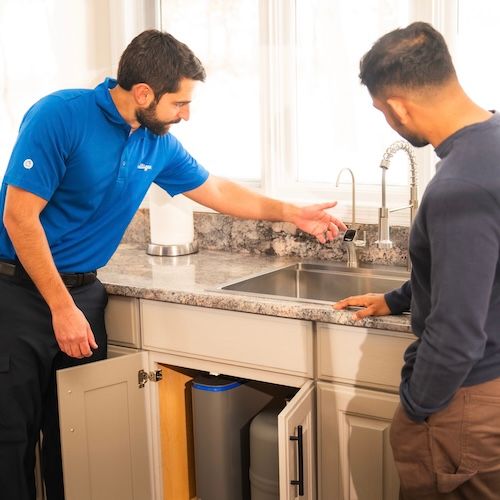
Get a free in-home test. A Culligan technician measures hardness, chlorine, total dissolved solids, pH and iron at your tap in about 20 minutes and explains what each number means. Learn more on our water testing page.
Add a lab test when it matters. For bacteria, nitrate, lead, arsenic or PFAS, we arrange certified laboratory testing. That is worth it in older homes, homes with infants, and on private wells.
Treatment options that fit Pinellas County water
For drinking water: The Aquasential® Smart Reverse Osmosis system reduces lead by 99.7%, and with Total Defense it reduces total PFAS by more than 99.99%. It also takes out most of the chloramine taste, fluoride and dissolved solids. The Aquasential® Tankless RO is a compact option for condos and kitchens with tight cabinets. An RO system with the Advanced Post Tank Filter is certified to NSF P231 to reduce bacteria by more than 99.9999%.
For the whole house: The Aquasential® Smart HE Water Filter or a Select Series whole-house filter reduces chlorine and chloramine taste and odor at every faucet and shower. The Whole Home PFAS Water Filter reduces PFAS by more than 99% throughout the home. Most county homes also benefit from a water softener. See our water filtration and water softener options.
We also deliver bottled water and coolers for homes and offices across Pinellas County, and we offer both rental and purchase on our systems.
Frequently asked questions about Pinellas County tap water
Can I drink tap water in St. Petersburg?
Yes. St. Petersburg’s 2025 report lists no health-based violations, with lead, nitrate and disinfection byproducts below their limits. Many residents still filter for taste, since the city disinfects all of its water with chloramines.
Why does Largo tap water taste different than it used to?
Several things can change taste, including the mix of groundwater, surface water and desalinated water Tampa Bay Water sends to the county, and the disinfectant level, which the county reported anywhere from 0.30 to 5.30 ppm in 2025. A test at your tap is the quickest way to see what changed.
Is there PFAS in Clearwater water?
Clearwater’s December 2025 samples detected low levels, with PFOS up to 4.4 ppt and PFOA up to 2.6 ppt depending on the plant. The EPA limit for each is 4.0 ppt as an annual average. A reverse osmosis system with Total Defense reduces total PFAS by more than 99.99%.
Does boiling Pinellas County tap water remove chloramine or PFAS?
No. Boiling kills bacteria, which is why it is used during a boil-water notice, but it does not remove chloramine efficiently and it concentrates PFAS and minerals as water evaporates. Carbon filtration handles chloramine, and reverse osmosis handles PFAS.
Do I need a filter if my Seminole water meets standards?
Not to be safe by federal standards. Most people who filter in Seminole do it for taste, to remove chloramine, to reduce lead from older plumbing or for peace of mind about PFAS. A free test helps you decide whether it is worth it.
Schedule your free water test with Culligan of Largo
Culligan of Largo has served homes and businesses across Pinellas County for decades, from Tarpon Springs, Palm Harbor and Dunedin to Clearwater, Largo, Seminole, Pinellas Park and St. Petersburg. We know the differences between county, St. Petersburg and Clearwater water, and we will tell you plainly whether your home needs treatment or not.
Ready for better water? Schedule your free in-home water test and consultation with Culligan of Largo today.