Quick answer: Well water in the Lowcountry can be safe to drink, but only the owner can make sure of it. No utility tests or treats a private well, and the geology under Charleston, Berkeley, Dorchester and Colleton counties produces very different water depending on how deep the well goes: iron and bacteria in shallow sands, hardness in limestone, sodium and chloride near the coast and in the deep aquifers. The South Carolina Department of Environmental Services and Clemson Extension both recommend a coliform bacteria test every year as the minimum. Treatment, when it is needed, is straightforward once a test shows what you are dealing with.
Private wells are a fact of life across much of the Charleston region. Drive past the utility lines toward Awendaw and McClellanville, south toward Hollywood, Ravenel, Wadmalaw Island and Edisto Island, or inland to Ridgeville, St. George and the farm country around Walterboro, and you are in well territory. SCDES reports that slightly more than 20 percent of South Carolinians rely on individual wells and that Charleston County approved 450 new wells in a single recent fiscal year, second only to Lexington County. Here is what Lowcountry well owners should know about the water under their feet, the problems that show up most often and how each is fixed.
Private wells and public systems: what changes when you own the source
Public systems such as Charleston Water System are regulated under the Safe Drinking Water Act and publish annual reports. Private wells fall outside those rules: SCDES permits construction, but once a well is in service, water quality is the homeowner’s job.
Water quality also moves. A well that tested clean five years ago can change after a drought lowers the water table, a hurricane pushes floodwater over the casing, a neighbor’s septic system fails or the casing cracks. Bacteria and nitrate have no taste, smell or color, which is why testing on a schedule matters even when nothing seems different.
Where Lowcountry well water comes from
Understanding the layers helps explain why two wells on the same road can behave so differently.
Shallow sand aquifers. The surficial sands and Tertiary sand units under the coastal counties supply many older bored and shallow drilled wells. They recharge quickly from rain, which also exposes them to surface contamination, and the U.S. Geological Survey identifies dissolved iron as the most commonly exceeded drinking water standard in the state’s shallow aquifers.
The Floridan aquifer. This limestone unit underlies Charleston, Berkeley and Dorchester counties and supplies about 78 percent of reported groundwater use in the Lowcountry counties to the south, according to SCDES. USGS describes its water as ranging from soft near recharge areas to very hard downgradient as it dissolves calcium from the rock, with total dissolved solids rising from under 50 mg/L to several hundred along the way. Near the coast the Floridan picks up chloride and sodium where fresh water mixes with seawater.
The deep Charleston aquifer. Formerly called the Middendorf, this Cretaceous sand lies roughly 1,700 to 2,200 feet down. Mount Pleasant Waterworks pumps it through reverse osmosis, and a 2020 SCDNR study of 25 wells found total dissolved solids of 611 to 1,807 mg/L, chloride of 10 to 320 mg/L, sodium of 228 to 620 mg/L and fluoride above 2 mg/L in every summer sample. Few private wells reach it; those that do need reverse osmosis rather than a softener.
Common well water problems around North Charleston
1. Iron
What homeowners notice: Orange or rust-colored stains on tubs, toilets, sinks and laundry; a metallic taste; water that comes out clear but turns cloudy orange after sitting.
What causes it: Groundwater moving through iron-bearing sands dissolves the metal. It stays invisible until it reaches air at your tap and oxidizes into the particles that stain.
Why it matters: Iron is the most common complaint we hear from well owners in Ravenel, Hollywood, Ridgeville and St. George. Besides staining, it fouls softener resin and clogs fixtures.
How to fix it: An Iron-Cleer® whole-house filter oxidizes and traps iron before it reaches your plumbing. Where hardness is also present, a Softener-Cleer handles both in one unit. Iron-OX5 is an option for higher concentrations.
2. Hydrogen sulfide
What homeowners notice: A rotten-egg odor at the tap, sometimes only from the hot side.
What causes it: Hydrogen sulfide forms when sulfur-reducing bacteria act on organic matter or sulfate in groundwater, common in the oxygen-poor sediments of the coastal plain. If the smell is only in hot water, the reaction is happening inside the water heater.
Why it matters: The odor makes water unpleasant to drink, cook with and bathe in, and the same conditions that produce sulfur often produce iron and manganese.
How to fix it: A Sulfur-Cleer® whole-house filter or Sulfur-OX3 system oxidizes and removes hydrogen sulfide at the point of entry. A water heater problem is handled at the heater.
3. Salty or brackish water
What homeowners notice: A salty or flat taste, white crust that is not scale, and corrosion on fixtures.
What causes it: Chloride and sodium from the freshwater-saltwater boundary. USGS reports that natural chloride often exceeds 250 mg/L in coastal South Carolina aquifers, SCDNR’s 2020 study places the 250 mg/L chloride line in the deep Charleston aquifer at the northern tip of Isle of Palms, and SCDES reports the saltwater boundary moving inland beneath coastal Colleton County in the Gordon aquifer. Wells on Johns Island, Wadmalaw, Edisto Island and near the marsh edges are the most likely to see it.
Why it matters: Sodium is a concern for people on restricted diets, chloride corrodes plumbing and appliances, and a water softener will not remove either one.
How to fix it: Reverse osmosis is the tool for dissolved salts. The Aquasential® Smart Reverse Osmosis system handles drinking and cooking water; for whole-house needs we size a system to the chloride level a lab test confirms.
4. Hard water
What homeowners notice: Chalky scale on fixtures and showerheads, spotted glassware, soap that will not lather and dry skin.
What causes it: Calcium and magnesium dissolved from limestone and shell beds. Floridan wells in the Lowcountry can be very hard; shallow sand wells and the deep Charleston aquifer typically are not. Hardness varies well to well, and the only way to know yours is to test it.
Why it matters: Scale shortens the life of water heaters and appliances and makes everything harder to clean. It is a maintenance problem, not a health one.
How to fix it: The Aquasential® Smart High Efficiency Water Softener removes hardness at the point of entry. For wells with both hardness and iron, the Softener-Cleer is built for exactly that combination.
5. Bacteria
What homeowners notice: Usually nothing at all.
What causes it: Coliform bacteria live in soil and surface water and reach a well through a cracked casing, a loose cap, an improperly sealed well, floodwater or a nearby septic system. Low-lying lots that flood during hurricanes and king tides are at particular risk.
Why it matters: Total coliform signals a pathway for disease-causing organisms; E. coli signals fecal contamination. SCDES states that a flooded well must be disinfected and tested before it is used again, and recommends an annual coliform test for every private well.
How to fix it: Correct the source, disinfect the well and retest. For ongoing protection, UV disinfection at the point of entry inactivates microorganisms in every gallon entering the house, and the Aquasential® Smart Reverse Osmosis system with the Advanced Post Tank Filter is certified under NSF Protocol P231 to reduce bacteria by more than 99.9999%.
6. Nitrate
What homeowners notice: Nothing; nitrate is colorless and tasteless.
What causes it: Fertilizer, livestock and septic effluent carried into shallow groundwater, a concern for rural Dorchester and Colleton county wells near fields or dense septic development.
Why it matters: Elevated nitrate is a health risk for infants under six months. Only a lab test can detect it.
How to fix it: The Aquasential® Smart Reverse Osmosis system reduces nitrate in drinking water, and the Nitrate Reduction Conditioner addresses it throughout the home.
7. PFAS
What homeowners notice: Nothing.
What causes it: Firefighting foam, industrial releases and landfill leachate that reach groundwater. Joint Base Charleston, with facilities in North Charleston and Goose Creek, has acknowledged historic use of PFOS-based foam and is one of 203 Air Force installations under investigation for PFOS and PFOA in drinking water; the base monitors its Charleston Water System and Berkeley County supplies for both compounds.
Why it matters: South Carolina’s statewide sampling of public wells found Lowcountry systems including Mount Pleasant’s deep wells, Dorchester County’s wells, Edisto Beach and Walterboro below the 2 ppt detection limit, while some wells elsewhere in the state exceeded the new 4 ppt limits by wide margins. Private wells are not part of that sampling, so a well near a known source should be tested.
How to fix it: The Aquasential® Smart Reverse Osmosis system with Total Defense reduces total PFAS by more than 99.99%; the Whole Home PFAS Water Filter reduces total PFAS by more than 99% at every tap.
How to check your well water
Watch for signs. Orange staining, rotten-egg odor, salty taste, gritty sediment, blue-green stains or chalky scale each point to a testable cause.
Use state resources. The SCDES Private Well Program offers testing for a fee through its laboratories, with kits at regional offices, and runs a Private Well Hotline at 1-888-761-5989. Clemson’s Home and Garden Information Center publishes plain-language guidance on which tests to run. For the regional picture, SCDNR’s 2021 groundwater quality report on the Charleston aquifer and USGS’s Mount Pleasant groundwater studies are the authoritative sources.
Test on a schedule and after events. Coliform bacteria every year, with nitrate, pH and total dissolved solids. Add iron, manganese, hardness, chloride and sodium when sizing treatment, and lead, arsenic or PFAS when circumstances call for it. Retest after any flood, hurricane or well repair, and before an infant or pregnant household member drinks the water. Our water testing page explains what the free on-site screening covers and when a certified lab is needed.
Get local well water expertise from Culligan of North Charleston
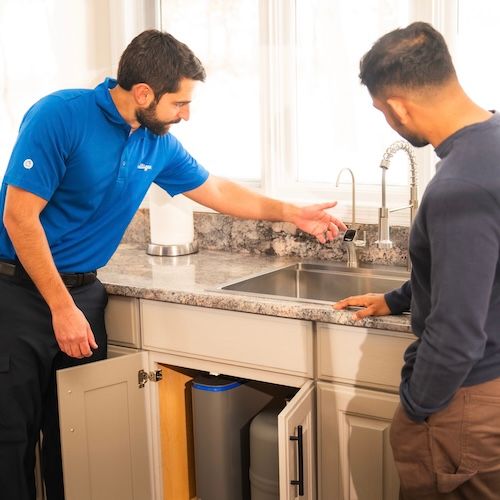
Culligan of North Charleston has worked on wells across Charleston, Berkeley, Dorchester and Colleton counties for decades, from the sea islands to the farmland around St. George and Walterboro, and we know the patterns: iron and sulfur inland, salt near the marsh, hardness where the limestone is close. Our technicians screen hardness, iron, TDS, pH and chlorine at your sink in about 20 minutes, collect samples for certified lab testing when bacteria, nitrate, arsenic, lead or PFAS are in question, and design treatment around your results rather than a package.
From softeners and iron and sulfur filters to reverse osmosis and UV disinfection, we install, maintain and service what we sell, and salt delivery is available on your schedule. Learn more on our well water solutions page.
Frequently asked questions about private wells near North Charleston
Where does well water around North Charleston come from?
Depending on depth, from shallow surficial and Tertiary sands, from the Floridan limestone aquifer, or, rarely for private wells, from the deep Charleston aquifer formerly called the Middendorf. Each produces a different kind of water, which is why neighbors can have very different results.
How often should I test a well in Charleston or Dorchester County?
SCDES and Clemson Extension recommend a coliform bacteria test every year, with nitrate, pH and dissolved solids on the same schedule. Test again after flooding, hurricanes or repairs, or when the water changes.
My well water on Wadmalaw Island tastes salty. Will a softener help?
No. Softeners exchange calcium and magnesium; they do not remove sodium or chloride. Reverse osmosis does, and a lab chloride result lets us size the system correctly.
What should I do with my well after a hurricane floods my yard?
Stop using the water until it has been tested. SCDES says a flooded well must be disinfected and tested before use. Call the SCDES Private Well Hotline or Culligan of North Charleston to arrange bacteria sampling, and consider UV disinfection if your lot floods regularly.
Ready for better well water? Schedule your free in-home water test and consultation with Culligan of North Charleston today.