Quick answer: Nobody can hand you a single hardness number for North Charleston, because the utilities that serve the Lowcountry do not publish one. Hardness is not a regulated contaminant, so it does not appear in the annual water quality reports for the Charleston Water System service area, and what comes out of your tap depends on which plant feeds your street, how far the water travels and what your own plumbing adds along the way. Private wells in Charleston, Berkeley, Dorchester and Colleton counties range from naturally low in minerals to very hard depending on the aquifer. The practical answer is to measure it at your own faucet, which takes about 20 minutes and costs nothing.
Most people start asking about hard water after noticing the symptoms: a hazy film on the shower glass, crust around the kitchen faucet, cloudy glasses out of the dishwasher, or hair and skin that feel stripped after a shower. Each is a calling card of dissolved calcium and magnesium. Here is why the answer differs from Park Circle to Mount Pleasant to Moncks Corner, and how to get a reliable reading for your own home.
Why there is no single hardness number for North Charleston
The Tri-County area drinks from several different systems, and that matters more here than in many cities.
Charleston Water System supplies North Charleston, the City of Charleston and a long list of wholesale customers, including the St. John’s Water Company on Johns Island, the City of Folly Beach and the Town of Sullivan’s Island. Its raw water comes from the Edisto River and the Bushy Park Reservoir and is treated at the Hanahan Water Treatment Plant. The 2025 annual reports published for those systems list chloramine residual, lead, fluoride, disinfection byproducts and more, but none of them lists a hardness figure, because federal rules do not require it.
Santee Cooper’s Lake Moultrie Regional Water System treats lake water at a 40 million gallon per day plant near Moncks Corner and sells it wholesale to Summerville CPW, the City of Goose Creek, the Moncks Corner Public Works Commission and Berkeley County Water & Sanitation. Summerville CPW does report a hardness value in its annual report, and homeowners in Summerville, Nexton and Goose Creek who want the system-wide figure can read it there or call the utility. The treatment plant does not remove hardness, and a report figure describes the plant, not your kitchen.
Mount Pleasant Waterworks is different again. According to the U.S. Geological Survey, it blends purchased Charleston Water System surface water with groundwater from six wells drilled roughly 1,800 to 2,000 feet into the Charleston aquifer, formerly called the Middendorf, and runs that groundwater through four reverse osmosis plants before it enters the mains. Reverse osmosis strips most dissolved minerals, so the character of Mount Pleasant water shifts with the blend.
A hardness figure for one neighborhood, in other words, does not transfer to the next. Hardness also changes between the plant and your tap as water sits in storage tanks, moves through older mains in downtown Charleston or West Ashley, and passes through your water heater, where heat drives calcium carbonate onto the element.
Is well water or city water harder in the Lowcountry?
Outside the utility networks, in places like Awendaw, McClellanville, Hollywood, Ravenel, Wadmalaw Island, Ridgeville and the rural stretches of Colleton County around Walterboro, homes rely on private wells. The South Carolina Department of Environmental Services reports that slightly more than 20 percent of the state’s residents depend on individual wells, and that Charleston County approved 450 new wells in a single recent fiscal year, second only to Lexington County.
Well hardness in this region depends almost entirely on which layer the well reaches. USGS describes water in the Floridan limestone aquifer as ranging from soft near its recharge areas to very hard downgradient as the water picks up calcium from the rock, and limestone wells in the Lowcountry can land anywhere on that spectrum. Shallow sand wells tend to carry iron more than hardness. The deep Charleston aquifer that Mount Pleasant taps is naturally very low in calcium and magnesium but, according to a 2020 South Carolina Department of Natural Resources study, high in sodium and total dissolved solids, which is a different problem that softeners do not solve.
Two wells a mile apart on Johns Island can test completely differently, and neither is monitored by anyone but the owner. SCDES and Clemson Extension recommend annual testing for private wells; hardness is easy to add to the bacteria test.
What hard water does around a Charleston area home
Hard water is not a health concern. It is a maintenance and comfort concern, and it adds up.
Scale inside water heaters and appliances
When hard water is heated, dissolved calcium and magnesium precipitate out as a chalky crust called scale. On a tank heater it coats the element and forces longer run times; on a tankless heater it narrows passages and triggers error codes. Dishwashers, washing machines and coffee makers collect the same deposits and fail years earlier than they should.
Film, spots and soap scum
Calcium and magnesium react with soap to form a sticky residue that does not rinse away: the film on shower doors, the ring in the tub, the spots on glassware. Hard water also makes detergent less effective, so households use more and still get stiff laundry.
Dry skin and dull hair
The same soap reaction leaves a thin residue on skin and hair. Skin feels tight or itchy after a shower, hair feels coated and flat, and conditioners and lotions seem to stop working.
A whole-house ion-exchange softener such as the Aquasential® Smart High Efficiency Water Softener addresses all three problems at the source by swapping calcium and magnesium for sodium before water reaches any fixture or appliance. Scale stops forming, existing deposits gradually loosen, and soap starts lathering the way it is supposed to.
How to find out the hardness at your own tap
Read the utility’s report. Charleston Water System posts its annual reports and a separate set of PFAS lab results on its water quality reports page. Summerville CPW and Dorchester County Water Authority publish their reports as well. Look for a line labeled total hardness; if it is absent, as it is for the Charleston Water System service area, that tells you the utility does not track it as a customer-facing figure, not that the water has none.
Look for the signs. Scale on showerheads, spotting on glassware, soap that will not lather and a water heater that pops as it heats all point toward hardness worth measuring.
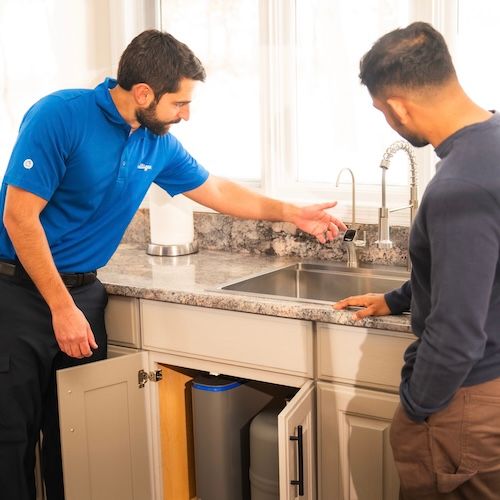
Test the water in your house. This is the only method that accounts for your supply, your pipes and your water heater. A professional test reads hardness in grains per gallon on the spot, along with chlorine or chloramine, total dissolved solids, pH and iron. Private well owners should pair that screening with the annual bacteria and nitrate test the state and Clemson recommend; the SCDES private well program offers testing services and guidance.
Frequently asked questions about North Charleston water hardness
How hard is the water in North Charleston, SC?
The annual reports covering the Charleston Water System service area do not list a hardness figure, and hardness varies by source, by distance from the plant and by the plumbing in your home. Summerville CPW publishes a system figure in its report. A free in-home test gives you the reading for your own tap in grains per gallon.
Does Charleston Water System soften the water?
No. Charleston Water System treats Edisto River and Bushy Park Reservoir water at the Hanahan plant to meet drinking water standards and disinfects it with chloramine, but removing calcium and magnesium is not part of that process. The same is true of Santee Cooper’s Lake Moultrie plant. Softening, where wanted, happens at the home.
Will a pitcher filter fix hard water in my Charleston apartment?
No. Pitcher filters are built to reduce taste, odor and certain contaminants in a few cups of drinking water at a time; they do not exchange minerals and they do nothing for the shower, dishwasher or water heater. A softener is a whole-house device, and compact models exist for condos and townhouses.
My Johns Island well leaves crust on everything. Is that hardness?
Probably, and possibly iron as well. Limestone wells in the Lowcountry can be very hard, and shallow wells often carry dissolved iron that leaves orange stains. A test separates the two, because the fixes are different: a softener handles hardness, an Iron-Cleer® filter or a Softener-Cleer handles iron, and a combined approach is common on Charleston County wells.
Start with a free hard water test from Culligan of North Charleston
Culligan of North Charleston has been solving hard water for Lowcountry households for decades, from the Charleston peninsula and West Ashley to Mount Pleasant, Hanahan, Goose Creek, Summerville and Moncks Corner, and out to the well communities on Johns Island, Wadmalaw Island, Edisto Island and in Colleton County. We see every one of these supplies each week, which is why we test first and recommend second.
When you schedule a free in-home water test, a technician measures your hardness, chlorine, TDS, pH and iron in about 20 minutes, walks you through the results and, if a softener makes sense, lays out rental and purchase options in a written quote. If your water tests low, we will tell you that, too. You can also learn more about drinking water filtration, what our testing covers and well water treatment for rural Charleston, Berkeley, Dorchester and Colleton county homes.
Ready for better water? Schedule your free in-home water test and consultation with Culligan of North Charleston today.