Quick answer: Yes, by the federal yardstick. The 2025 annual water quality reports for Charleston Water System customers, including Johns Island, Folly Beach and Sullivan’s Island, show no violations, and Summerville CPW, Dorchester County Water Authority and the City of Walterboro report the same. But “no violations” describes testing at the treatment plant against regulated limits. It says nothing about hardness, about chloramine taste, about PFAS compounds that are legal today and regulated in 2029, or about the pipes between the main and your faucet. Water quality in North Charleston is good and it is also worth understanding in detail.
If you live in North Charleston, Charleston or on one of the barrier islands, your water started as river or reservoir water, was treated at the Hanahan Water Treatment Plant and traveled miles of pipe to reach you. If you live in Summerville, Goose Creek or Moncks Corner, it started in Lake Moultrie. Both supplies are well run, and both have characteristics homeowners ask us about every week. Here is what the Tri-County area’s water contains, what the reports leave out, and how to find out what is at your own tap.
What the annual report measures, and what it leaves out
The EPA regulates more than 90 contaminants in public drinking water, and every community system publishes an annual Consumer Confidence Report showing how it did. Those reports are reliable. Three limits are worth understanding, though.
First, federal standards weigh cost and feasibility alongside health. EPA set 4.0 parts per trillion for PFOS and PFOA in 2024, but utilities have until 2029 to comply, so water above the new limit today is still in compliance.
Second, compliance sampling happens at the plant and at set distribution points, not at your kitchen sink. Water that leaves Hanahan in excellent shape still travels through mains of varying age under the peninsula, West Ashley and Park Circle, then through whatever your house was plumbed with. Charleston Water System maintains a lead service line inventory map for this reason.
Third, the rules target health, not comfort. Hardness, the earthy taste lake water picks up in summer and the pool note of chloramine are not violations of anything; whether you want to change them is up to you.
City water versus private wells in the Lowcountry
None of this applies to a private well, because no utility tests it. The South Carolina Department of Environmental Services reports that slightly more than 20 percent of state residents rely on individual wells, and around Awendaw, McClellanville, Hollywood, Ravenel, Wadmalaw Island, Edisto Island, Ridgeville, St. George and rural Colleton County, wells are the norm.
Well quality depends on depth and geology. USGS identifies dissolved iron as the most commonly exceeded standard in the state’s shallow aquifers, notes that Floridan limestone water ranges from soft to very hard, and reports natural chloride above 250 mg/L near the coast. Bacteria can enter any shallow or poorly sealed well. SCDES and Clemson Extension recommend a coliform test every year at minimum, and our well water page covers the common fixes.
Where North Charleston’s drinking water comes from
Charleston Water System draws raw water from the Edisto River and the Bushy Park Reservoir, treats it at the Hanahan plant and distributes it to North Charleston, the City of Charleston and wholesale customers such as the St. John’s Water Company on Johns Island, the City of Folly Beach, the Town of Sullivan’s Island and Joint Base Charleston. The utility and the base jointly developed a watershed protection plan for the Bushy Park Reservoir and Foster Creek.
Santee Cooper’s Lake Moultrie Regional Water System treats lake water at a 40 million gallon per day plant near Moncks Corner and sells it wholesale to Summerville CPW, the City of Goose Creek, the Moncks Corner Public Works Commission and Berkeley County Water & Sanitation. In March 2026 a contractor struck the system’s 48-inch main near Moncks Corner, interrupting supply to Goose Creek, Summerville and parts of Berkeley County for two nights before repairs and follow-up testing confirmed the water was safe.
Mount Pleasant Waterworks blends purchased Charleston Water System water with reverse-osmosis-treated groundwater from six wells about 1,800 to 2,000 feet deep in the Charleston aquifer.
Walterboro, in Colleton County, runs nine groundwater wells with chlorine; its 2025 report lists sodium at 86 ppm and fluoride at 1.10 ppm, with no violations.
Across those systems, these are the issues Lowcountry homeowners bring to us most often.
1. Chloramine taste and odor
What homeowners notice: A chemical or pool-like smell, most obvious in the shower or in a glass of cold water, that does not fade when the water sits.
What causes it: Charleston Water System disinfects with chloramine, a combination of chlorine and ammonia; the 2025 reports for its customers list residuals up to 2.64 mg/L against a 4 mg/L maximum. Summerville CPW also uses chloramine. It lasts longer in the pipes than free chlorine, which protects water on long runs to the islands.
Why it matters: The persistence that protects the distribution system means the taste stays in your pitcher. Chloramine is also toxic to aquarium fish and must be removed from water used for home dialysis.
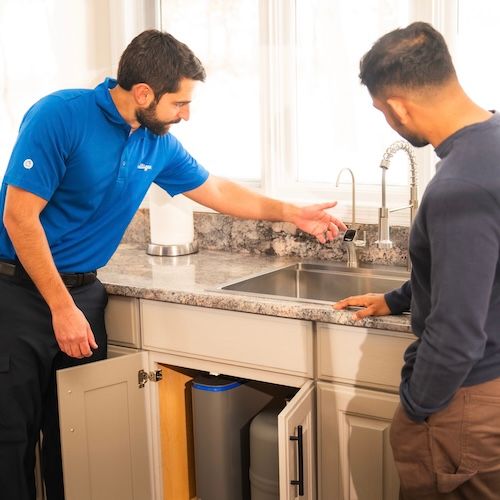
How to fix it: The Aquasential® Smart Reverse Osmosis system removes chloramine from drinking and cooking water. For showers, laundry and every other tap, a Select Series whole-house carbon filter with catalytic carbon media addresses it throughout the home.
2. PFAS in surface water
What homeowners notice: Nothing. PFAS have no taste, odor or color.
What causes it: Per- and polyfluoroalkyl substances come from firefighting foam, industrial discharges and wastewater, and they persist in rivers and reservoirs. Joint Base Charleston has acknowledged historic use of PFOS-based foam and is one of 203 Air Force installations under investigation for PFOS and PFOA in drinking water.
Why it matters: A February 2026 finished-water sample posted by Charleston Water System measured PFOS at 5.1 ppt and PFOA at 4.6 ppt, along with PFHxA, PFBS, GenX, PFHpA and PFHxS at 2 to 4 ppt. South Carolina’s statewide sampling found PFOS at 5.5 ppt and PFOA at 2.7 ppt in Charleston Water in 2020, and PFOS at 6.3 ppt and PFOA at 4 ppt at Santee Cooper’s Lake Moultrie plant. Summerville CPW’s report acknowledges the Lake Moultrie results are slightly above the new EPA standards and says Santee Cooper is evaluating treatment ahead of the 2029 compliance date. By contrast, the state found no PFAS above 2 ppt in Mount Pleasant’s deep wells or Walterboro’s wells.
How to fix it: The Aquasential® Smart Reverse Osmosis system with Total Defense is certified to reduce total PFAS by more than 99.99%. Households that want every tap covered can choose the Whole Home PFAS Water Filter, certified to reduce total PFAS by more than 99%.
3. Lead from household plumbing
What homeowners notice: Nothing; lead is invisible and tasteless.
What causes it: Lead enters water from solder, brass fixtures and old service lines at the house. South Carolina banned lead pipe in 1988, so older homes on the Charleston peninsula, in Park Circle and in the older parts of Summerville and Moncks Corner carry the most risk.
Why it matters: The 2025 reports for Charleston Water System customers show 90th percentile lead between 0.59 and 2.0 ppb against a 15 ppb action level, Summerville CPW 0.9 ppb and Walterboro 0.74 ppb, with zero sites over the limit. Reassuring system numbers cannot describe the fixture your child drinks from; a home with pre-1988 plumbing deserves its own test.
How to fix it: The Aquasential® Smart Reverse Osmosis system is certified to reduce lead by 99.7%.
4. Hard water
What homeowners notice: Spots on glassware, film on shower doors, scale on faucets and showerheads, laundry that feels stiff and skin that feels dry after bathing.
What causes it: Dissolved calcium and magnesium from rock and soil. Neither Charleston Water System nor Santee Cooper removes hardness, and it is not listed in the annual reports for the Charleston Water System service area because it is not regulated. It also changes between the plant and your tap.
Why it matters: Scale shortens the life of water heaters and appliances and soap scum makes cleaning harder. Hardness is a cost-of-ownership issue, not a health issue.
How to fix it: The Aquasential® Smart High Efficiency Water Softener removes calcium and magnesium where water enters the house. Details are on our water softeners page.
5. Seasonal taste from lake and river water
What homeowners notice: An earthy, musty or grassy flavor that comes and goes, often in late summer.
What causes it: The Edisto River and Lake Moultrie are living watersheds. Warm weather encourages algae and organic matter, and heavy rain stirs up sediment and tannins; treatment removes most of it, but trace taste and odor compounds can remain.
Why it matters: This is an aesthetic issue, not a safety one, and one of the most common reasons Summerville and Goose Creek families switch from bottled water to a home system.
How to fix it: The Aquasential® Smart Reverse Osmosis system removes taste and odor compounds from drinking water; the Aquasential® Smart HE Water Filter or a Select Series whole-house carbon filter handles the rest of the home.
How to check your home’s water quality
Read the report. Charleston Water System posts its annual reports, monthly finished-water data, PFAS lab results and lead service line map at its water quality reports page; Summerville CPW, Dorchester County Water Authority, Berkeley County Water & Sanitation and Walterboro publish theirs as well. The South Carolina Department of Environmental Services posts PFAS sampling results for every community system in the state.
Notice what your water is telling you. Chalky buildup, spots on dishes, a chloramine or earthy taste, tinted water after main work or blue-green copper stains all point toward something a test can confirm.
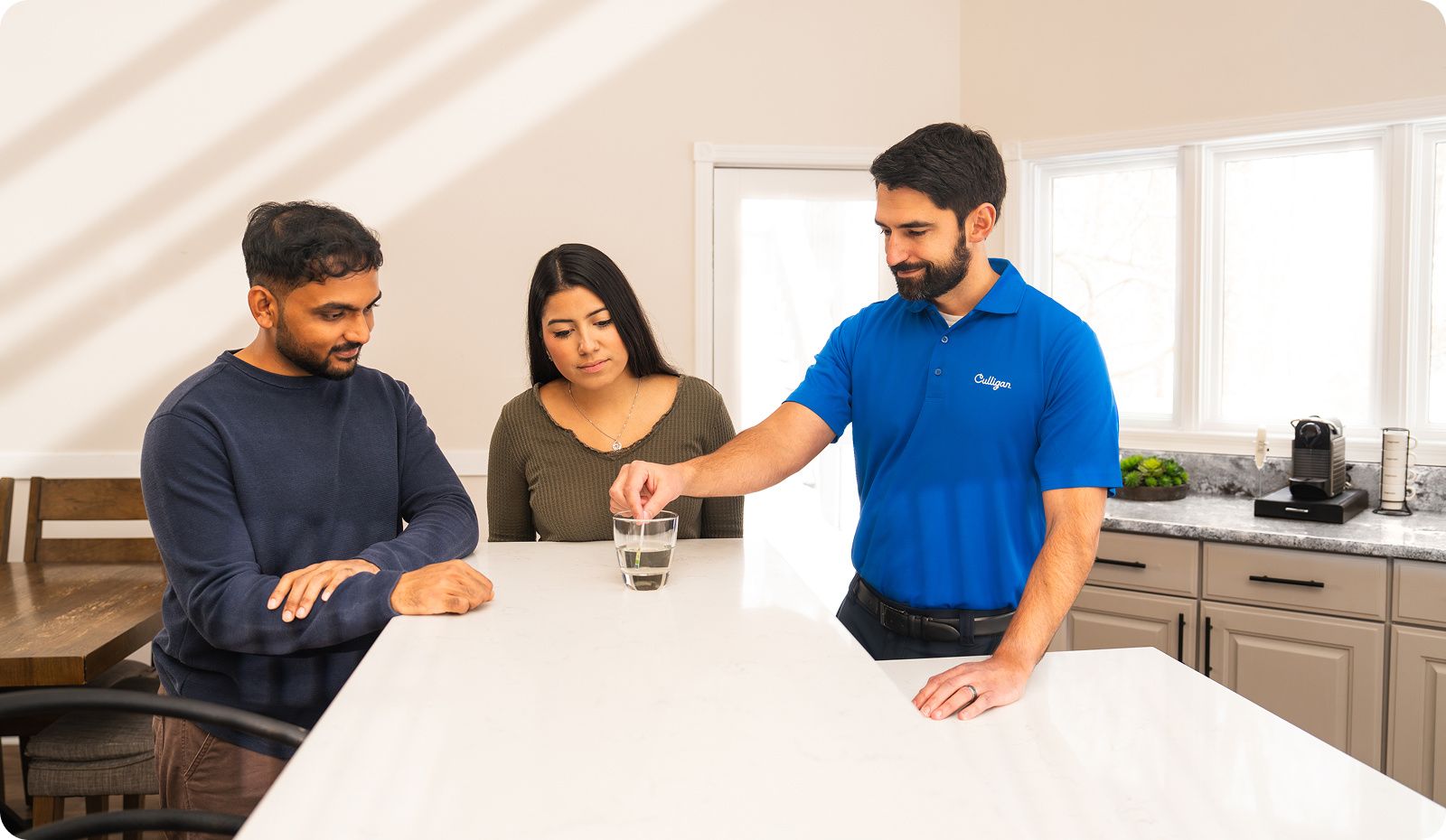
Test the water at your tap. An in-home test reads hardness, chlorine or chloramine, total dissolved solids, pH and iron on the spot; certified laboratory testing covers lead, nitrate, bacteria, arsenic and PFAS. Testing matters most if you are on a well, live in a pre-1988 home, have an infant or pregnant household member, or have never had the water checked. Our water testing page explains both levels of testing.
Frequently asked questions about North Charleston tap water
Can I drink North Charleston tap water straight from the faucet?
By federal standards, yes. The 2025 reports for Charleston Water System customers show no violations and low lead results. Whether you also want to remove chloramine taste, reduce PFAS below the 2029 limits now, or soften the water for your appliances is a comfort and preference decision that a home test can inform.
Does North Charleston use chlorine or chloramine?
Chloramine. Charleston Water System and Summerville CPW both list chloramine as their distribution disinfectant. It does not dissipate when water sits out, so a carbon-based filter or reverse osmosis is the way to remove it.
Is there PFAS in Charleston tap water?
Yes, at single-digit parts per trillion. Charleston Water System’s February 2026 sample showed PFOS at 5.1 ppt and PFOA at 4.6 ppt, slightly above EPA’s 4.0 ppt limits that take effect in 2029. Reverse osmosis with Total Defense reduces total PFAS by more than 99.99%.
Does the city soften the water in Charleston or Summerville?
No. Treatment at the Hanahan plant and the Lake Moultrie plant is designed to meet drinking water standards; it does not remove calcium and magnesium. If scale or spotting is a problem in your home, a softener is the fix.
Schedule your free water test with Culligan of North Charleston
Culligan of North Charleston has served homeowners across Charleston, Berkeley, Dorchester and Colleton counties for decades, in North Charleston, Charleston, Hanahan, Goose Creek, Ladson, Summerville, Moncks Corner, Mount Pleasant, James Island, Johns Island, Folly Beach, Isle of Palms and out to Walterboro. Our technicians test your water in about 20 minutes, explain every result and, if treatment makes sense, give you a written quote with rental and purchase options for filtration or softening. If the water is fine for what you need, we will say so.
Ready for better water? Schedule your free in-home water test with Culligan of North Charleston today.