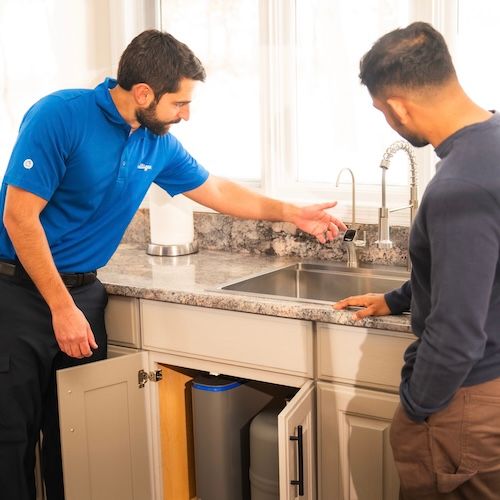
Quick answer: Yes, well water around Front Royal can be safe to drink, but only testing can confirm it, because no utility checks a private well for you. The northern Shenandoah Valley sits on karst limestone where sinkholes connect the surface directly to groundwater, and Virginia Tech clinics have found coliform bacteria in roughly half of the Warren and Frederick county wells they sampled. Hardness, iron, manganese and first-draw lead round out the common findings. The Virginia Department of Health recommends a bacteria and nitrate test every year, and the right treatment depends entirely on what that test shows.
Outside the Town of Front Royal, wells are the norm. The Northern Shenandoah Valley Regional Commission’s water supply plan estimated that about 19,000 Warren County residents, roughly half the county, rely on individual wells. Page County is near 58 percent. Rappahannock County’s plan puts it around 95 percent, with the Town of Washington’s two wells the only community system and homes in Sperryville, Flint Hill, Amissville and Chester Gap on their own supplies. Statewide, Virginia Cooperative Extension counts about 1.6 million Virginians, 19 percent, on wells, springs and cisterns.
A well is independent of any treatment plant, which is both its appeal and its responsibility. With regular testing and, where needed, treatment, well water is fine to drink, cook with and bathe in. Without them, problems can go unnoticed for years, because the ones that matter most for health have no taste, smell or color.
Town water versus well water: who is responsible
Public systems such as the Town of Front Royal, Frederick Water and Luray are tested on a federal schedule and publish annual reports. Private wells are covered by Virginia’s Private Well Regulations, which govern construction and require a coliform test when a well is first built. After that, as the Virginia Department of Health explains, testing is up to the owner, with a mortgage lender sometimes requiring it at a sale.
Water quality also varies more from well to well here than in most of Virginia, because the region straddles two geologic worlds. West of the Blue Ridge, the Valley floor is limestone and dolomite, the most productive aquifer rock in the state and the source of the hardness the Valley is known for. East of Front Royal, in Rappahannock County and along Skyline Drive, the Blue Ridge is fractured metamorphic and igneous rock whose water is less mineralized but sometimes acidic or iron-rich. Between them lies the Martinsburg shale, where USGS mapping shows most wells are under 200 feet deep with yields that cluster along faults. Two neighbors on opposite sides of a road can draw from different rock.
Conditions change over time, too. Heavy rain, flooding, drought, a failing septic system or a cracked well casing can alter a well that has tested clean for years. Culligan Water of Front Royal has treated well homes across this region for decades, and the issues below are the ones we meet most often.
Common well water problems around Front Royal
1. Coliform bacteria and E. coli
What homeowners notice: Usually nothing. Bacteria cannot be seen, tasted or smelled.
What causes it: Karst. Where limestone dissolves, rain and runoff drop into sinkholes and sinking streams and reach groundwater without passing through soil. The U.S. Geological Survey describes the Valley’s aquifers as karst and fractured-rock systems with caves, sinkholes, sinking streams and conduits, and Shenandoah County’s water primer warns that bacteria from septic systems can travel several miles in karst and survive below the water table for months. Shallow wells, poorly sealed caps and nearby septic drainfields add to the risk.
Why it matters: Virginia Tech’s Household Water Quality Program found total coliform in 47.7 percent of the 44 Warren County wells sampled at its 2012 clinic and E. coli in 4.5 percent. Frederick County’s 2010 clinic found coliform in 53 percent and E. coli in 17 percent; over 2011 to 2015, 21 percent of Clarke County samples carried E. coli. Total coliform itself is rarely harmful, but it signals a pathway for pathogens, and E. coli means fecal contamination.
How to fix it: Find and correct the source, shock-chlorinate the well, and retest. For ongoing protection, a UV disinfection system treats all water entering the house, and Culligan’s Aquasential® Smart Reverse Osmosis System with the Advanced Post Tank Filter is certified under NSF Protocol P231 to reduce bacteria by more than 99.9999 percent at the kitchen sink.
2. Hard water
What homeowners notice: Chalky scale on fixtures, spotted glasses, a rumbling water heater, dry skin and stiff laundry.
What causes it: Calcium and magnesium dissolved from carbonate rock. Extension reports on the Valley say it directly: carbonate formations cause hard water, and hardness is very common in the Valley and Ridge province.
Why it matters: In the 2012 Warren County clinic, 22.7 percent of wells exceeded 180 mg/L, the USGS threshold for very hard, with the highest at 373.5 mg/L, about 21.8 grains per gallon. In Frederick County, 33 percent were very hard. For scale, Frederick Water’s quarry groundwater measures 329 ppm, or 19.24 grains per gallon. Blue Ridge wells east of Front Royal are often less mineralized; Rappahannock County’s plan calls excessive hardness occasional there.
How to fix it: The Aquasential® Smart High Efficiency Water Softener removes hardness at the point of entry. Wells with iron and hardness together are often fitted with a Softener-Cleer that addresses both. See our water softeners page.
3. Iron and manganese
What homeowners notice: Rust-orange stains in toilets, tubs and laundry; black specks or a dark film from manganese; a metallic taste; water that runs clear then turns cloudy orange in the glass.
What causes it: Both metals dissolve from rock and soil. Extension reports note iron runs high in parts of the Blue Ridge, and the Virginia Department of Health lists iron and manganese among the most common well problems statewide.
Why it matters: The Warren County clinic found iron above 0.3 mg/L in 18.2 percent of wells and manganese above 0.05 mg/L in the same share. Neither is a health concern at typical levels, but the staining is permanent on fabric and the deposits foul softener resin and plumbing.
How to fix it: An Iron-Cleer® or Iron-OX5 whole-house filter oxidizes and traps iron and manganese before the softener. Where a rotten-egg odor accompanies the iron, a Sulfur-Cleer® or Sulfur-OX3 handles hydrogen sulfide as well.
4. Lead and copper from plumbing
What homeowners notice: Blue-green stains on fixtures point to copper corrosion; lead gives no sign at all.
What causes it: Corrosive water pulls metal from pipes, solder and brass. Acidic water, more common in Blue Ridge wells, accelerates it; 13.6 percent of Warren County clinic samples had pH below 6.5.
Why it matters: First-draw samples in the 2012 Warren clinic exceeded 0.015 mg/L of lead in 13.6 percent of homes and 1.0 mg/L of copper in 15.9 percent; over 2012 to 2015, 10 percent of Warren County first-draw samples exceeded the lead action level. Flushed samples were clean, which confirms the source is household plumbing, not the aquifer.
How to fix it: Correct the pH with a neutralizing filter if the water is acidic, and treat drinking water with the Aquasential® Smart Reverse Osmosis System, certified to reduce lead by 99.7 percent.
5. Nitrate
What homeowners notice: Nothing. Nitrate is colorless, odorless and tasteless.
What causes it: Fertilizer, livestock and septic systems. The Valley’s pastures and poultry operations put it on the list, and karst moves it quickly.
Why it matters: Warren County’s clinic found only 2.3 percent of wells above the 10 mg/L limit, but farther down the Valley in Rockingham County nearly 19 percent exceeded it. Infants under six months are the most vulnerable. Virginia’s health department recommends testing nitrate every year alongside bacteria.
How to fix it: The Aquasential® Smart Reverse Osmosis System configured for nitrate treats drinking water, and the Nitrate Reduction Conditioner treats the whole house.
6. Radon, arsenic and PFAS
What homeowners notice: Nothing for any of the three.
What causes it: Radon and arsenic occur naturally in some of Virginia’s bedrock; the Virginia Department of Health names bacteria, radon, arsenic, iron, manganese and radiological contaminants as the most common well problems in the state and suggests testing radiological parameters at least once. PFAS come from firefighting foam, industry and consumer products, and no utility tests private wells for them. Regionally, Frederick Water’s 2025 sampling found only PFBS at trace levels and Winchester reported PFOA and PFOS as non-detect.
How to fix it: The Aquasential® Smart Reverse Osmosis System with Total Defense is certified to reduce total PFAS by more than 99.99 percent, and the Whole Home PFAS Water Filter reduces it by more than 99 percent at every tap. Arsenic is addressed with RO at the sink. Radon in water is handled by aeration or carbon systems sized to the test result.
How to check your well water in Front Royal
Watch for signs. Orange or black stains, rotten-egg odor, blue-green marks on fixtures, gritty sediment or chalk on showerheads all tell you something is in the water. Their absence tells you nothing about bacteria, nitrate or lead.
Use local resources. Virginia Cooperative Extension’s Household Water Quality Program holds low-cost clinics in the northern Shenandoah Valley, and the Lord Fairfax Health District and Rappahannock-Rapidan Health District offices can point to area-specific concerns. The program’s Warren County summary reports well depths from 40 to 820 feet and finds that 59 percent of participants already had treatment, most often sediment filters and softeners.
Test on a schedule. VDH recommends bacteria and nitrate every year, a basic chemistry panel at the start and every five years after, and radon or gross alpha at least once. Retest after flooding, after work on the well or plumbing, when taste or color changes, or when an infant or pregnant household member will drink the water. Our free in-home test covers hardness, iron, pH, chlorine and total dissolved solids in about 20 minutes, and we collect samples for certified lab analysis of bacteria, nitrate, lead, arsenic and PFAS.
Frequently asked questions about wells around Front Royal
Where does well water around Front Royal come from?
From fractured bedrock aquifers. West of town, wells draw from the Valley’s limestone and dolomite and the Martinsburg shale; east of town, from the Blue Ridge’s metamorphic rock. USGS work in Warren County found median well yields of 10 to 20 gallons per minute, with the best-producing wells along faults.
How often should a Warren County well be tested?
Every year for total coliform bacteria and nitrate, per the Virginia Department of Health, with a broader chemistry panel every five years and a one-time radiological test. In karst country, the annual bacteria test is the one not to skip.
Why does my well water smell like rotten eggs?
Hydrogen sulfide, produced by sulfur bacteria in the well or, if the odor is only in hot water, inside the water heater. A Sulfur-Cleer® filter treats it at the point of entry; a hot-water-only odor usually means the heater’s anode rod or tank needs attention.
My well tested clean last year. Do I need to test after the river floods?
Yes. Sinkholes and sinking streams let floodwater reach groundwater fast, and a well that was clean in a dry month can pick up bacteria after a Shenandoah flood. Boil or use bottled water until results return; we deliver bottled water across the area if you need it.
Local well water expertise from Culligan Water of Front Royal
Every well is different, and in this region even neighboring wells can be. Culligan Water of Front Royal has helped well owners in Front Royal, Luray, Stanley, Shenandoah, Warrenton, The Plains, Bealeton, Remington, Sperryville, Washington, Flint Hill, Amissville, Chester Gap and Lake Frederick understand their water for decades. Our technicians read your test results with you, say plainly when a lab test is worth ordering, and recommend treatment based on what is in your water rather than a package. From softeners and iron filters to UV and reverse osmosis, we install, maintain and service what we sell, and salt delivery runs on scheduled routes across the same area.
Ready for better well water? Schedule your free in-home water test and consultation with Culligan Water of Front Royal today.