Quick answer: Yes, with the usual caveats. The Town of Front Royal’s 2025 Consumer Confidence Report shows no maximum contaminant level violations, and the town’s river-water plant uses both UV and chlorine disinfection. But a compliant report describes water as it leaves the plant, not as it arrives at your faucet. Chlorine taste, seasonal earthy flavors, disinfection byproducts that ran as high as 117 ppb in one 2025 sample, lead from older household plumbing and hardness are all things a passing grade does not rule out. Testing at the tap is how you learn what your own home is getting.
If you live inside Front Royal town limits, your water has been through a lot before it reaches you. It starts as the South Fork of the Shenandoah River, with Happy Creek and Sloan Creek as supplemental sources, and passes through oxidation, coagulation, settling, dual-media filtration, ultraviolet light, chlorine, lime and fluoride before it enters the mains. The Virginia Department of Health reviews the results and the town publishes them each year. Residents still ask what is actually in the water, and that is a fair question, because federal compliance and a glass of water you are happy with are not quite the same thing. Here is what Front Royal homeowners should know: what the report covers, what it leaves out, where the water comes from, the issues we see most often, and how to check your own.
What the Front Royal water report does and does not tell you
The U.S. Environmental Protection Agency regulates more than 90 contaminants in public drinking water under the Safe Drinking Water Act, and the Town of Front Royal tested within every limit in 2025. Three things keep that from being the whole story.
First, federal limits balance health against cost and available technology. A contaminant can be present below its limit and still be something you would rather not drink. The town’s total trihalomethanes, a byproduct of chlorinating river water, averaged 65 ppb against an 80 ppb limit, with individual quarterly samples ranging from 8 to 117 ppb. The system complies because the rule is based on a running annual average, but the high sample shows how much river water chemistry swings through the year.
Second, the report measures water in the distribution system, not at your kitchen sink. Between the main and your glass are the service line and the plumbing in your house. The town’s September 2024 lead sampling found a 90th percentile below 2.5 ppb, comfortably under the 15 ppb action level, but one of the sampled homes came back at 57.4 ppb. That lead did not come from the river. It came from that house.
Third, the plant is built to protect health, not to fix nuisances. Hardness, chlorine taste and a musty summer flavor are not violations, so they are not the utility’s job; they are, however, the reasons most Front Royal homeowners call us.
Town water versus private wells around Front Royal
The Town of Front Royal is the only large public system in Warren County. The Northern Shenandoah Valley Regional Water Supply Plan estimated that about 19,000 county residents, roughly half, draw from individual wells, with a few thousand more on small private community systems. Cross into Rappahannock County toward Chester Gap, Flint Hill, Washington and Sperryville and the county’s own plan puts well reliance near 95 percent. Page County, home to Luray, Stanley and Shenandoah, is close to 58 percent on wells.
Those wells are tested and treated by no one but their owners. Virginia requires a coliform test when a well is drilled; after that, the Virginia Department of Health recommends annual bacteria and nitrate testing but leaves it to the homeowner. Because much of the Valley floor is karst, surface water can reach a well quickly after a storm, and Virginia Tech’s Household Water Quality Program found total coliform in 47.7 percent of Warren County wells sampled at a 2012 clinic. If your home is on a well, our well water testing and treatment services cover that side of the line; the rest of this article is about town water.
Where Front Royal’s drinking water comes from
Front Royal’s supply is surface water, which makes it unusual in a region where most public systems pump groundwater. The town’s 2025 report names the South Fork of the Shenandoah River as the primary source, with Happy Creek and Sloan Creek in support. VDH’s source water assessment rates those sources as susceptible to contamination from surrounding land use, which is why the plant layers UV disinfection on top of chlorine. The report also notes Cryptosporidium present in the raw river water, a parasite that filtration and UV are specifically designed to remove.
Neighboring systems look different. Frederick Water, which serves the Lake Frederick area and most of Frederick County, pumps groundwater from flooded limestone quarries at Stephens City and Clearbrook and buys some finished water from Winchester, which treats the North Fork of the Shenandoah, as do Strasburg and Woodstock. Luray treats Hite Spring and a drilled well. Each source carries its own mineral load, which is why a Front Royal household and a Lake Frederick household can have different water problems. Across decades of testing in Front Royal homes, these are the issues we encounter most often on town water.
1. Chlorine taste and odor
What homeowners notice: A pool-like smell in the shower, a flat chemical taste in tap water, coffee and tea that taste off.
What causes it: The town disinfects with chlorine and maintains a residual in the pipes, averaging 1.54 ppm in 2025 with a range of 0.2 to 2.70 ppm. The residual is what keeps water safe between the plant and your tap, and it is often higher in homes closer to the plant.
Why it matters: Chlorine at these levels is safe to drink, but many people dislike the taste, and it is hard on skin, hair and aquarium fish.
How to fix it: Culligan’s Aquasential® Smart Reverse Osmosis System removes chlorine from drinking and cooking water at the sink. For whole-house relief in showers and laundry, a Select Series whole-house carbon filter or the Aquasential® Smart High Efficiency Municipal Water Softener with Chlorine Filtration handles it at the point of entry.
2. Disinfection byproducts
What homeowners notice: Nothing. Trihalomethanes and haloacetic acids have no taste or smell at these concentrations.
What causes it: Chlorine reacting with organic matter in river water. Surface sources carry more organic material than groundwater, especially after rain and in late summer, so river systems run higher. Front Royal’s 2025 TTHM figure was 65 ppb (samples 8 to 117 ppb) and HAA5 was 39 ppb (13 to 56 ppb); Winchester’s North Fork system reported 54 and 53 ppb.
Why it matters: Both are regulated because long-term exposure above the limits is associated with health effects. The town’s running annual averages comply, but the swing between samples is wide.
How to fix it: Reverse osmosis with activated carbon reduces trihalomethanes and haloacetic acids in drinking water. The Aquasential® Smart RO and Aquasential® Tankless RO both fit under a kitchen sink; see our water filtration page.
3. Lead from household plumbing
What homeowners notice: Nothing. Lead cannot be seen, smelled or tasted.
What causes it: Lead enters water from lead solder, brass fixtures and, in older neighborhoods, lead or galvanized service lines, after the water leaves the main. The town adds lime for corrosion control, which reduces leaching, and it submitted a service line inventory to the state in October 2024 with an update in December 2025.
Why it matters: The town’s 2024 sampling found a 90th percentile under 2.5 ppb but one home at 57.4 ppb, nearly four times the action level. Homes built before 1986 are the most likely to have lead solder. Infants, young children and pregnant women are most at risk.
How to fix it: Culligan’s Aquasential® Smart Reverse Osmosis System is certified to reduce lead by 99.7 percent. A certified lab test of first-draw water tells you whether your plumbing is contributing.
4. Hard water
What homeowners notice: White scale on faucets, spotted glasses, a rumbling water heater, dry skin and stiff laundry.
What causes it: Dissolved calcium and magnesium. The South Fork drains a limestone valley, and the town’s treatment does not remove hardness minerals.
Why it matters: The town tests for hardness but does not publish a figure, so hardness varies by source and season and a test at your tap is the way to know. For comparison, Frederick Water’s groundwater supply measured 329 ppm, or 19.24 grains per gallon, in 2025, very hard on the USGS scale. Wherever hardness is present, scale shortens appliance life and raises energy use.
How to fix it: The Aquasential® Smart High Efficiency Water Softener removes hardness before it reaches your plumbing. See our water softeners page for the full lineup.
5. PFAS
What homeowners notice: Nothing. PFAS have no taste, odor or color.
What causes it: Per- and polyfluoroalkyl substances come from firefighting foam, industrial discharges and consumer products and persist in the environment for decades.
Why it matters: The Town of Front Royal’s 2025 report does not include PFAS results, so there is no published town figure. Nearby, Frederick Water’s 2025 UCMR 5 sampling of 29 compounds detected only PFBS, averaging 0.0051 micrograms per liter at its Anderson plant, and Winchester reported PFOA and PFOS as non-detect. Low regional numbers are reassuring, but the missing Front Royal figure is a gap.
How to fix it: The Aquasential® Smart Reverse Osmosis System with Total Defense is certified to reduce total PFAS by more than 99.99 percent; the Whole Home PFAS Water Filter, certified to reduce total PFAS by more than 99 percent, protects every tap.
How to check your tap water in Front Royal
Read the report. The town posts its Consumer Confidence Report each spring at the link above. It shows what the system delivered; it does not show your home.
Watch for signs. A chlorine smell, an earthy taste in summer, white scale on fixtures, blue-green stains that point to copper corrosion, or cloudy water after a main repair are clues worth following up.
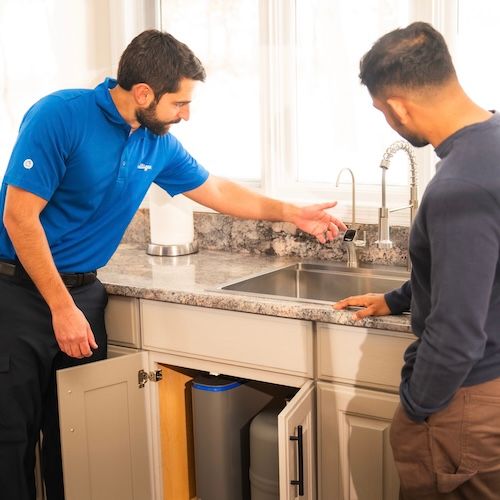
Test at the tap. Our free in-home water test reads hardness, chlorine, total dissolved solids, pH and iron in about 20 minutes; for lead, bacteria, nitrate, arsenic or PFAS we collect a sample for a certified laboratory. Testing is most worthwhile if your home predates 1986, you have an infant or a pregnant household member, or you notice a change in taste or color.
Frequently asked questions about Front Royal tap water
Did Front Royal have any water violations in 2025?
No. The town’s 2025 Consumer Confidence Report states there were no maximum contaminant level or water quality standard violations. One sample tested positive for E. coli in October 2025, but follow-up samples did not confirm it, so no violation was recorded.
Does Front Royal use chlorine or chloramine?
Chlorine, following UV disinfection. The 2025 residual averaged 1.54 ppm against a 4 ppm maximum. Frederick Water and Winchester also use chlorine rather than chloramine, which matters because activated carbon in RO systems and whole-house filters reduces free chlorine readily.
Is there fluoride in Front Royal water?
Yes. The town adds fluoride and reported 0.58 ppm in 2025, well under the 4 ppm federal limit. Households that prefer to limit fluoride in drinking water typically use a reverse osmosis system, which reduces it.
Why does Front Royal water taste earthy in late summer?
Because it is river water. Warm, low-flow conditions on the South Fork increase algae and organic matter, which can leave a musty flavor the plant reduces but does not always eliminate. It is an aesthetic issue, not a safety one, and a carbon stage in an RO system removes it.
Schedule your free water test with Culligan Water of Front Royal
You should not have to guess about your water. Culligan Water of Front Royal has helped households in Front Royal, Luray, Stanley, Warrenton, The Plains, Bealeton, Remington, Sperryville, Washington, Flint Hill, Amissville, Chester Gap and Lake Frederick understand and improve their water for decades. Our technicians test at your tap, explain the results in plain terms and, if treatment makes sense, lay out rental and purchase options in a written quote. Salt and bottled water delivery run on scheduled routes across the same area.
Ready for better water? Schedule your free in-home water test with Culligan Water of Front Royal today.