Quick answer: It depends on which water reaches your house. The Town of Front Royal treats river water from the South Fork of the Shenandoah and does not publish a finished-water hardness figure. Frederick Water, which pumps groundwater from limestone quarries north of Front Royal, reported an average of 329 ppm, or 19.24 grains per gallon, in its 2025 report, which is very hard on the USGS scale. Private wells drilled into the Valley’s carbonate bedrock often run hard as well, while Blue Ridge wells vary. The only way to know your own number is to test the water at your tap.
Ask ten homeowners between Front Royal and Luray whether their water is hard and you will get ten different answers, and most of them will be right. This corner of Virginia sits where two kinds of rock meet. To the west and north, the floor of the Shenandoah Valley is limestone and dolomite, the same rock that forms the caverns at Luray and the quarries Frederick Water uses as reservoirs. To the east, the Blue Ridge is old metamorphic and igneous rock that does not dissolve the same way. A well in Lake Frederick and a well in Flint Hill can be twenty minutes apart and behave nothing alike. Here is what homeowners in Warren, Page, Rappahannock, Fauquier and southern Frederick counties should know about local hardness and how to find out where their own water stands.
Town water, Frederick Water or a well: which is harder around Front Royal?
Start with the Town of Front Royal’s 2025 Consumer Confidence Report. The town draws surface water from the South Fork of the Shenandoah River, Happy Creek and Sloan Creek and treats it with coagulation, settling, sand and anthracite filtration, UV and chlorine disinfection, lime for corrosion control and fluoride. The report lists hardness among the characteristics the plant tests, but it does not print a value. Nothing in that treatment train removes calcium or magnesium, so whatever minerals the river carries on a given day pass through to town customers, and river chemistry shifts with the seasons. For Front Royal addresses, hardness varies by source and by what happens between the plant and your tap; the practical answer is to measure it at the sink.
Frederick Water, which serves much of Frederick County including the Lake Frederick area, is a different story because its source is groundwater and it publishes the number. The utility pumps from flooded limestone quarries at Stephens City and Clearbrook, plus wells, all fed by what it calls the Carbonate aquifer. Its 2025 Drinking Water Quality Report gives an average hardness of 329 ppm, which the report itself converts to 19.24 grains per gallon; the 2024 report put it at 339 ppm. The U.S. Geological Survey classifies anything above 180 mg/L as very hard, so Frederick Water customers are well past that line. The utility notes that hardness is not regulated and does not soften.
Private wells are the largest group. The Northern Shenandoah Valley Regional Commission’s water supply plan estimated that about 19,000 Warren County residents, roughly half the county, rely on individual wells, and Rappahannock County’s plan puts its figure near 95 percent. No utility tests or treats those wells. The Virginia Household Water Quality Program at Virginia Tech has sampled them at drinking water clinics: in a 2012 Warren County clinic, 22.7 percent of 44 wells exceeded 180 mg/L, with the highest at 373.5 mg/L, about 21.8 grains per gallon. In Frederick County’s 2010 clinic, 33 percent were very hard. The program’s reports say it plainly: calcium and magnesium from carbonate formations cause hard water, and hardness is very common in the Valley and Ridge province.
Blue Ridge wells in Rappahannock County and eastern Warren County are the exception. Extension reports note that Blue Ridge rock is relatively insoluble, so groundwater there is not severely mineralized, though iron runs high in places; Rappahannock County’s plan describes excessive hardness and acidic conditions as occasionally encountered.
What hard water does inside a Front Royal home
Hard water is not a health concern; the Virginia Department of Health lists hardness as a basic indicator rather than a contaminant. What it is is expensive, and the damage accumulates quietly. These are the three complaints our technicians hear most from Front Royal, Luray and Warrenton households.
Scale in water heaters and appliances
What you notice: A water heater that pops and rumbles, a tankless unit throwing error codes, a dishwasher that leaves film, and appliances that fail years early.
What causes it: Heating drives dissolved calcium and magnesium out of solution as carbonate scale on the hottest surfaces: the tank bottom, the heat exchanger, the dishwasher element.
Why it matters: Scale insulates. A heater burns more gas or draws more electricity to push heat through it, and in narrow passages it restricts flow outright. At 19 grains per gallon, the buildup is steady enough that many homeowners descale tankless heaters on a schedule.
Spots, film and soap scum
What you notice: Cloudy glassware, white crust around faucets and showerheads, a gray film on shower doors, and soap that will not lather.
What causes it: Calcium and magnesium react with soap to form an insoluble curd, and evaporating hard water leaves its minerals behind as chalk.
Why it matters: Surfaces take more scrubbing and more product, and the residue returns within days.
Dry skin, dull hair, stiff laundry
What you notice: Skin that feels tight after a shower, hair that is dull and hard to manage, towels that dry stiff and whites that gray.
What causes it: The same mineral-and-soap residue clings to skin, hair and fabric and rinses away poorly.
Why it matters: It blocks moisture from skin and hair and traps detergent in clothing. People blame the soap or the climate when the water is the variable.
A whole-house softener addresses all three at once. Culligan’s Aquasential® Smart High Efficiency Water Softener removes calcium and magnesium by ion exchange before water reaches the heater, fixtures or appliances, meters actual use so it regenerates only when needed, and tracks salt level so a refill can be scheduled before the tank runs dry. For Front Royal town water, the Aquasential® Smart High Efficiency Municipal Water Softener with Chlorine Filtration adds a carbon stage that handles chlorine taste at the same time. The Aquasential® Select Series and Advantage softeners suit homes that want a simpler unit, and wells with iron and hardness together are often fitted with a Softener-Cleer. The options are on our water softeners page.
How to check your home’s water hardness
Read the utility report. Frederick Water customers will find the hardness figure in the annual report linked above. Town of Front Royal customers will find sources, treatment steps and regulated contaminants in the Consumer Confidence Report, but no hardness value; the treatment plant can usually supply it on request.
Look for the signs. Chalk on faucets, spotted glassware, a noisy water heater and soap that will not lather are consistent with hardness, though iron and high total dissolved solids cause some of the same symptoms.
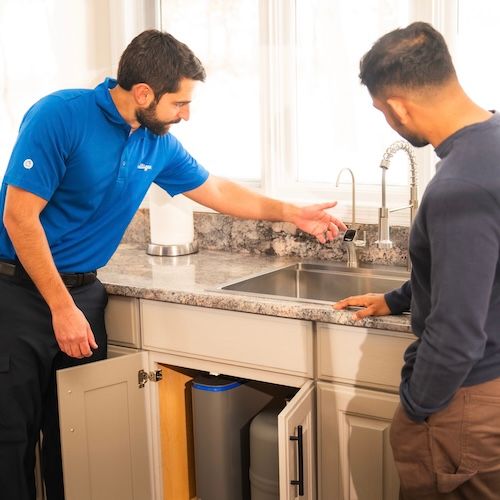
Test at the tap. This is the only method that gives your home its own number, and a professional test reads iron, pH and total dissolved solids alongside hardness, which decides whether a Valley well with iron or town water with chlorine needs a different softener. Our free in-home water test takes about 20 minutes and comes with a written explanation of every reading.
FAQs about Front Royal water hardness
How many grains per gallon is Front Royal water?
The Town of Front Royal does not publish a finished-water hardness figure, so there is no official number for town customers. Frederick Water, the nearest utility that does publish one, reported 19.24 grains per gallon (329 ppm) for 2025. Well hardness varies by property, and a free in-home test gives your home its own reading.
Does the Town of Front Royal soften its water?
No. The town’s treatment removes turbidity, organic matter and microorganisms and adds lime and fluoride, but none of those steps remove calcium or magnesium. Frederick Water and Winchester do not soften either. Homeowners who want softer water install an ion-exchange softener at the point of entry.
Is well water in Warren County harder than town water?
Often, if the well is in the Valley’s limestone; the 2012 Virginia Tech clinic found 22.7 percent of Warren County wells above 180 mg/L. Blue Ridge wells east of Front Royal are frequently less mineralized but may carry iron or acidic water instead. Because the town publishes no hardness figure, a direct comparison requires testing both.
Will a filter pitcher or refrigerator filter soften my water?
No. Carbon filters improve taste and reduce chlorine but do not remove dissolved calcium and magnesium, and they treat only drinking water, which is not where hardness causes problems. Reducing scale in the heater, dishwasher and shower requires a whole-house softener.
Start with a free hard water test from Culligan Water of Front Royal
Culligan Water of Front Royal has helped homeowners across Front Royal, Luray, Stanley, Warrenton, Sperryville, Washington, Flint Hill, Amissville, Chester Gap and Lake Frederick deal with hard water for decades. Our technicians work on Town of Front Royal water, Frederick Water accounts and private wells in both the Valley’s limestone and the Blue Ridge’s fractured rock, so we know what each tends to look like at the tap and which equipment fits it. Salt delivery and bottled water delivery run on scheduled routes across the same territory.
When you schedule a free in-home consultation, a technician tests your water for hardness, chlorine, iron, pH and total dissolved solids, walks you through the readings and answers your questions. If a softener makes sense, we lay out rental and purchase options in a written quote so you can decide at your own pace.
Ready for better water? Schedule your free in-home water test and consultation with Culligan Water of Front Royal today.