Quick answer: Private well water around Escondido can be safe to drink, but only testing tells you whether yours is. Wells in Valley Center, Pauma Valley, Ramona, Fallbrook, Bonsall, Hidden Meadows and the San Pasqual Valley draw from valley alluvium and weathered granite that no water district monitors. When the State Water Resources Control Board sampled 137 private wells across San Diego County, it found coliform bacteria in 26 percent, nitrate above the limit in 18 percent, manganese above the limit in 33 percent, and uranium above the limit in 30 percent of the wells tested for radionuclides. None of those can be seen, tasted or smelled. The County of San Diego’s minimum for a potable well is a certified lab test for bacteria and nitrate; most owners should add arsenic, uranium and dissolved solids at least once.
Step outside the boundaries of the City of Escondido, Vista Irrigation District, Vallecitos or Valley Center MWD and the water utility disappears. Across the groves of Valley Center and Pauma Valley, the horse properties around Ramona, the hillsides between Fallbrook and Bonsall and the farms of the San Pasqual Valley, homes pump their own water. The County of San Diego permits the drilling, requires a passing water test before a new home can be occupied, and then steps back. Here is what well owners in the Escondido area should know.
District water versus private well water: what changes
If you are on City of Escondido, Vista, Vallecitos, Poway, Valley Center, Rainbow or Fallbrook PUD water, a public agency disinfects, filters and tests it against more than 90 standards and publishes the results every year. All of those agencies reported no violations for 2025.
A private well has none of that: no disinfection unless you install it, no filtration unless you add it, no testing unless you order it. The state does not regulate domestic well quality. The County of San Diego’s Department of Environmental Health and Quality requires a bacteria and nitrate test to approve a well as potable for new construction, collected by a qualified sampler and run by a certified lab, and treats the result as valid for one year. After that, the county’s guidance says, the owner is responsible for the ongoing safety of the supply.
Well water also varies. It changes from property to property with depth, geology and land use, and over time as the water table rises in wet winters and falls in drought. Two wells on the same road in Valley Center can produce very different water.
Where well water around Escondido comes from
North San Diego County sits on the granitic bedrock of the Peninsular Ranges, and groundwater occurs in two settings. In the valleys, including the San Pasqual Valley, the San Luis Rey valley through Pauma and Bonsall, the Santa Maria Valley at Ramona and the alluvium along Escondido Creek, water fills shallow, productive sand and gravel. On the hillsides, wells are drilled into weathered and fractured granite, where water moves slowly through cracks and yields are lower.
The U.S. Geological Survey’s study of the Escondido hydrologic subarea describes that pattern: groundwater moving from weathered crystalline rock on the hillsides into the alluvium, generally within 20 feet of the surface. It sampled 20 wells and found total dissolved solids of 720 to 4,500 mg/L, all above the 500 mg/L recommended limit, and nitrate as nitrogen of 1.1 to 86 mg/L, with 14 of 20 wells over the 10 mg/L limit. The State Water Board found 117 of its 137 San Diego County wells outside any defined groundwater basin, which is to say most private wells here are hard-rock wells.
Common well water problems around Escondido
1. Hard water and high dissolved solids
What homeowners notice: Heavy scale on fixtures and in the water heater, spotted dishes, a flat or salty taste, white crust where water evaporates, and irrigation emitters that clog.
What causes it: Minerals dissolved from rock and concentrated by evaporation, plus salts from imported irrigation water that percolate back into the ground. The county’s San Pasqual Valley monitoring found dissolved solids of 462 to 2,550 mg/L in 2021, and the State Water Board found 15 percent of San Diego County wells over 1,000 mg/L.
Why it matters: Hardness is a maintenance cost, not a health risk, but water this mineralized is hard on water heaters and appliances and unpleasant to drink.
How to fix it: An Aquasential® water softener sized for well flow handles the hardness. A reverse osmosis system at the kitchen sink removes dissolved solids from drinking water.
2. Iron and manganese
What homeowners notice: Orange or rust-colored stains in toilets, tubs and laundry, black specks or a black film in the toilet tank, a metallic taste, and water that turns cloudy or colored after sitting.
What causes it: Both metals dissolve naturally from the granite and weathered rock that hold the groundwater, especially in deeper or low-oxygen wells.
Why it matters: Manganese was the most frequent problem in the State Water Board’s San Diego County sampling, over the 50 microgram per liter limit in 33 percent of wells. Iron exceeded its 300 microgram limit in 15 percent, at up to 12,500 micrograms per liter. Both stain everything they touch and foul softener resin if not removed first.
How to fix it: An Iron-Cleer® or Iron-OX5 filter oxidizes and removes both metals ahead of the softener. The right unit depends on the concentration and whether the metals are dissolved or already oxidized, which the test shows.
3. Nitrate
What homeowners notice: Nothing. Nitrate is colorless and tasteless.
What causes it: Fertilizer on groves and landscaping, dairy and manure, and septic systems. The county’s San Pasqual Valley fact sheet names fertilizer as the largest contributor there and reports nitrate as nitrogen of 0.4 to 26 mg/L in 2021 monitoring, with several western-basin wells above the 10 mg/L standard. The USGS found 14 of 20 Escondido-area wells over the limit.
Why it matters: Nitrate above 10 mg/L is a health standard, most dangerous to infants under six months. The County of San Diego will not approve a new well over that level as a potable source.
How to fix it: For an existing home, reverse osmosis removes nitrate from drinking and cooking water, and Culligan’s Nitrate Reduction Conditioner treats it for the whole house. Boiling does not remove nitrate; it concentrates it.
4. Coliform bacteria
What homeowners notice: Usually nothing. Occasionally cloudiness or an off odor after heavy rain.
What causes it: Surface water entering through a cracked casing or poor wellhead seal, a nearby septic system or livestock, or flooding around the well. Shallow and older wells are the most exposed.
Why it matters: Total coliform was present in 26 percent of the private wells the State Water Board sampled in San Diego County. Coliform signals a path for pathogens like E. coli, and the county’s potability standard is simple: no coliform, no E. coli.
How to fix it: Find and fix the entry point, shock-chlorinate the well following the county’s disinfection guidance, and retest. For ongoing protection, UV disinfection treats the whole house, and a Culligan reverse osmosis system with the Advanced Post Tank Filter is certified NSF P231 to reduce bacteria by more than 99.9999 percent at the tap.
5. Uranium and gross alpha radiation
What homeowners notice: Nothing at all.
What causes it: Granite. The Peninsular Ranges bedrock under Valley Center, Pauma Valley, Ramona and the hills around Escondido naturally contains uranium and other radionuclides that dissolve into groundwater in fractured-rock wells.
Why it matters: In the State Water Board’s sampling, 30 percent of the wells tested for radionuclides exceeded the 20 picocurie per liter uranium standard, with results as high as 168 pCi/L, and 35 percent exceeded the gross alpha standard. Uranium is a kidney toxin and a long-term cancer risk, and it is the strongest argument for a one-time lab panel on any hard-rock well.
How to fix it: Reverse osmosis removes uranium from drinking water, and a softener’s ion-exchange resin reduces it as a side benefit. Lab testing first tells you whether and how much treatment is needed.
How to check your well water quality
Test every year for bacteria and nitrate. That is the County of San Diego’s minimum for potability and the recommendation the San Pasqual Valley groundwater agency makes to domestic well owners. Results are valid for one year for county purposes, which is a sensible interval for your own peace of mind as well.
Run a full panel at least once. Hardness, dissolved solids, iron, manganese, arsenic, uranium and gross alpha, pH and sodium. Arsenic exceeded its limit in only 2 percent of the state’s San Diego County wells, but a positive result is serious. Repeat the panel after well work, a long drought or a change in taste, color or odor.
Test after storms and flooding. If water pooled around the wellhead, if the San Luis Rey or Santa Ysabel Creek left its banks, or if a nearby septic system failed, assume the well may be contaminated until a lab says otherwise. Use bottled water in the meantime, disinfect following the County of San Diego Water Well Program guidance, and retest.
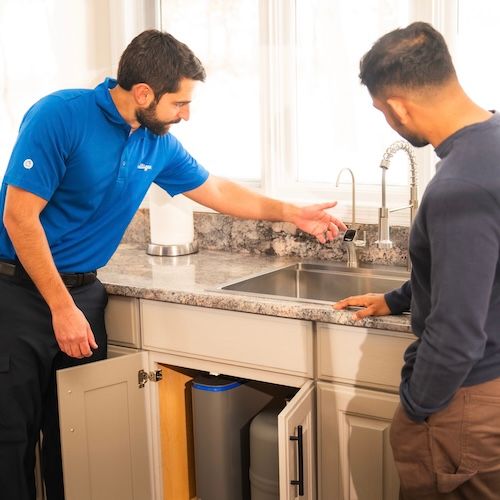
Use the right test for the job. Culligan of Escondido’s free in-home test covers hardness, iron, pH, dissolved solids and chlorine in about 20 minutes and is the starting point for sizing a softener or iron filter. For bacteria, nitrate, arsenic, uranium and PFAS, we send samples to a certified laboratory. If you need a result the county will accept for a permit, tell us, because the county requires a qualified sampler and a certified lab. The State Water Board’s GAMA Domestic Well program and the USGS Escondido groundwater study are useful background on what has been found in your area. Learn about water testing in Escondido.
Well water treatment that works around Escondido
Well treatment is built in stages, and the order matters. Sediment comes out first with a backwashing filter. Iron and manganese come out next with an Iron-Cleer® or Iron-OX5 unit, because they coat softener resin if they get past it. Hardness is handled by an Aquasential® softener sized for the well pump’s flow rate. If bacteria recur, UV disinfection follows the filters so the lamp sees clear water. Nitrate, arsenic, uranium and high dissolved solids are removed from drinking water by reverse osmosis, with the Nitrate Reduction Conditioner as a whole-house option for nitrate. Most well homes we work on in Valley Center, Ramona and Pauma Valley end up with two or three of these stages, and the test results decide which. See well water solutions for the Escondido area.
Frequently asked questions about private wells around Escondido
How often should I test my well near Escondido?
Bacteria and nitrate every year, which is the County of San Diego’s potability minimum and the groundwater agency’s recommendation. A full mineral and metals panel including arsenic and uranium at least once, and again after any work on the well or a change in the water.
Why does my Valley Center well water stain the toilet orange or black?
Iron causes orange and rust stains; manganese causes black stains and specks. Both are common in granite-rock groundwater, and the State Water Board found manganese over the limit in a third of the San Diego County wells it sampled. An Iron-Cleer® or Iron-OX5 filter removes them.
Is nitrate a problem in San Pasqual Valley and Escondido-area wells?
It can be. The county’s 2021 monitoring found nitrate as high as 26 mg/L against a 10 mg/L standard in the San Pasqual basin, and a USGS study found 14 of 20 Escondido-area wells over the limit. Reverse osmosis or a Nitrate Reduction Conditioner is the fix; boiling makes it worse.
Should I worry about uranium in a Ramona or Pauma Valley well?
Test for it once. Thirty percent of the San Diego County wells the state checked for radionuclides exceeded the uranium standard. It has no taste, and reverse osmosis removes it from drinking water.
Get your well water tested by Culligan of Escondido
Culligan Water Conditioning of Escondido has worked with well owners across North San Diego County for decades, from the groves of Valley Center and Pauma Valley to the ranches around Ramona and the hillsides of Fallbrook and Bonsall. We know what local groundwater tends to carry, and we size equipment to a well pump, not a city main. Schedule a free in-home test and we will explain what the numbers mean and recommend treatment only where the results call for it, with rental and purchase options for every system. Salt and bottled water delivery are available throughout the area.
Ready for better water? Schedule your free in-home well water test with Culligan of Escondido today.