Quick answer: Yes. Water in Escondido is very hard. The City of Escondido’s 2025 Water Quality Report lists hardness of 210 to 230 milligrams per liter as calcium carbonate, an average of 215 mg/L, which converts to roughly 12.3 to 13.5 grains per gallon. The U.S. Geological Survey classifies anything above 180 mg/L as very hard. Neighboring districts report the same thing: Poway 218 mg/L on imported water, Vallecitos about 226 mg/L, Valley Center and Rainbow 230 mg/L, Fallbrook PUD 235 mg/L. Private wells in the hills and valleys around Escondido vary widely and are frequently harder still. Whether you are on city water or a well, a test at your own tap tells you the number you are actually living with.
If you have lived in Escondido for more than a few months, you know the symptoms: a white haze on the shower door, crusty rings around faucet bases, spotted glasses out of the dishwasher, a kettle that rattles with chalk. In North San Diego County that is not a plumbing problem. It is what 215 mg/L of dissolved calcium and magnesium does.
Here is what homeowners in Escondido, San Marcos, Vista, Poway and the surrounding communities should know about where that hardness comes from, how to check their own level, and what a softener does about it.
Is city water or well water harder in Escondido?
Around Escondido the honest answer is that both are hard, and wells are the wild card.
If your home is on City of Escondido water, whether you are in the Old Escondido Historic District, Felicita, Hidden Meadows or out toward Harmony Grove, your water is treated at the Escondido-Vista Water Treatment Plant. The plant, built in 1976 with a capacity of 75 million gallons a day, disinfects, filters and fluoridates the water and tests it against more than 90 state and federal standards. It does not soften it. Hardness is not a health standard, so no utility in the region removes it, and the city’s report says as much by listing hardness alongside dissolved solids and sodium as a general-mineral characteristic rather than a contaminant.
Hardness also moves around. The Escondido-Vista plant blends local water from the Lake Henshaw watershed, which travels the historic Escondido Canal to Lake Wohlford, with imported Colorado River and State Water Project water bought from the San Diego County Water Authority and stored in Dixon Lake. Vista Irrigation District, which shares the plant and also receives desalinated seawater from Carlsbad, reports a system-wide range of 54 to 310 mg/L, or 3.2 to 18.1 grains per gallon, depending on the blend on a given day. That is why two neighbors on different sides of Vista can measure different numbers in the same week.
Private wells are a different matter. Nobody tests them but the owner. Groundwater in Valley Center, Pauma Valley, Ramona and the San Pasqual Valley sits in alluvium and weathered granite, and the U.S. Geological Survey found total dissolved solids of 720 to 4,500 mg/L in 20 wells it sampled in the Escondido area. Water that mineralized is nearly always very hard as well, and often carries iron and manganese on top of it. Two wells a quarter mile apart can test completely differently, so a well owner’s only reliable number is the one from his or her own tap.
What hard water does to an Escondido home
Hard water is not a health concern. Calcium and magnesium are nutrients, not contaminants. The trouble is everything they do on the way out of the tap. These are the three complaints we hear most in Escondido homes.
1. Scale inside water heaters and appliances
What homeowners notice: A water heater that rumbles or pops as it fires, hot water that runs out faster than it used to, a dishwasher that leaves grit in the bottom, a coffee maker that needs descaling every few weeks, and higher gas or electric bills.
What causes it: When hard water is heated, dissolved calcium carbonate comes out of solution and bonds to the hottest surface available, which is the heating element or the bottom of the tank. At 215 mg/L, Escondido water deposits that scale quickly.
Why it matters: Scale is an insulator. A layer on the element means the heater burns more energy for the same hot water, runs hotter and fails sooner. Tankless heaters are especially sensitive. Dishwashers, washing machines and ice makers see the same buildup on their internal valves and jets.
2. Spots, film and soap scum
What homeowners notice: Cloudy glassware, a white film on the shower glass and tile, crust around faucet aerators and the base of the kitchen tap, and a bathtub ring that needs scrubbing instead of rinsing.
What causes it: Minerals left behind as droplets evaporate, plus the sticky curd that forms when calcium and magnesium react with soap. The higher the hardness, the more soap it takes to get a lather and the more residue is left.
Why it matters: Soap scum traps dirt and mildew, and the extra detergent, rinse aid and cleaning products add up. Many Escondido households run the dishwasher on a heavy cycle and still get spots, because the problem is the water, not the machine.
3. Dry skin, dull hair and stiff laundry
What homeowners notice: Skin that feels tight or itchy after bathing, hair that is hard to rinse and looks flat, towels that come out of the dryer stiff, and dark clothes that fade or gray.
What causes it: Soap does not fully dissolve or rinse in hard water, so a thin residue of soap and minerals stays on skin, hair and fabric. In laundry, the same minerals bind to detergent and keep it from working.
Why it matters: People with eczema or sensitive skin notice it most, and Escondido’s dry inland climate adds to the problem.
A whole-house softener removes the calcium and magnesium through ion exchange before the water reaches the heater, fixtures or appliances. Culligan’s Aquasential® Smart High Efficiency Water Softener meters how much water your household actually uses and regenerates only when the resin is spent, which matters in a region where both salt and water are worth conserving. See softener options for Escondido.
How to check your home’s water hardness in Escondido
Read the utility’s report. The City of Escondido posts its annual Water Quality Report at escondido.gov. Hardness appears in the general-minerals table in mg/L; divide by 17.1 to get grains per gallon, the unit softeners are sized in. Vista Irrigation District, Vallecitos Water District, the City of Poway, Valley Center MWD, Rainbow MWD and Fallbrook PUD all publish their own reports with a hardness line, and several print grains per gallon directly.
Look at the evidence in your house. Pull the aerator off a bathroom faucet and look for white crust. Check the bottom of the dishwasher and the inside of the kettle. Listen to the water heater. Hard water leaves a trail.
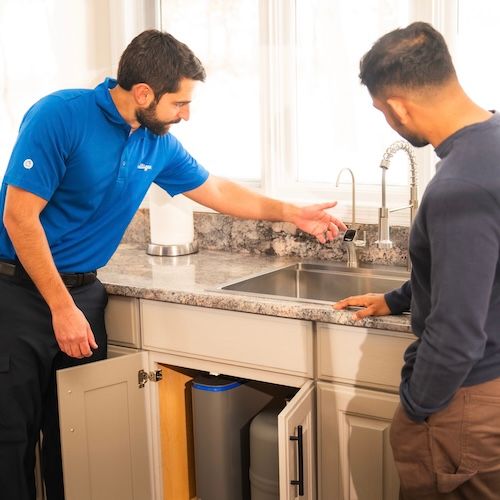
Test at the tap. This is the only way to know your own number, and it is the only option for a well. A free in-home test from Culligan of Escondido measures hardness, chlorine, total dissolved solids, pH and iron in about 20 minutes, and the technician can tell you what size softener the result calls for. Hardness strips from a hardware store give a rough band but are not accurate enough to size equipment. Learn about water testing in Escondido.
Frequently asked questions about Escondido water hardness
How many grains per gallon is Escondido water?
About 12.3 to 13.5 grains per gallon, based on the 210 to 230 mg/L the City of Escondido reported for 2025. Anything above 10.5 grains is very hard. Vista Irrigation District’s range of 3.2 to 18.1 grains reflects how much desalinated and imported water is in the blend, and well water in the surrounding hills can run higher.
Does the City of Escondido soften the water?
No. The Escondido-Vista plant treats for health and safety and adds fluoride, but it does not remove calcium or magnesium, and neither does any other district in North County. Softening is done at the home.
Will a filter pitcher or refrigerator filter fix hard water?
No. Carbon filters improve taste and remove chlorine or chloramine, but they do not remove dissolved minerals. A reverse osmosis system at the kitchen sink does remove hardness from drinking water, but only a whole-house softener protects the water heater, showers and appliances.
Do San Marcos, Vista and Poway have the same problem?
Yes. Vallecitos reports about 226 mg/L, Poway 218 mg/L and Valley Center 230 mg/L. The whole region shares the same imported supply.
Start with a free hard water test from Culligan of Escondido
Culligan Water Conditioning of Escondido has been fixing hard water for homeowners across Escondido, San Marcos, Vista, Oceanside, Poway, Rancho Bernardo, Rancho Peñasquitos, Fallbrook, Bonsall, Valley Center, Pauma Valley and Ramona for decades. Our technicians work every week with homes on City of Escondido, Vista Irrigation District, Vallecitos and Poway water, and with private wells those districts do not reach, so we know the typical grain loads in each area.
When you schedule a free in-home consultation, a local specialist tests your water, walks you through the results and, if a softener makes sense, explains the rental and purchase options so you can choose what fits your home. Softener salt delivery is available throughout our service area.
Ready for better water? Schedule your free in-home water test with Culligan of Escondido today.