Quick answer: Yes. The City of Escondido’s 2025 Water Quality Report shows a system that met every state and federal drinking water standard with no violations, and the city’s inventory found no lead service lines. That is the regulatory answer. The practical answer is that Escondido water is very hard at 215 mg/L, carries about 527 mg/L of dissolved solids, is disinfected with chloramine at an average of 3.1 mg/L, and has a documented seasonal earthy taste from geosmin. None of that is a safety problem; all of it is something you notice. The report also describes water at the plant and in the mains, not after your own pipes, so testing at the tap is how you learn what you are drinking.
Escondido’s water has been treated at the Escondido-Vista Water Treatment Plant since 1976, and people in the Old Escondido Historic District, Felicita, Hidden Meadows and Del Dios drink it every day. Still, “can I drink the tap water?” is one of the first questions we hear from new North County residents, and it comes back every time the water tastes a little off, as it did during a city-acknowledged taste-and-odor episode in September 2025.
Here is what homeowners in Escondido and the surrounding communities of San Marcos, Vista, Poway and Valley Center should know.
What the city’s testing does, and does not, tell you
Federal and California rules regulate more than 90 contaminants, and the City of Escondido tests for all of them on the State Water Resources Control Board’s schedule. The 2025 report shows zero E. coli, arsenic averaging 2 parts per billion against a limit of 10, and trihalomethanes at a highest running average of 48 parts per billion against a limit of 80. That is a well-run system.
Meeting the standard and having nothing to think about are two different things, for three reasons.
First, the standards are set for health and weigh what treatment costs. Hardness, dissolved solids, sodium and taste are “secondary” characteristics with advisory limits or none at all. Escondido’s water is within every one of them and still tastes flat and leaves scale on everything.
Second, the city tests at the plant and in the mains, not at your faucet. Escondido’s inventory found no lead service lines on the city’s side, but a house built before 1986 in the older neighborhoods around Grand Avenue can still have lead solder or brass fittings that the city does not test.
Third, treatment is designed around health, not comfort. Chloramine is in the water on purpose, at 2.8 to 3.4 mg/L leaving the plant, to keep it disinfected across more than 440 miles of pipe. The utility will not remove it, soften the water or filter out the geosmin that algae release into Dixon Lake and Lake Wohlford every warm season.
City water versus well water around Escondido
Inside the City of Escondido and the neighboring districts, a public agency treats and tests the water. Vista Irrigation District shares the Escondido-Vista plant. Vallecitos serves San Marcos with imported water from the Twin Oaks Valley and Skinner plants plus Carlsbad desalinated seawater. Poway treats imported water at its Berglund plant. Valley Center, Rainbow and Fallbrook PUD receive water treated at Metropolitan’s Skinner plant, and Fallbrook adds Santa Margarita River groundwater cleaned with reverse osmosis. Every one of those agencies reported no violations in 2025.
Outside those boundaries, in Valley Center, Pauma Valley, Ramona, the San Pasqual Valley and the hills around Fallbrook and Bonsall, homes run on private wells that nobody tests but the owner. The State Water Board’s sampling of 137 San Diego County domestic wells found coliform bacteria in 26 percent and nitrate over the limit in 18 percent. If you are on a well, see our separate guide to well water in the Escondido area; annual lab testing is the floor.
Where does Escondido’s drinking water come from?
Two places, blended. Local water begins in the Lake Henshaw watershed and the well fields beside it in the upper San Luis Rey valley, flows down the river and the historic Escondido Canal to Lake Wohlford, and then to the treatment plant. Imported water is purchased from the San Diego County Water Authority, which buys Colorado River and Northern California water from the Metropolitan Water District, and is stored in Dixon Lake above the city. The plant disinfects with chloramine, filters, adjusts pH and adds fluoride before the water enters the mains.
That mix is clean in the ways that matter most, but Colorado River minerals and a long trip through open reservoirs each leave a signature. In the Escondido homes we test, these are the issues that show up again and again.
1. Hard water
What homeowners notice: Scale on fixtures and shower glass, spotted dishes, a crusty water heater, dry skin and hair.
What causes it: Calcium and magnesium dissolved from rock, most of it upstream on the Colorado River.
Why it matters: The city reports 210 to 230 mg/L, which is very hard by the USGS scale. It is not a health issue, but scale shortens the life of water heaters, dishwashers and tankless units and raises energy bills, and it is the most common complaint in every community we serve.
How to fix it: A Culligan Aquasential® Smart High Efficiency Water Softener at the point where water enters the home. See softener options for Escondido.
2. Chloramine and disinfection byproducts
What homeowners notice: A chemical or swimming-pool smell, especially in a hot shower. Aquarium owners and home brewers notice it most.
What causes it: Escondido and Vista disinfect with chloramine, a combination of chlorine and ammonia, because it holds up longer in the pipes than chlorine alone. The finished-water residual averaged 3.1 mg/L in 2025, under the 4.0 mg/L maximum. When disinfectant reacts with natural organic matter, it forms trihalomethanes and haloacetic acids.
Why it matters: The residual is normal and necessary. The byproducts are worth watching: trihalomethanes reached 48 parts per billion as a running average against the 80 limit, haloacetic acids 20 against 60. Both comply, but the limits exist because of long-term exposure, which is why many households remove them at home.
How to fix it: Chloramine does not off-gas the way chlorine does, so it needs catalytic carbon with real contact time. A whole-house carbon filter removes it from every tap and shower, and a reverse osmosis system handles drinking water. See filtration options for Escondido.
3. Earthy taste and odor from geosmin
What homeowners notice: A musty, dirt-like or lake-water taste that comes and goes, often in late summer and fall.
What causes it: The city’s report attributes most taste-and-odor complaints to geosmin, released by algae in open reservoirs such as Dixon Lake and Lake Wohlford, together with natural organic carbon of 1.4 to 4.0 mg/L. In September 2025 the city posted a notice about a temporary taste-and-odor issue in the imported water, confirmed it was safe to drink and adjusted plant processes to shorten it.
Why it matters: Geosmin is harmless, but people can taste it at a few parts per trillion.
How to fix it: Activated carbon removes geosmin well. A whole-house carbon filter or a reverse osmosis system with carbon stages at the kitchen sink both solve it.
4. Dissolved solids, sodium and a flat mineral taste
What homeowners notice: Water that tastes flat or faintly salty, white residue when a pot boils dry, coffee and tea that taste dull.
What causes it: Colorado River water is naturally mineral-rich. The city reported total dissolved solids of 463 to 631 mg/L, averaging 527, with sodium averaging 88 mg/L, chloride 91 mg/L and sulfate 173 mg/L.
Why it matters: All are under California’s secondary limits. But 527 mg/L of dissolved solids is well above what most people call good-tasting water, and people on sodium-restricted diets may want the sodium number for their own tap.
How to fix it: Reverse osmosis is the only common household treatment that removes dissolved salts. Culligan’s Aquasential® Smart Reverse Osmosis or the compact Aquasential® Tankless RO at the kitchen sink handles drinking and cooking water. A softener does not remove dissolved solids.
5. Lead and copper from household plumbing
What homeowners notice: Nothing. Lead has no taste, smell or color.
What causes it: Water leaves the plant without lead and the city found no lead service lines. Lead comes from the last stretch of pipe in a home: solder joints, brass valves and fixtures in houses built before 1986, which describes much of central Escondido and older parts of Vista and San Marcos.
Why it matters: In June 2024 the city sampled 57 homes and found 90th-percentile lead below 5 parts per billion, with no home over the 15 ppb action level. That is reassuring, but results differ house by house because the source is the house. Infants, young children and pregnant women are the most sensitive.
How to fix it: Culligan’s Aquasential® Smart Reverse Osmosis System is certified to reduce lead by 99.7 percent. If your home predates 1986 and still has original plumbing, a lab test for lead is inexpensive insurance.
6. PFAS
What homeowners notice: Nothing. PFAS have no taste, smell or color.
What causes it: Manufactured chemicals from firefighting foam, nonstick coatings and industrial processes.
Why it matters: The published numbers here are good. Escondido’s 2025 report lists only PFBA, an unregulated compound, at not detected to 6 nanograms per liter with an average of not detected. Vista Irrigation District detected no PFAS in its PFOA and PFOS monitoring, and Fallbrook PUD found none of 29 PFAS compounds in its 2023 to 2025 federal sampling.
How to fix it: For households that want a barrier regardless of current results, Culligan’s Aquasential® Smart Reverse Osmosis with Total Defense is certified to reduce total PFAS by more than 99.99 percent, and the Whole Home PFAS Water Filter is certified to reduce total PFAS by more than 99 percent.
How to check your water quality in Escondido
Read the report. The City of Escondido’s annual Water Quality Report is posted at escondido.gov. Vista, Vallecitos, Poway, Valley Center, Rainbow and Fallbrook publish their own. Each describes the system, not your faucet.
Watch for the signs. Scale and spots, a chloramine smell in the shower, a musty taste in late summer, a flat mineral taste and dry skin are the usual ones. A metallic taste or blue-green staining points at household copper, not the utility.
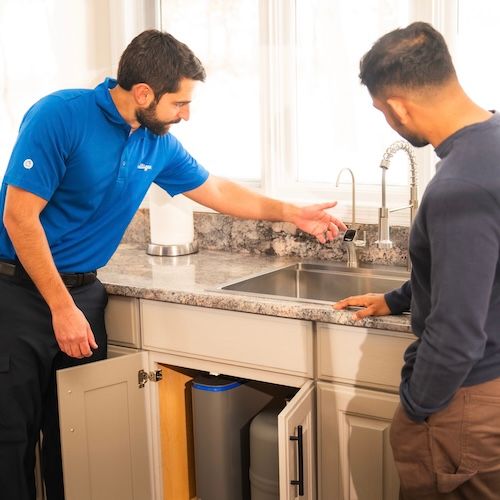
Test at the tap. A free in-home test from Culligan of Escondido measures hardness, chlorine, total dissolved solids, pH and iron in about 20 minutes. For lead, nitrate, arsenic, bacteria or PFAS, we send a sample to a certified laboratory. Testing is especially worthwhile on a private well, in a pre-1986 home, with a newborn in the house, or when the water’s taste or smell has changed. Learn about water testing in Escondido.
Schedule your free water test with Culligan of Escondido
You should not have to guess about the water your family drinks. Culligan Water Conditioning of Escondido has helped homeowners across Escondido, San Marcos, Vista, Oceanside, Poway, Rancho Bernardo, Rancho Peñasquitos, Fallbrook, Bonsall, Valley Center, Pauma Valley and Ramona understand and improve their water for decades, from our office on Gannon Place. We also deliver bottled water and set up coolers for homes and businesses across North County. Our experts test your water, explain the results plainly and, if treatment makes sense, lay out rental and purchase options.
Ready for better water? Schedule your free in-home water test with Culligan of Escondido today.
Frequently asked questions about Escondido tap water
Can I drink Escondido tap water straight from the faucet?
Yes. The City of Escondido’s 2025 report shows no violations of any state or federal standard and no lead service lines in the system. Taste, hardness and your own home’s plumbing are the variables the report cannot cover.
Why does Escondido water sometimes taste like dirt or a lake?
Geosmin, a harmless compound from algae in Dixon Lake, Lake Wohlford and the imported supply. The city names it as the main source of taste-and-odor complaints, and carbon filtration removes it.
Does Escondido use chlorine or chloramine?
Chloramine, averaging 3.1 mg/L leaving the plant in 2025. It is more stable than free chlorine, which is why a pitcher left in the refrigerator does not lose the smell. Catalytic carbon filtration removes it.
Is there fluoride in Escondido water?
Yes. The city adds fluoride at the plant and reported an average of 0.64 mg/L in 2025, well below the 2.0 mg/L limit. Reverse osmosis removes it from drinking water if you prefer.