Quick answer: Private well water in the Bellflower area can be safe to drink with laboratory testing and, where needed, treatment, but the honest first point is that almost nobody here has one. Bellflower, Long Beach and the Gateway Cities sit on the Central Basin, a groundwater basin so heavily used that a court judgment allocates every acre-foot pumped from it, and the 151 parties to that judgment are cities, water companies, school districts, cemeteries and industrial firms rather than homeowners. The few private wells that remain draw from the same aquifers the utilities use, and those aquifers are very hard and, in places, carry PFAS, arsenic, manganese and 1,4-dioxane. If you own one of those wells, no one is testing it but you.
Municipal water vs. private wells in Los Angeles County
Public water systems are regulated by the State Water Resources Control Board’s Division of Drinking Water and publish an annual Consumer Confidence Report. A private well is covered by none of that; California’s rules focus on how a well is built and sealed, not on what comes out of it over time. In Los Angeles County, the Department of Public Health’s Drinking Water Program reviews and approves new production and non-production wells and permits small water systems with fewer than 14 connections, everywhere in the county except Long Beach, Pasadena and Vernon, which run their own environmental health departments.
There is a second layer here that most of the country does not have. The Central Basin and the neighboring West Coast Basin are adjudicated: a court settled who may pump how much, and a Watermaster tracks it. The Water Replenishment District of Southern California’s 2024–25 report counts 151 parties, 117 rights holders and 62 active pumpers in the Central Basin, pumping 168,966 acre-feet that year. Drilling a new residential well in Bellflower is therefore not a matter of hiring a rig; it involves a county permit and the basin’s pumping rules.
Where Bellflower-area groundwater comes from and why it is engineered
Beneath Bellflower, Lakewood, Downey, Norwalk and Cerritos lie the sand and gravel aquifers of the Central Basin; beneath Torrance, Carson, Gardena, Inglewood and the beach cities lies the 160-square-mile West Coast Basin. Together they supply nearly half of the drinking water for the four million people in the southern half of Los Angeles County, according to the Water Replenishment District.
That did not happen without intervention. By 1940, coastal wells were being abandoned because seawater had pushed inland into the aquifers as water levels fell from heavy pumping, and a 1943 study by the U.S. Geological Survey and the Los Angeles County Flood Control District concluded that artificial recharge was the only economical fix. The result is a system that few residents know is there:
Three seawater intrusion barriers. Lines of injection wells along the coast pump fresh water into the aquifer to hold the ocean back. The West Coast Basin Barrier grew out of a 1950s pilot in Hermosa Beach. The Dominguez Gap Barrier, along the Dominguez Channel in Wilmington and Carson, began operating in 1971 with 41 injection wells and 107 observation wells over 12 miles. The Alamitos Barrier, about two miles inland from the mouth of the San Gabriel River near the Los Angeles–Orange county line, was built in 1964 with the Orange County Water District and has 43 injection wells and 226 observation wells. The Los Angeles County Flood Control District operates them; WRD buys the water, which is now mostly recycled: 75 percent at the West Coast Basin Barrier, and 1,668 of the 3,153 acre-feet injected at Alamitos in 2024–25.
Spreading grounds. At the Montebello Forebay in Pico Rivera, WRD and the county percolate stormwater and purified recycled water into the ground to refill the Central Basin: 94,938 acre-feet in 2024–25, 55,454 of it recycled, including 10,124 acre-feet from the Albert Robles Center completed in 2019. WRD has bought no imported water for recharge for six straight years.
What groundwater here contains: the public-supply wells as a guide
Because utilities must publish results from their own Central and West Coast Basin wells, we have a detailed picture of what any private well in the same formations might encounter. These are the issues Culligan of Bellflower treats most often, drawn from the 2025 reports.
1. Hardness
What homeowners notice: Heavy scale on fixtures and inside water heaters, spotted glassware, stiff laundry, dry skin.
What causes it: Calcium and magnesium dissolved from the basin’s sediments.
Why it matters: Raw groundwater here ranges from hard to extremely hard. Liberty Utilities’ Bellflower wells tested at 250 to 260 ppm (about 15 grains per gallon); Golden State Water’s Bellflower-Norwalk sources ranged up to 505 mg/L (30 gpg); Cal Water’s Hermosa-Redondo wells pumped water at 486 to 517 ppm, roughly 28 to 30 gpg, before blending; The USGS classifies anything over 180 mg/L as very hard.
How to fix it: Culligan’s Aquasential® Smart High Efficiency Water Softener, sized to the tested hardness. Where manganese or iron is also present, the Softener-Cleer combination unit handles both.
2. PFAS
What homeowners notice: Nothing; PFAS are undetectable without a lab.
What causes it: Decades of industrial activity, firefighting foam and consumer products across the Los Angeles Basin, now present in groundwater.
Why it matters: Liberty’s Bellflower-area wells showed PFOS at 25 to 61 parts per trillion and PFOA at 3.1 to 16 ppt in 2025. Downey’s wells reported PFOS up to 42 ppt and PFOA up to 15 ppt. California’s notification levels are 6.5 ppt for PFOS and 5.1 for PFOA, and the federal 4 ppt standard phases in through 2029 to 2031. Utilities blend and plan treatment; a private well cannot.
How to fix it: The Aquasential® Smart Reverse Osmosis System with Total Defense is certified to reduce total PFAS by more than 99.99 percent; the Whole Home PFAS Water Filter is certified to reduce total PFAS by more than 99 percent.
3. Arsenic
What homeowners notice: Nothing. Arsenic has no taste, odor or color.
What causes it: Natural minerals in the basin’s deeper sediments.
Why it matters: Cerritos groundwater averaged 7.4 micrograms per liter in 2025 with a high of 9.9, and Lakewood averaged 6.0 with a high of 9.9, both under the 10 µg/L limit but close to it.
How to fix it: Reverse osmosis at the kitchen tap for drinking and cooking water, with the system configured for arsenic.
4. Manganese and iron
What homeowners notice: Gray or tea-colored water, black or rust stains in toilets and on laundry, a metallic taste.
What causes it: Naturally occurring metals in the aquifer that oxidize when the water reaches air.
Why it matters: Cerritos reported manganese averaging 56 µg/L, above the 50 µg/L secondary standard at one well before blending; Torrance’s West Coast Basin wells ran 42 to 48 µg/L; Liberty’s Compton wells 38. Cal Water’s Hermosa-Redondo system runs wellhead treatment specifically for iron and manganese. These are aesthetic standards, but a private well has no wellhead plant.
How to fix it: Culligan’s Iron-Cleer® or Iron-OX5 whole-house filter, or the Softener-Cleer where hardness is also high.
5. Salinity, chloride and TDS
What homeowners notice: A salty or flat taste, white residue that is not quite scale, corroded fixtures.
What causes it: Historic seawater intrusion near the coast, plus the naturally high mineral content of Colorado River water that has recharged the basin for decades.
Why it matters: Torrance’s wells reported chloride of 81 to 160 mg/L and total dissolved solids of 630 to 760 mg/L. The secondary standards are 500 mg/L for chloride and 1,000 mg/L for TDS, so these are within limits, but they are high enough to taste and to drive the salty complaints we hear in Torrance and Carson.
How to fix it: Reverse osmosis is the only residential treatment that removes dissolved salts. The Aquasential® Smart RO or Tankless RO at the sink covers drinking and cooking water.
6. Bacteria
What homeowners notice: Usually nothing; sometimes illness after heavy rain.
What causes it: Surface water entering a well through a cracked casing, poor seal or low wellhead, particularly during winter storms when the Los Angeles and San Gabriel river channels run high.
Why it matters: Total coliform indicates a pathway for pathogens; E. coli indicates sewage or animal waste. If either appears, stop drinking untreated water and contact Los Angeles County Public Health’s Drinking Water Program (or Long Beach’s health department inside that city).
How to fix it: Repair the well, disinfect and retest. For ongoing protection, UV disinfection at the point of entry, and for drinking water the Aquasential® Smart RO with Advanced Post Tank Filter, certified under NSF Protocol P231 to reduce bacteria by more than 99.9999 percent.
How to check your well water quality in the Bellflower area
Look for signs. Scale, dark stains, salty taste and cloudy water after storms all point to something worth measuring.
Use the public records. The State Water Board’s Drinking Water Watch database shows results from every public-supply well near you. Los Angeles County Public Health’s wells and small water systems page covers permitting, and the Water Replenishment District publishes basin reports.
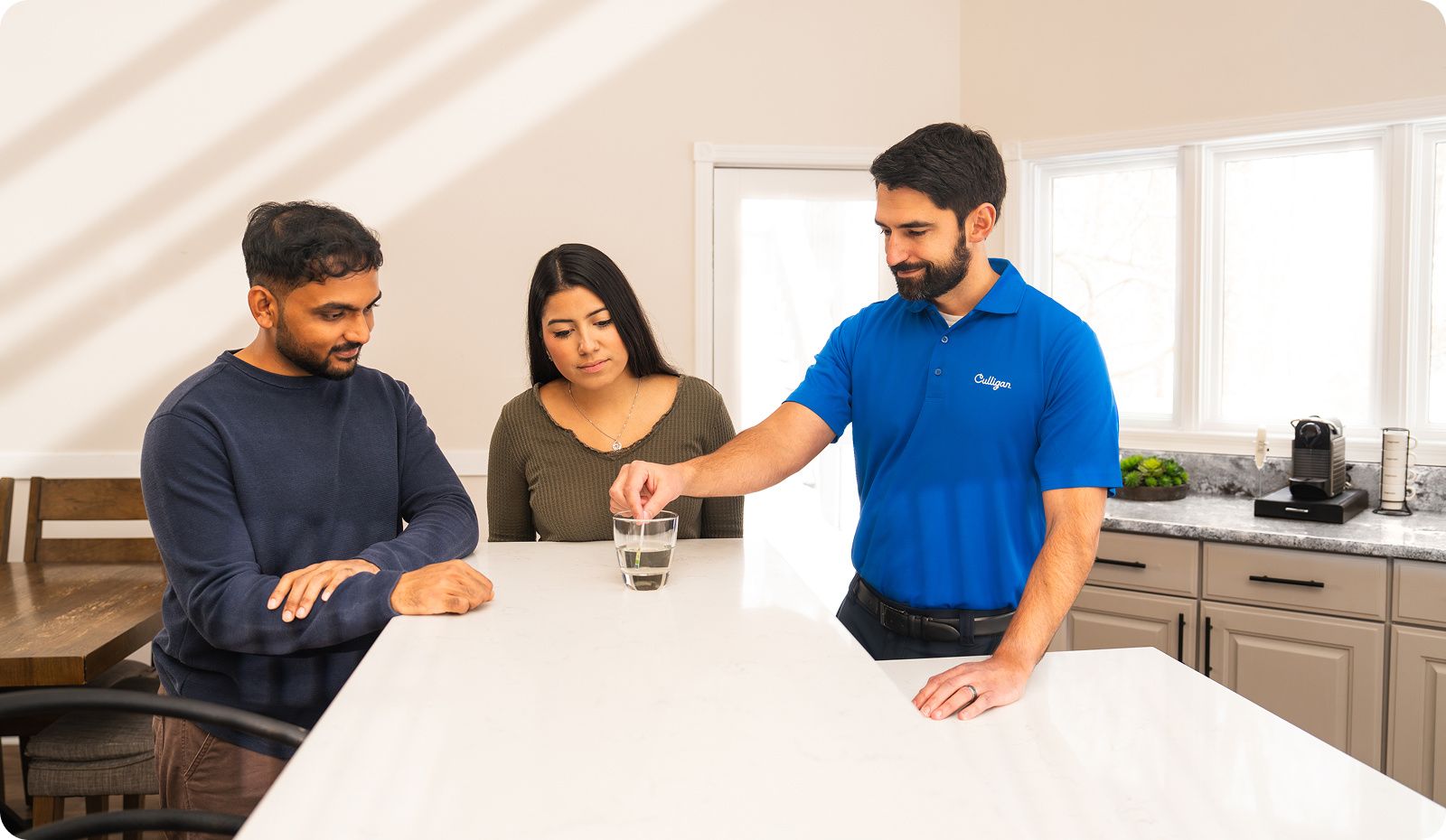
Test on a schedule. The EPA recommends annual testing for total coliform, nitrate, total dissolved solids and pH. In this basin, add PFAS, arsenic, manganese and 1,4-dioxane to the first test and repeat them every few years. Test immediately after flooding, after any work on the well or pump, if taste or appearance changes, or if a pregnant household member or infant will drink the water. Culligan of Bellflower’s free in-home test covers hardness, chlorine, TDS, pH and iron on the spot, and we collect samples for certified laboratory analysis of everything else. Details are on our Bellflower water testing page.
Frequently asked questions about private wells in the Bellflower area
Where does Bellflower’s well water come from?
From the Central Basin, the layered sand and gravel aquifers beneath the Gateway Cities, recharged at the Montebello Forebay spreading grounds in Pico Rivera with stormwater and recycled water. West of the Newport-Inglewood uplift, Torrance, Carson and the beach cities draw from the West Coast Basin. Both are protected from the ocean by injection barriers.
Can I drill a private well in Bellflower or Long Beach?
Rarely in practice. Both basins are adjudicated, so pumping is governed by court judgment and tracked by a Watermaster, and any new well needs approval from Los Angeles County Public Health’s Drinking Water Program, or the Long Beach health department inside Long Beach. Most households are better served by treating utility water.
How often should a private well near Downey or Lakewood be tested?
Annually for coliform bacteria, nitrate, TDS and pH, plus a baseline test for PFAS, arsenic, manganese and 1,4-dioxane given what the nearby public wells show, and again after flooding or any well repair.
Why does well water in Torrance taste salty?
Torrance’s West Coast Basin wells report chloride of 81 to 160 mg/L and TDS near 700 mg/L, reflecting both historic seawater intrusion and the mineral-rich Colorado River water that has recharged the basin. Reverse osmosis removes the salts from drinking water.
Local well water expertise from Culligan of Bellflower
Culligan of Bellflower has worked on the water of the Gateway Cities, Long Beach and the South Bay for decades: Bellflower, Lakewood, Downey, Norwalk, Cerritos, Whittier, Compton, Carson, Torrance, Redondo Beach, Manhattan Beach, Gardena, Inglewood and Culver City. Most of that work is on utility water, and because the utilities pump from the same aquifers, we know what this basin’s groundwater does to a home. When a private well does come our way we start with a laboratory test and design treatment around what it finds, from softening and iron and manganese filtration to reverse osmosis and UV; see our Bellflower well water solutions page and water filtration page.
Ready for better well water? Schedule your free in-home water test and consultation with Culligan of Bellflower today.