Quick answer: Water quality varies from home to home, but by the regulatory yardstick Bellflower’s tap water is safe to drink. Liberty Utilities, which serves most of Bellflower, Norwalk and Artesia, states in its 2026 Consumer Confidence Report that no contaminant exceeded a federal or state drinking water standard during 2025, and Golden State Water says the same for its Bellflower-Norwalk system. Liberty’s Central Basin wells carry PFOS, PFOA and PFHxS above California’s notification levels, one well contains 1,4-dioxane above the state’s notification level, the disinfectant residual is high enough to taste and the water is very hard. None of those is a violation; all of them are things a homeowner may want to know about and can do something about.
If you get a bill from Liberty Utilities or Golden State Water, your water is treated, tested and reported on every year. Most people still want to know what, exactly, is in it. Here is what homeowners across Bellflower, the Gateway Cities, Long Beach and the South Bay should know, and what we see most often after decades of working on these systems.
What municipal water testing does, and does not, tell you
The U.S. Environmental Protection Agency sets enforceable limits for more than 90 contaminants, and California’s State Water Resources Control Board Division of Drinking Water enforces those plus a set of stricter or additional state standards. Liberty Utilities and Golden State Water test against both. There are three reasons compliance is a floor and not a ceiling.
First, limits balance health against cost and treatment feasibility. California’s notification levels for PFOS (6.5 parts per trillion), PFOA (5.1 ppt) and PFHxS (3 ppt) are health-based advisories, not enforceable limits, and the federal 4 ppt standard for PFOS and PFOA does not require compliance until later this decade. Liberty’s wells are above all three notification levels today without being out of compliance.
Second, utilities sample at the source and at selected points in the system. The report cannot account for the service line and plumbing that carry water the last hundred feet into a 1950s Bellflower tract house or a Long Beach bungalow. Lead, if it is present, almost always enters there.
Third, treatment targets health risks, not comfort. Hardness, chlorine taste, chloramine odor and total dissolved solids are not health standards, so no utility in the area removes them.
Municipal water vs. private well water in the Gateway Cities
This part is short because private wells are a rarity here. The Central Basin under Bellflower is managed under a court judgment that allocates pumping among 151 parties, and the Water Replenishment District’s 2024–25 Watermaster report lists cities, water companies, school districts, cemeteries and industrial users among them, not households. Los Angeles County Public Health’s Drinking Water Program permits wells in the county (Long Beach runs its own program), and the few private wells that exist tend to be on nurseries, institutional campuses or older industrial parcels. If you own one, the testing and treatment are entirely on you, and our Bellflower well water page covers what that involves.
Where does Bellflower’s drinking water come from?
Liberty Utilities drew 62 percent of its 2025 supply from the Metropolitan Water District of Southern California and 38 percent from its own wells in the Central Basin. The MWD water is a blend of Colorado River and State Water Project water treated at the Diemer Filtration Plant; the groundwater is pumped from beneath the Gateway Cities and disinfected with chlorine before it enters the pipes. Golden State Water’s Bellflower-Norwalk system uses the same two sources. The Central Basin itself is recharged at the Montebello Forebay spreading grounds with local stormwater and recycled water, and the Water Replenishment District reports it has bought no imported water for recharge in six years.
Across our wider service area the picture shifts: Lakewood, Downey and Cerritos pump nearly all of their water from local wells; Long Beach blends 71 percent groundwater with 29 percent MWD water at its Groundwater Treatment Plant; Torrance and Cal Water’s South Bay systems lean on MWD water with local wells; and Golden State’s Culver City system is entirely imported. Issues we see most often:
1. Chlorine and chloramine
What homeowners notice: A swimming-pool taste or smell at the tap and in the shower, especially in summer, and a flat taste in coffee and tea.
What causes it: Liberty adds free chlorine to its well water, and the MWD water that makes up most of the supply arrives disinfected with chloramine, a chlorine-ammonia compound chosen because it persists through long pipelines. Liberty’s distribution residual averaged 2.0 ppm in 2025; Long Beach Utilities reported a chloramine residual ranging up to 2.84 ppm; Golden State’s Southwest system averaged 2.4 ppm.
Why it matters: The residual protects against bacteria between the plant and your home, and these levels are within the 4.0 ppm limit. Chloramine, however, is harder to remove than free chlorine, so an ordinary carbon filter works slowly on it.
How to fix it: For drinking water, Culligan’s Aquasential® Smart Reverse Osmosis System includes carbon stages ahead of the membrane. For the whole house, the Aquasential® Smart HE Water Filter can be built with catalytic carbon, which handles chloramine at normal household flow rates.
2. PFAS in Central Basin groundwater
What homeowners notice: Nothing. PFAS have no taste, odor or color.
What causes it: Decades of industrial use, firefighting foam and consumer products put these persistent compounds into soil and groundwater. The Central Basin’s wells now show them.
Why it matters: Liberty Utilities’ 2026 report lists PFOS at 25 to 61 ppt (average 38), PFOA at 3.1 to 16 ppt (average 10.3) and PFHxS at 5.9 to 9.4 ppt in its well sources, with no detections in the MWD portion. Downey’s wells reported PFOS up to 42 ppt and Lakewood’s Well 18 reported 18.2 ppt. Long Beach Utilities, by contrast, reports no PFAS detections in either of its zones. The federal limit of 4 ppt for PFOS and PFOA phases in through 2029 to 2031, and utilities are planning treatment, but today the well water in Bellflower exceeds California’s advisory levels.
How to fix it: Culligan’s Aquasential® Smart Reverse Osmosis System with Total Defense is certified to reduce total PFAS by more than 99.99 percent. For every tap in the house, the Whole Home PFAS Water Filter is certified to reduce total PFAS by more than 99 percent.
3. Hard water
What homeowners notice: White spots on glassware, crust on faucets, film on shower doors, a rumbling water heater and soap that will not lather.
What causes it: Calcium and magnesium dissolved from rock and soil. Both of Bellflower’s sources are rich in them.
Why it matters: Liberty reports 191 to 280 ppm (11.1 to 16.3 grains per gallon) in its MWD water and 250 to 260 ppm (about 15 gpg) in its wells; Golden State’s Bellflower-Norwalk system averages 18 gpg. The USGS calls anything above 180 ppm very hard. Scale shortens the life of water heaters and dishwashers, raises energy use and makes cleaning a chore. Our Bellflower water softeners page goes deeper.
How to fix it: A whole-house softener such as Culligan’s Aquasential® Smart High Efficiency Water Softener, sized to your tested hardness.
4. 1,4-dioxane
What homeowners notice: Nothing. It is colorless and essentially odorless at these concentrations.
What causes it: 1,4-dioxane was used as a stabilizer in industrial solvents and has migrated into groundwater in parts of the Los Angeles Basin.
Why it matters: Liberty found it in one active Bellflower-area well at 1.1 to 2 parts per billion in 2025, above California’s 1 ppb notification level but below the 10 ppb response level at which the state recommends removing a well from service. The utility notified the Bellflower, Norwalk and Artesia city councils and the Los Angeles County Board of Supervisors on May 9, 2025. It is not a violation, and the well is blended with other sources.
How to fix it: Reverse osmosis reduces 1,4-dioxane in drinking water; granular carbon alone is much less effective. The Aquasential® Smart RO or the Aquasential® Tankless RO at the kitchen sink is the practical option.
5. Lead from household plumbing
What homeowners notice: Nothing. Lead cannot be seen, smelled or tasted.
What causes it: Lead solder, brass fixtures and old galvanized pipe inside homes built before 1986. Golden State Water, Cal Water, the City of Downey and Long Beach Utilities all report that their inventories found no lead service lines, so the risk is inside the house.
Why it matters: Liberty’s 2025 sampling of 31 homes found a 90th-percentile lead level of 0.0019 ppb, and Long Beach’s 63-tap sampling was below the detection limit. Those are reassuring system numbers, but Golden State’s Culver City system reported a 90th percentile of 6.2 ppb, which shows how much plumbing age matters. Bellflower, Downey and Lakewood have a great deal of 1940s-to-1960s housing stock.
How to fix it: A laboratory test of your own first-draw water is the only way to know. Culligan’s Aquasential® Smart Reverse Osmosis System is certified to reduce lead by 99.7 percent.
How to check your home’s water quality in Bellflower
Read the report. Liberty Utilities’ Consumer Confidence Report is posted at california.libertyutilities.com; Golden State Water’s Bellflower-Norwalk report is at gswater.com/norwalkCCR; Long Beach Utilities’ reports are at lbutilities.org. The State Water Board’s Drinking Water Watch database has statewide results. These describe the system, not your tap.
Watch for signs at home. White scale on fixtures, spotted glassware, a pool smell from the shower, cloudy or tinted water after street work, dark toilet-bowl stains, or dry skin and hair after bathing. None of these is a health alarm, but each points to something treatable.
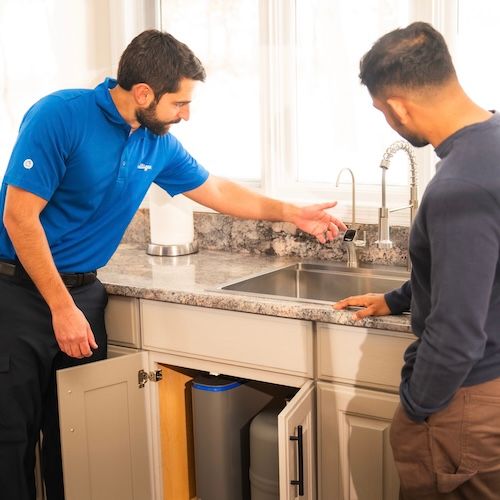
Test the water itself. Culligan of Bellflower’s free in-home test measures hardness, chlorine, total dissolved solids, pH and iron in about 20 minutes. For lead, PFAS, 1,4-dioxane, nitrate or arsenic we collect a sample for a certified laboratory. Testing is especially worthwhile if your home was built before 1986, if you are on Liberty or Golden State well-heavy parts of the system, if someone in the home is pregnant or an infant, or if the taste or look of the water has changed. Our Bellflower water testing page explains both options.
Frequently asked questions about Bellflower tap water
Is Bellflower tap water safe to drink straight from the tap?
By the regulatory standard, yes. Liberty Utilities and Golden State Water both report no exceedances of federal or state standards for 2025. Well water in the blend does carry PFAS above California notification levels and 1,4-dioxane in one well, and hardness is very high, so many households add reverse osmosis for drinking water and a softener for the house.
Why does my Bellflower water taste like chlorine?
Liberty chlorinates its well water and buys chloraminated water from MWD, with a combined residual averaging about 2 ppm in 2025. A reverse osmosis system removes it from drinking water; a whole-house catalytic carbon filter removes it everywhere.
Is there still fluoride in Bellflower’s water?
Liberty Utilities stopped adding fluoride in October 2025, but because most of its supply is fluoridated MWD water, the report says taps still receive about 0.3 to 0.7 mg/L. Reverse osmosis removes most fluoride for those who want it out.
Does Liberty Utilities soften Bellflower’s water?
No. Hardness is not a drinking water standard and no utility in the Gateway Cities or South Bay removes it. Homes that want soft water install their own softener.
Schedule your free water test with Culligan of Bellflower
You should not have to guess about what comes out of your faucet. Culligan of Bellflower has helped homeowners throughout Bellflower, Lakewood, Downey, Norwalk, Cerritos, Whittier, Compton, Long Beach, Carson, Torrance, Redondo Beach, Manhattan Beach, Gardena, Inglewood and Culver City understand and improve their water for decades. Our technicians test, explain the results in plain terms and, if treatment makes sense, walk you through rental and purchase options with a written quote.
Ready for better water? Schedule your free in-home water test with Culligan of Bellflower today.