Quick answer: It depends on which pipe feeds your house. Indian River County sits on two aquifers, and raw groundwater from both carries dissolved calcium and magnesium. The City of Vero Beach and Indian River County Utilities each reduce hardness at the plant, but neither publishes a finished-water hardness number and neither removes the minerals completely. Private wells in Fellsmere, Wabasso, Gifford and the rural west county get the aquifer as it comes, and the county’s own data puts untreated Upper Floridan water at roughly 19 to 20 grains per gallon, which is very hard. A free in-home test is the only way to learn the number at your tap.
Hard water does not announce itself. It shows up as a white ring at the base of the kitchen faucet, a haze on the shower door that returns a day after you squeegee it, spotted glassware and a water heater that rumbles when it fires. If you have noticed two or three of those in a Vero Beach home, calcium and magnesium are almost certainly the reason. Here is where that hardness comes from, how the local utilities handle it, what a private well changes and how to find out what you actually have.
Two aquifers, two utilities, three kinds of water in Vero Beach
Every drop of public water in Indian River County starts underground. The City of Vero Beach Water & Sewer Department operates 21 surficial aquifer wells, 80 to 140 feet deep near the airport, and six Floridan aquifer wells drilled 570 to 680 feet down. The shallow water goes to a lime-softening plant, which the city’s 2025 Water Quality Report describes as treatment “to reduce color and hardness.” The deep Floridan water is salty and mineral-heavy, so it runs through reverse osmosis membranes that remove “salts and hardness causing minerals.” The two finished streams are blended, disinfected with chloramines and sent out across Vero Beach and onto the barrier island along A1A.
Indian River County Utilities, which supplies Sebastian, Gifford, Wabasso and most of the unincorporated county, works differently. Its Hobart and Oslo plants pump the Upper Floridan Aquifer through 16 wells, run about 80 percent of it through nanofiltration membranes and blend 10 to 20 percent raw water back in. The county’s 2023 plant evaluation lists the raw water at 828 to 896 mg/L total dissolved solids with calcium near 55 mg/L and magnesium at 46 to 50 mg/L; work the arithmetic and untreated Floridan water comes out around 325 to 345 mg/L as calcium carbonate, or 19 to 20 grains per gallon. The same document sets a finished-water hardness operating goal of 75 to 130 mg/L, roughly 4 to 8 grains per gallon. That is a plant target, not a reading at your sink, and it means county water still arrives with hardness in it.
The City of Fellsmere, the third public system, draws from four surficial aquifer wells and likewise reports no hardness value. Hardness is not a health standard, so no rule requires any utility to publish it. If you want the number for your tap in Vero Beach, Sebastian or Indian River Shores, you have to measure it there.
Private wells around Vero Beach: the aquifer, unfiltered
Roughly 4,500 Indian River County residents drew household water from their own wells in the most recent USGS county survey, and the Florida Department of Health’s 2023 parcel inventory flags about 7,600 parcels, just under one in ten, as known or likely wells, most of them west of Vero Beach and around Fellsmere and Wabasso.
A private well gets none of the lime softening, membranes or blending described above. A deep Floridan well delivers something close to the 19 to 20 grains per gallon the county measures in its raw supply, often with iron and hydrogen sulfide riding along. A shallower surficial well usually carries less hardness but picks up iron and tannin color. No utility tests or treats any of it; the homeowner does.
What hard water does to a Vero Beach home
Hardness will not make anyone sick. It will shorten appliance life and quietly cost money every month. These are the complaints we hear most across Indian River County.
1. Scale in the water heater and dishwasher
What homeowners notice: A water heater that pops and rumbles, takes longer to recover and runs up the electric bill; a dishwasher with clogged spray arms; a showerhead losing flow.
What causes it: Heat drives dissolved calcium and magnesium out of solution, and they harden into scale on the hottest surfaces first: the heating element, the tank floor and the hot-water lines.
Why it matters: Scale on an element works like insulation, so the heater burns more energy and fails early. On a Floridan well near 20 grains per gallon, that layer forms fast; on blended city water it accumulates year after year.
2. Film on glass and residue on fixtures
What homeowners notice: Cloudy shower doors, spotted glassware, a white crust around the faucet base and on the aerator, soap scum on grout.
What causes it: Minerals react with soap to form a sticky curd instead of lather, and the same minerals are left behind when droplets evaporate. Indian River County’s plant evaluation notes customer complaints about a whitish precipitate and milky-looking water tied to its pipe-protection chemistry, which compounds the effect in county-served homes.
Why it matters: Beyond scrubbing, hard-water households burn through noticeably more detergent, shampoo and dish soap.
3. Dry skin, flat hair, stiff laundry
What homeowners notice: Skin that feels tight after a shower, hair that never feels rinsed, towels that come out of the dryer rough.
What causes it: Soap cannot fully lather or rinse in hard water, so a film of minerals and product stays on skin, hair and fabric.
Why it matters: That film blocks moisture, which is why the bathroom is where people notice softened water first, often within a couple of weeks.
A whole-house softener such as Culligan’s Aquasential® Smart High Efficiency Water Softener removes the calcium and magnesium where water enters the home, so the heater, the dishwasher, the laundry and every shower run on soft water. Well homes with iron in the mix often pair the softener with an Iron-Cleer® filter or use a Softener-Cleer unit that handles both. Compare the options on our Vero Beach water softeners page.
How to find out how hard your water is in Vero Beach
There are three ways to check, and only one gives you a number you can size equipment with.
Read the utility’s annual report. The City of Vero Beach posts its Water Quality Report at covb.org, and Indian River County Utilities posts its reports at indianriver.gov. Both explain the treatment process but neither prints a hardness figure.
Look for the signs. Scale on the showerhead, spots that survive the rinse cycle, soap that will not lather and a noisy water heater together point to hard water. They cannot tell you how hard.
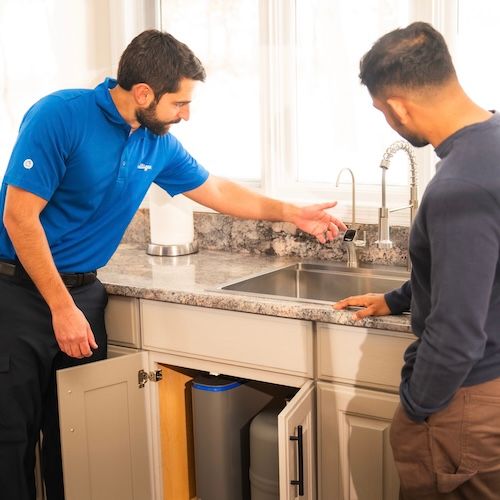
Test at your own tap. This is the step that matters. Because both utilities blend treatment streams, two homes a few miles apart can read differently, and a well in Fellsmere will read nothing like a condo in Indian River Shores. Culligan of Vero Beach’s in-home test is free, takes about 20 minutes and measures hardness in grains per gallon along with chlorine, iron, pH and total dissolved solids. That number sets the softener capacity you need.
FAQs about Vero Beach water hardness
How hard is the water in Vero Beach, FL?
No local utility publishes a finished-water hardness figure. City of Vero Beach water is a blend of lime-softened and reverse-osmosis water; Indian River County water is membrane-treated with an operating goal of 75 to 130 mg/L, about 4 to 8 grains per gallon. Untreated Floridan well water measures roughly 19 to 20 grains per gallon in the county’s raw-water data. A home test gives your specific reading.
Does the City of Vero Beach soften the water?
Partly. The city lime-softens its surficial-well water and runs its Floridan-well water through reverse osmosis, then blends the two. Residual calcium and magnesium remain, which is why scale and spotting still occur in city-served homes. A home softener removes what the plant leaves behind.
Is well water harder than city water around Vero Beach?
Almost always. A Floridan well delivers the raw groundwater the utilities treat, and the county’s measurements put it near 20 grains per gallon. Iron and sulfur often come along, so well homes in Wabasso and Fellsmere usually need a softener and a filter together.
Will a refrigerator or pitcher filter fix hard water?
No. Those filters improve the taste of drinking water and are not designed to remove calcium and magnesium, and they only touch the water you pour through them. Softening the whole home requires an ion-exchange softener at the point of entry.
Start with a free hard water test from Culligan of Vero Beach
Culligan of Vero Beach has been treating Indian River County water for decades, in homes and businesses across Vero Beach, Indian River Shores, Gifford, Wabasso, Sebastian and Fellsmere. Our technicians work on city blended water, county membrane-treated water and untreated wells every week, so we know what each does to a water heater and what size system a house needs.
Schedule a free in-home water test and a local specialist will measure your hardness at the tap, explain the results in plain terms and, if a softener makes sense, walk you through rental and purchase options with a written quote. No obligation; the test answers the question on its own.
Ready for better water? Schedule your free in-home water test and consultation with Culligan of Vero Beach today.