Quick answer: Yes, by the federal definition. The City of Vero Beach’s 2025 Water Quality Report shows no contaminant above a maximum contaminant level, and Indian River County Utilities, which serves Sebastian, Gifford, Wabasso and most of the unincorporated county, reports the same. Both logged paperwork violations for late filings with the state, and the city’s trihalomethane results ran close to the limit, with individual barrier-island samples over it. Meeting standards says nothing about hardness, chloramine taste or what your own plumbing adds, and the city’s reports do not list PFAS results at all. Water that passes is not the same as water you would choose, which is why a test at your tap is worth 20 minutes.
If your Vero Beach water comes from a utility, it was treated and tested before it entered the mains. The rest of this article is about the gap between a compliant system and what comes out of your kitchen faucet, which is where most of the questions we hear in Indian River County actually live.
What utility testing in Vero Beach does and does not tell you
Under the Safe Drinking Water Act, EPA regulates more than 90 contaminants, and every public system in Florida samples for them on a state-set schedule, with results published in an annual Water Quality Report. Three limits of that process matter to a homeowner. First, a maximum contaminant level is a ceiling that balances health against cost and feasibility, not a guarantee the water is free of the substance. Second, compliance samples come from the plant or a handful of distribution points, not your address; the City of Vero Beach’s highest 2025 trihalomethane samples, 103 ppb at Oaks Lane and A1A and 101 ppb at 5099 Highway A1A, were far from the plant because by-products keep forming as water ages in long barrier-island mains. Third, the rules address health, not nuisance. Hardness, chloramine odor, sodium and the film on your shower door are outside the regulatory frame entirely.
Municipal water versus private wells around Vero Beach
A private well is a different situation: no utility treats, samples or reports on it. The USGS put about 4,500 Indian River County residents on household wells in its most recent county survey, and the Florida Department of Health’s 2023 parcel inventory flags roughly 7,600 parcels, just under one in ten, as known or likely wells, mostly west of Vero Beach and around Fellsmere and Wabasso. Those wells draw from the same aquifers without the lime softening, membranes, degasifiers and chlorine, and the state health department recommends testing them for bacteria and nitrate at least once a year. Our well water page covers the specifics, and the water testing page explains the free in-home test and lab options.
Where Vero Beach’s drinking water comes from
All of it is groundwater from two depths. The City of Vero Beach Water & Sewer Department pumps 21 surficial aquifer wells 80 to 140 feet deep near the airport and six Floridan aquifer wells 570 to 680 feet deep. Surficial water goes through lime softening, coagulation, filtration and chloramine disinfection; brackish Floridan water goes through reverse osmosis. The two streams are blended and distributed across the city and onto the barrier island along A1A.
Indian River County Utilities pumps the Upper Floridan Aquifer through 16 wells at its Hobart and Oslo plants, runs about 80 percent of the flow through nanofiltration membranes, blends 10 to 20 percent raw water back in, strips hydrogen sulfide in degasifiers and disinfects with chlorine. The county’s 2023 plant evaluation lists raw water at 828 to 896 mg/L total dissolved solids and 307 to 373 mg/L chloride, both above the 500 and 250 mg/L secondary standards, which is why the membranes are there. The City of Fellsmere runs a small system on four surficial wells with carbon filtration.
Treated to those standards, the water still arrives with characteristics our technicians see every week across the county. These five come up most.
1. Chloramine taste and odor
What homeowners notice: A swimming-pool smell in the shower, a flat chemical taste in tap water and coffee, and a pitcher that never loses the odor in the refrigerator.
What causes it: The City of Vero Beach disinfects with chloramines, chlorine combined with ammonia, at a 2025 running average of 3.13 ppm and a range up to 4.00 ppm, the regulatory maximum. Chloramine is chosen because it persists through long distribution lines, which is exactly why it does not fade in a glass. Each fall the city switches to free chlorine for pipe maintenance; for November 1 through 20, 2026 it posted levels up to 3.5 ppm. Indian River County Utilities uses chlorine at about 1.75 ppm.
Why it matters: Disinfectant keeps the water safe between the plant and your house, so the place to remove it is at the point of use.
How to fix it: Culligan’s Aquasential® Smart Reverse Osmosis System removes chloramine from drinking and cooking water at the kitchen sink; a whole-house carbon filter built for chloramine handles showers and laundry.
2. Disinfection by-products
What homeowners notice: Nothing. Trihalomethanes and haloacetic acids have no taste or smell at these levels.
What causes it: Chloramine and chlorine react with natural organic matter, and the reaction continues as water travels. The City of Vero Beach’s 2025 total trihalomethane average was 74.2 ppb against an 80 ppb limit, with four individual samples between 92 and 103 ppb; the system stayed compliant because each site’s annual average was at or below 80. Indian River County averaged 63.95 ppb, with August samples of 84.6 ppb on Old Dixie Highway and 81.3 ppb at 13180 Highway A1A.
Why it matters: The reports themselves note that long-term exposure to trihalomethanes above the limit may affect the liver, kidneys and nervous system and may raise cancer risk. Homes at the far end of the system, on the barrier island and in north-county neighborhoods, are where single samples ran high.
How to fix it: A reverse osmosis system with carbon stages at the kitchen tap addresses by-products in the water you drink; whole-house carbon filtration covers the rest of the home.
3. Lead from household plumbing
What homeowners notice: Nothing; lead cannot be seen or tasted.
What causes it: Water leaves both plants without lead and can pick it up from older service lines, brass fixtures and solder inside a home. The City of Vero Beach’s 2024 tap sampling produced a 90th-percentile result of 5.0 ppb, under the 15 ppb action level, but one of the roughly 30 homes sampled read 20.0 ppb. The city is inventorying more than 17,000 service lines under the federal lead and copper rule. Indian River County’s 2025 tap results were far below the action level.
Why it matters: Lead risk is house-specific, highest in homes built before the mid-1980s and for infants and pregnant women. The system-wide number cannot tell you about your kitchen.
How to fix it: A certified lab test of a first-draw sample settles the question. Culligan’s Aquasential® Smart Reverse Osmosis System is certified to reduce lead by 99.7 percent.
4. Hardness and white residue
What homeowners notice: Film on shower glass, spots on dishes, crust on faucet aerators and the heating element, dry skin, dull laundry. Some Indian River County customers also report milky-looking water or a whitish precipitate, which the county’s plant evaluation ties to the corrosion-control chemistry in its finished water.
What causes it: Calcium and magnesium dissolved from limestone. Lime softening, reverse osmosis and nanofiltration all reduce hardness, and all leave some behind. Neither utility publishes a finished hardness figure; the county’s plant target is 75 to 130 mg/L as calcium carbonate, roughly 4 to 8 grains per gallon, while raw Floridan water runs about 19 to 20 grains per gallon before treatment.
Why it matters: Hardness is not a health issue. It is the biggest driver of water heater, dishwasher and fixture wear in local homes; see Vero Beach water softeners.
How to fix it: A Culligan Aquasential® Smart High Efficiency Water Softener removes hardness at the point of entry for every tap and appliance.
5. PFAS
What homeowners notice: Nothing. PFAS have no taste, odor or color.
What causes it: Per- and polyfluoroalkyl substances come from firefighting foam, industrial processes, consumer products and landfills, and they move readily through groundwater. In April 2024 EPA set enforceable limits of 4.0 parts per trillion for PFOA and PFOS, with compliance required by 2029.
Why it matters: The public record in Vero Beach is incomplete. The City of Vero Beach’s 2023, 2024 and 2025 water quality reports do not list PFAS results, so a resident reading the city’s own report cannot tell where the system stands. Indian River County Utilities reports that its 2024 sampling under EPA’s fifth Unregulated Contaminant Monitoring Rule found no PFAS. On city water, a certified lab test of your tap is the direct route to an answer.
How to fix it: Culligan’s Aquasential® Smart Reverse Osmosis System with Total Defense is certified to reduce total PFAS by more than 99.99 percent. For every tap in the house, the Whole Home PFAS Water Filter is certified to reduce total PFAS by more than 99 percent.
One footnote: both systems carry sodium, 51.1 ppm in the city’s report and 54.2 ppm in the county’s, relevant to anyone on a sodium-restricted diet. Reverse osmosis removes most of it.
How to check your water quality in Vero Beach
Read your utility’s report. The City of Vero Beach archives its Water Quality Reports at covb.org; Indian River County Utilities posts its reports at indianriver.gov. Each covers source, treatment and every regulated result for the system; neither covers your plumbing, your hardness or, in the city’s case, PFAS. Homes in Indian River Shores and on the barrier island may be on either system; the city publishes an address lookup map.
Watch for the signs at home. In Vero Beach the common ones are a pool smell in the shower, white film on glass and chrome, cloudy or milky water, a flat taste and dry skin after bathing.
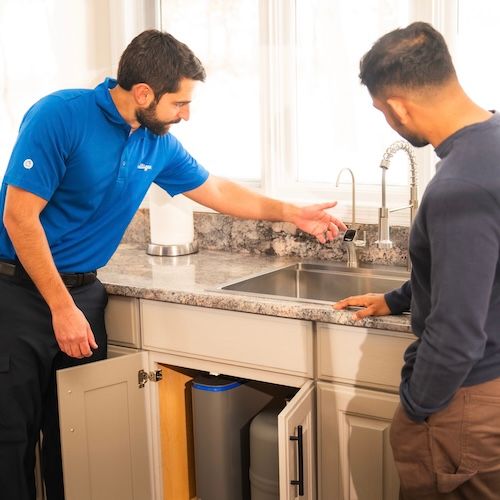
Test the water at your tap. Culligan of Vero Beach’s free in-home test reads hardness, chlorine, total dissolved solids, pH and iron in about 20 minutes. For lead, PFAS, bacteria, nitrate and arsenic, we collect samples for a certified laboratory and go over the written report with you. Testing matters most if your home predates 1986, if you are on a well, if the taste or smell has changed, or if an infant drinks the water.
Frequently asked questions about Vero Beach tap water
Is Vero Beach tap water safe to drink straight from the faucet?
The City of Vero Beach’s 2025 Water Quality Report shows no maximum contaminant level violations; its one violation was a late report to the state, and Indian River County Utilities reported the same. The water met federal health standards during the reporting period. That does not make it free of chloramine taste, hardness, disinfection by-products or lead from your own pipes, and the city’s report does not list PFAS.
Does Vero Beach use chlorine or chloramine?
The City of Vero Beach uses chloramines, averaging 3.13 ppm in 2025, with a free-chlorine switchover each November. Indian River County Utilities in Sebastian, Gifford and Wabasso uses chlorine at about 1.75 ppm. Chloramine is the harder of the two to remove; a reverse osmosis system or a whole-house filter designed for chloramine takes care of it.
Is there fluoride in Vero Beach water?
Not from the city any longer. The 2025 report states that as of June 30, 2025, fluoride was no longer added; the last reported level was 0.70 ppm from 2023 sampling. Indian River County reported 0.64 ppm in 2023, and Fellsmere describes its water as fluoridated. Reverse osmosis reduces fluoride along with sodium and dissolved solids.
Schedule your free water test with Culligan of Vero Beach
You should not have to guess about the water your family drinks. Culligan of Vero Beach has been helping households and businesses across Vero Beach, Indian River Shores, Gifford, Wabasso, Sebastian and Fellsmere understand and improve their water for decades, on city water, county water and private wells alike. A local water expert will test your water at the tap, explain the results against what your utility reports and, if treatment makes sense, show you rental and purchase options with a written quote. We also deliver bottled water and softener salt throughout Indian River County.
Ready for better water? Schedule your free in-home water test with Culligan of Vero Beach today.