Quick answer: Yes, well water in the Vero Beach area can be safe to drink, provided it is tested regularly and treated for whatever the test turns up. Private wells in Indian River County tap the same surficial and Floridan aquifers that the City of Vero Beach and Indian River County Utilities pump, but without the lime softening, membranes, degasifiers and disinfection those plants apply. Untreated Floridan water here runs roughly 19 to 20 grains per gallon of hardness and frequently carries hydrogen sulfide, iron and enough chloride to taste brackish; shallow surficial wells are more exposed to bacteria and nitrate. The Florida Department of Health recommends testing a private well for bacteria and nitrate at least once a year.
Most Indian River County homes are on a utility, but a meaningful share are not. The USGS counted about 4,500 county residents on self-supplied household wells in its most recent survey, and the Florida Department of Health’s 2023 parcel inventory flags roughly 7,600 parcels, just under one in ten, as known or likely private wells. They cluster west of Vero Beach along the farm and ranch roads, around Fellsmere, in the older parts of Wabasso and Gifford and in scattered neighborhoods that were never connected to a main.
If one of those is your house, you are your own water utility. This guide covers what the two aquifers put into the water, which problems we see most often, how to test and what the fixes look like.
Municipal water versus a private well in Indian River County
Public systems are regulated under the Safe Drinking Water Act. The City of Vero Beach lime-softens its surficial water, runs its Floridan water through reverse osmosis, blends the two and disinfects with chloramines; Indian River County Utilities pushes Upper Floridan water through nanofiltration membranes, strips hydrogen sulfide in degasifiers and chlorinates; the City of Fellsmere filters its surficial water through activated carbon. Each samples continuously and publishes an annual report.
A private well skips every one of those steps unless the homeowner installs them. Florida rules govern how a well is drilled and permitted, but no agency tests the water afterward; as the state health department’s own fact sheet puts it, there is no required sampling of private drinking water wells. Quality also varies from one property to the next with depth, construction, nearby land use and the aquifer tapped, and it can change after a hurricane, a dry spell or a new septic system next door. Because several of the most important problems have no taste or smell, the Florida Department of Health recommends bacteria and nitrate testing at least annually and lead every three years.
Common well water problems around Vero Beach
Culligan of Vero Beach has treated wells across Indian River County for decades. These are the issues that show up most often in our test results.
1. Hardness
What homeowners notice: Chalky scale on fixtures, spotted glassware, a water heater that rumbles, soap that will not lather and skin that feels tight after a shower.
What causes it: Both local aquifers are limestone, and groundwater dissolves calcium and magnesium as it moves through. The county’s 2023 plant evaluation lists raw Upper Floridan water with calcium near 55 mg/L and magnesium at 46 to 50 mg/L, which works out to roughly 325 to 345 mg/L as calcium carbonate, or 19 to 20 grains per gallon. A private Floridan well delivers that water as is. Surficial wells vary more but are rarely soft.
Why it matters: Hardness is not a health concern, but at these levels it scales water heaters quickly and shortens appliance life. It is the most common reason a well home in Fellsmere or Wabasso calls us.
How to fix it: A Culligan Aquasential® Smart High Efficiency Water Softener removes the minerals at the point of entry. Where iron is also present, the Softener-Cleer handles both in one unit.
2. Hydrogen sulfide
What homeowners notice: A rotten-egg smell from the taps, sometimes only from the hot side.
What causes it: Sulfur-bearing minerals and decaying organic matter in the aquifer release hydrogen sulfide gas, and sulfur bacteria in a well or water heater can add to it. The gas is common enough in local groundwater that Indian River County’s Hobart and Oslo plants run degasifiers specifically to remove it before the water reaches Sebastian and Gifford. A private well has no degasifier. If the odor is only in hot water, the water heater’s anode rod is the usual source.
Why it matters: The smell makes water unpleasant to drink, cook with and bathe in, and hydrogen sulfide corrodes plumbing. A test pinpoints the level and whether the source is the well or the heater.
How to fix it: A Culligan Aquasential® Smart High Efficiency Sulfur-Cleer® Filter or Sulfur-OX3 oxidizing system removes the gas for the whole house, installed ahead of the softener.
3. Iron
What homeowners notice: Orange or rust-colored stains in tubs, toilets and laundry, a metallic taste, and sometimes a reddish slime in the toilet tank.
What causes it: Iron dissolves out of soil and rock into groundwater. It can come out of the tap clear and then oxidize to rust-colored particles when exposed to air. The Florida Department of Health’s iron fact sheet notes that staining begins at about 300 micrograms per liter, which is also the state’s secondary standard, and that excess iron feeds iron bacteria that leave slime and odor.
Why it matters: Iron is not a health hazard at the levels found in wells, but it ruins fixtures and laundry, clogs aerators and coats the resin in a softener that was not designed for it.
How to fix it: A Culligan Aquasential® Smart High Efficiency Iron-Cleer® Filter or Iron-OX5 system oxidizes and filters iron for the whole house.
4. Chloride and dissolved solids
What homeowners notice: A salty or flat taste, white crust on fixtures that is not ordinary scale, and corrosion of metal plumbing.
What causes it: The Floridan aquifer under Indian River County is brackish. The county’s raw water measured 307 to 373 mg/L chloride and 828 to 896 mg/L total dissolved solids in 2022, above the 250 and 500 mg/L secondary standards, which is the reason its plants use membranes at all. A private Floridan well gets the same water, and UF/IFAS advises testing chloride, sodium and TDS when a well near the coast tastes salty.
Why it matters: Sodium and chloride matter to anyone on a restricted diet, and high dissolved solids are corrosive to water heaters and fixtures over time.
How to fix it: A Culligan Aquasential® Smart Reverse Osmosis System removes salts and dissolved solids from drinking and cooking water, which is where they matter most.
5. Bacteria and nitrate
What homeowners notice: Usually nothing. Coliform bacteria and nitrate have no taste, color or smell.
What causes it: Coliform bacteria live in soil and surface water and reach a well through a cracked casing, a poor cap, flooding or a nearby septic drainfield. Nitrate comes from septic systems, fertilizer and livestock. Shallow surficial wells are the most exposed, and the state health department notes that both bacteria and nitrate reach groundwater through poorly maintained septic systems. Septic-to-sewer work around the Indian River Lagoon, including a West Wabasso project that connected 52 parcels and abandoned 65 septic tanks, is aimed at exactly that pathway.
Why it matters: Total coliform signals that disease-causing organisms could be present; E. coli indicates contamination from human or animal waste. Nitrate above the 10 mg/L standard is a serious risk for infants under six months. If E. coli is found, stop drinking the water and contact the Florida Department of Health in Indian River County.
How to fix it: Correct the source, disinfect the well and retest. For ongoing protection, UV disinfection treats the whole house as water enters, and Culligan’s Aquasential® Smart Reverse Osmosis System with the Advanced Post Tank Filter is certified under NSF Protocol P231 to reduce bacteria by more than 99.9999 percent. For nitrate, the Nitrate Reduction Conditioner treats the whole home.
How to check your well water quality in Vero Beach
Look for the signs. Orange stains, a sulfur smell, chalky scale, a salty taste or gritty sediment all point to something worth testing.
Use local resources. The Florida Department of Health in Indian River County runs a NELAP-certified drinking water laboratory at 1900 27th Street in Vero Beach that tests private-well samples for total coliform and E. coli, supplies sample bottles and recommends an annual bacteria check. The statewide private well page at floridahealth.gov links to a flooded-well brochure, a well disinfection fact sheet and a certified-lab search.
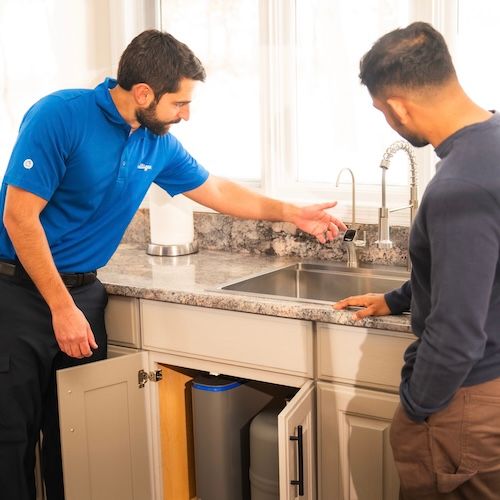
Test on a schedule and after changes. Bacteria and nitrate every year, lead every three years, and a retest after flooding, well or pump repairs, a change in taste, smell or color, or before an infant or pregnant household member drinks the water. Culligan of Vero Beach’s free in-home test covers hardness, iron, pH, total dissolved solids and chlorine in about 20 minutes, and we arrange certified lab analysis for bacteria, nitrate, lead, arsenic and PFAS. Details are on our Vero Beach water testing page.
Well water treatment with Culligan of Vero Beach
Every well is different, and two neighbors on the same road in Fellsmere can test differently. Our technicians have worked on Indian River County wells for decades, which means we have seen most combinations: hardness with iron, sulfur with hardness, brackish Floridan water that needs reverse osmosis at the sink, shallow wells that need UV after a storm. A typical treatment train here is a Sulfur-Cleer or Iron-Cleer ahead of an Aquasential softener, with a reverse osmosis system for drinking water. We install, maintain and service all of it, deliver softener salt to the door and deliver bottled water to households that want a backup during storm season or while a well is being cleared. The full lineup is on our well water solutions page.
Frequently asked questions about private wells near Vero Beach
Where does well water near Vero Beach come from?
From one of two aquifers. Shallow wells draw from the surficial aquifer, the same formation the City of Vero Beach taps at 80 to 140 feet; deeper wells, several hundred feet down, draw from the Upper Floridan Aquifer. The surficial water tends toward iron, tannin color and septic-related risk; Floridan water is harder, sulfurous and often brackish. A well driller’s record or a water test tells you which you have.
How often should I test my well in Indian River County?
The Florida Department of Health recommends bacteria and nitrate at least once a year and lead every three years, plus a retest after flooding, repairs or any change in the water. The county health department’s lab in Vero Beach handles the bacteria test; Culligan handles hardness, iron, sulfur and the treatment decisions that follow.
Why does my well water near Vero Beach smell like rotten eggs?
Hydrogen sulfide, which is common in Floridan groundwater here; the county utility runs degasifiers to remove it from its own supply. If the odor is only in hot water, the water heater is the likely source. For odor at every tap, a Sulfur-Cleer or Sulfur-OX3 whole-house system removes it.
What should I do with my well after a hurricane or flood?
Assume it is contaminated until a lab says otherwise. Use bottled water, have the well inspected and disinfected, then test for total coliform and E. coli before using it again. The Florida Department of Health’s flooded-well brochure walks through the steps. Culligan of Vero Beach delivers bottled water across the county during recovery.
Will a softener fix iron and sulfur in my Fellsmere well?
Not on its own. A standard softener is built for calcium and magnesium; iron fouls its resin and hydrogen sulfide passes straight through. The right setup is an Iron-Cleer, Sulfur-Cleer or Softener-Cleer sized to your test results, with the softener downstream.
Ready for better well water? Schedule your free in-home water test and consultation with Culligan of Vero Beach today.