Quick answer: Yes, and on city water it is very hard. Valparaiso City Utilities posts a mineral analysis showing about 23 grains per gallon (400 ppm) from its Airport plant and about 28 grains per gallon (480 ppm) from its Flint Lake plant. The U.S. Geological Survey classifies anything above 180 mg/L as very hard, so Valparaiso tap water is more than twice that threshold. Homes in Chesterton and Portage on Indiana American Water receive treated Lake Michigan water at roughly 8 grains per gallon, which still falls in the hard range. Private wells in Porter, Jasper, Starke and Pulaski counties vary well to well, and a free in-home test gives you the number for your house.
Most people in Valparaiso do not need a lab report to know their water is hard. They see it in the white crust around faucet bases, the cloudy film on drinking glasses, the showerhead that sputters after a few months, and the kettle that rattles with flakes of scale. None of this is a health problem. It is a mineral problem, and it costs money in the form of shortened water heater life, extra detergent and appliances that work harder than they should. This guide explains where that hardness comes from, how it differs across the towns we serve, and what you can do about it.
Is municipal or well water harder around Valparaiso?
It depends on which water you have, and northwest Indiana has three distinct kinds: city well water in Valparaiso, Lake Michigan water along the lakeshore communities, and private wells in the countryside.
Valparaiso City Utilities
Valparaiso City Utilities serves roughly 36,000 customers from two treatment plants and four well fields. According to its 2025 Water Quality Report, the Flint Lake Treatment Plant draws from ten wells in the Lake Michigan Basin aquifer and the Airport Treatment Plant draws from fourteen wells in the Kankakee Basin aquifer. The Indiana Department of Natural Resources describes the aquifer systems of Porter County as glacial outwash: sand and gravel with clay and silt lenses under the Valparaiso Moraine, and loose fine sand across the Kankakee lowland to the south. Groundwater moving slowly through those deposits dissolves calcium and magnesium along the way.
The utility’s posted water analysis lists hardness of 400 ppm (23 grains per gallon) at the Airport plant tap and 480 ppm (28 grains per gallon) at the Flint Lake plant tap. The raw well water shows the same numbers, which tells you the plants are not removing hardness. They do remove iron, bringing it from 1.7 to 2 ppm in the raw water down to about 0.03 ppm, and they add phosphate for corrosion control and fluoride for dental health. Hardness passes through to your faucet.
Which plant supplies your home depends on where you sit in the distribution system. Either way, both numbers are several times the USGS very-hard threshold, and Valparaiso city water is among the hardest municipal water we work with.
Indiana American Water: Chesterton, Portage and parts of Valparaiso
Indiana American Water’s Northwest Indiana system serves Chesterton, Portage, Porter, Burns Harbor and parts of Valparaiso including Shorewood Forest and South Haven, according to its 2023 Annual Water Quality Report. The source is Lake Michigan, treated at the Borman Park and Ogden Dunes filtration plants, with a six-well groundwater plant in Lake Station as backup. The 2025 report lists hardness of 140 ppm at Borman Park and 143 ppm at Ogden Dunes, with a range of 130 to 150 ppm. That works out to about 7.6 to 8.8 grains per gallon. Lake water is far less hard than Valparaiso’s wells, but it is still in the USGS hard category, and you will see spotting on glass and slow scale buildup in water heaters.
Kouts, Winamac and Rensselaer
Kouts Water Works pumps from wells in the Kankakee sand and gravel aquifer, and Winamac Municipal Utilities pumps from three wells more than 400 feet deep. Neither town publishes a finished-water hardness figure in its annual report, and we could not obtain a current report for Rensselaer. Hardness in these systems varies by source and by what happens between the plant and your tap. Check your utility’s annual report or call the utility for system data, and a free in-home test will give you your home’s number.
Private wells
Outside the town systems, most homes in rural Porter, Jasper, Starke and Pulaski counties rely on private wells. A statewide USGS groundwater quality summary describes Indiana groundwater as very hard, with median hardness across the state’s aquifers of 286 to 340 mg/L, or roughly 17 to 20 grains per gallon. Individual wells can run higher or lower, and many also carry iron, which changes the type of equipment you need. Our well water solutions page covers that in more detail.
Hard water problems Valparaiso homeowners deal with
1. Scale in water heaters and appliances
When hard water is heated, calcium carbonate comes out of solution and settles. In a tank water heater, it collects on the bottom and coats the heating elements, which makes the heater work longer to deliver the same hot water. Tankless heaters scale up inside their heat exchangers and need regular descaling. The USGS notes that the long-term flow of hard water through a pipe builds scale that narrows the pipe and reduces pressure. Dishwashers, coffee makers, humidifiers and ice makers all take the same hit. At 23 to 28 grains per gallon, Valparaiso homes see this faster than most.
2. Spots, film and soap scum
Hard water reacts with soap to form scum, so you use more soap and detergent to get the same result. The white spots on dishes and shower doors are minerals left behind when water evaporates. Laundry comes out stiffer and colors fade sooner. Cleaners remove it, but it comes back.
3. Dry skin and dull hair
Mineral residue and leftover soap film can make skin feel tight and itchy after a shower and leave hair dull or hard to rinse. Many people notice the difference most during northwest Indiana winters, when indoor air is already dry. Softened water rinses cleaner.
4. Fixtures and faucets
Chalky crust around faucet bases, clogged aerators, and showerheads that spray at angles are the everyday signs. Over time, scale can stiffen valve cartridges and shorten the life of fixtures.
What a water softener does
A water softener exchanges the calcium and magnesium in your water for sodium or potassium as water passes through a resin bed. The hardness minerals are flushed out during regeneration, and softened water flows to the rest of the house. With hardness as high as Valparaiso’s, capacity and efficiency matter. The Aquasential® Smart High Efficiency Water Softener regenerates based on how much water you actually use, which saves salt and water. The Aquasential® Select Series and Aquasential® Advantage Whole Home Water Softener fit different household sizes and budgets. For wells that carry iron along with hardness, a Softener-Cleer or a softener paired with an Iron-Cleer® filter is often the better match. See our water softener options for more.
How to check your home’s water hardness
Start with your utility. Valparaiso City Utilities posts its water quality reports and mineral analysis online, and Indiana American Water publishes its annual report for the Northwest Indiana system. Those numbers describe the water leaving the plant. They do not tell you what happens in your own plumbing, and they do not cover private wells at all.
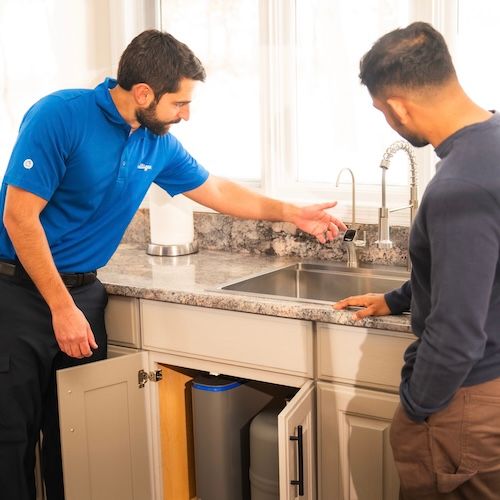
For your home’s actual number, schedule a free in-home water test. Our technician measures hardness, iron, chlorine, pH and total dissolved solids at your tap in about 20 minutes and explains what the results mean. If you are on a well, we can also arrange certified lab testing for bacteria, nitrate, arsenic and other contaminants. More on that is on our water testing page.
Culligan of Valparaiso: local hard water help
Culligan of Valparaiso has treated water in Valparaiso, Chesterton, Portage, Kouts, Rensselaer and Winamac for decades. Our technicians work on Valparaiso city water, Lake Michigan water and private wells every week, so we size equipment for what is actually in your water. Rental and purchase options are available for every softener we install, and we deliver salt on a schedule that fits your household, along with bottled water delivery if you want it.
FAQs about hard water in Valparaiso
How many grains of hardness is Valparaiso city water?
Valparaiso City Utilities lists 23 grains per gallon from the Airport plant and 28 grains per gallon from the Flint Lake plant. Both are far above the 180 mg/L level the USGS calls very hard.
Is Chesterton water as hard as Valparaiso water?
No. Chesterton is on Indiana American Water’s Lake Michigan supply, which its 2025 report lists at 140 to 143 ppm, about 8 grains per gallon. That is hard, but well below Valparaiso’s well water.
Does Valparaiso City Utilities soften the water?
No. The utility’s posted analysis shows the same hardness in raw well water and at the tap. The plants remove iron and add phosphate and fluoride, but hardness reaches your home.
Is hard water bad for my health?
No. Calcium and magnesium are not a health hazard. Hard water is a cost and maintenance problem for plumbing, appliances, skin and laundry.
Can a softener handle 28 grains per gallon?
Yes, when it is sized correctly. A high-efficiency softener with enough capacity for your household handles Valparaiso’s hardness without constant regeneration.
Ready for better water? Schedule your free in-home water test and consultation with Culligan of Valparaiso today.