Quick answer: Yes. Valparaiso City Utilities says its water meets or exceeds every state and federal drinking water requirement, and its 2024 report states that none of the 29 PFAS compounds it sampled for were detected. Indiana American Water, which serves Chesterton, Portage and parts of Valparaiso, lists no violations in its 2025 report and a lead 90th percentile of 3 ppb, with none of 50 homes above the action level. Meeting the standards does not mean the water is perfect for every household. Very hard water, chloramine taste, iron and household plumbing are the issues we see most often, and a free in-home test tells you which of them apply to your tap.
“Is the tap water safe?” is one of the first questions new residents ask us, whether they have moved into a subdivision off Calumet Avenue or a farmhouse outside Kouts. The honest answer has two parts. The first is about the utility: what it tests for, what it found and whether it met the rules. The second is about your home: the pipes, fixtures and water heater between the street and your glass, and, if you are on a well, everything about that well. This guide covers both.
What municipal water testing does and does not tell you
Public water systems in Indiana test on schedules set by federal rules and enforced by the Indiana Department of Environmental Management. Every year, each system publishes a Consumer Confidence Report that lists what was detected, how much, and whether any limit was exceeded. Those reports are the best public record of what leaves the treatment plant.
What they do not show is what happens after the water leaves the plant. Lead and copper can enter water from older service lines, solder and brass fixtures. Iron can build up in old galvanized pipe. A water heater can grow bacteria that cause odor. And a utility report tells you nothing about a private well, which no agency tests unless the owner arranges it. That is why we recommend reading your utility’s report and then testing at your own tap.
Municipal water vs. private well water
City water customers in Valparaiso, Chesterton, Portage, Kouts and Winamac are covered by the Safe Drinking Water Act. Their utility treats, disinfects and tests the water and must notify customers of problems. Private well owners across rural Porter, Jasper, Starke and Pulaski counties are on their own. According to Purdue University, groundwater supplies more than 60 percent of Indiana’s drinking water and about half of that comes from private wells. If that describes your home, our well water page and our well water guide go into the details.
Where does Valparaiso drinking water come from?
Valparaiso City Utilities pumps groundwater from four well fields to two plants. The 2025 Water Quality Report lists ten wells in the Lake Michigan Basin aquifer feeding the Flint Lake Treatment Plant and fourteen wells in the Kankakee Basin aquifer feeding the Airport Treatment Plant. The utility describes its water as filtered, disinfected and tested, and it was the first public water supply in Indiana to complete a Wellhead Protection Program, which limits risky land uses near its wells.
Indiana American Water serves Chesterton, Portage, Porter, Burns Harbor and parts of Valparaiso including Shorewood Forest and South Haven, according to its 2023 report. Its source is Lake Michigan, treated at the Borman Park and Ogden Dunes filtration plants, with six wells in Lake Station as backup.
Kouts Water Works pumps from two wells in the Kankakee sand and gravel aquifer. Its 2023 report notes that a third well in the Ellsworth Shale aquifer is not in use because of petroleum contamination. Winamac Municipal Utilities pumps from three wells more than 400 feet deep, per its 2025 report. We could not obtain a current annual report for Rensselaer, so customers there should ask the city utility for its latest one.
Common tap water concerns around Valparaiso
1. Chlorine and chloramine
Disinfection keeps bacteria out of the distribution system, and the chemical used affects taste. Indiana American Water uses chloramine, a blend of chlorine and ammonia, on its Lake Michigan water. Its 2025 report lists a highest running annual average of 2.24 ppm, under the 4 ppm limit. Kouts reports a chlorine residual of 0.31 to 1.7 mg/L, and Winamac reports a highest running average of 3.4 ppm. Valparaiso City Utilities does not name its disinfectant on its website. Chloramine lasts longer in pipes and is harder to remove than chlorine. Standard carbon handles chlorine; chloramine needs catalytic carbon or reverse osmosis.
2. Lead from service lines and plumbing
Lead almost never comes from the source water. It comes from lead service lines, older solder and brass fixtures. Indiana American Water’s 2025 report shows a 90th percentile lead level of 3 ppb from 2024 sampling, with none of 50 homes above the 15 ppb action level. Winamac reports a 90th percentile of 0.117 ppb, and Kouts reports its results below the action level. Valparaiso City Utilities completed its lead service line inventory in 2024 and says it complies with current federal lead and copper requirements; it also adds phosphate for corrosion control. If your home was built before the late 1980s, a lead test at your tap is worth doing. The Aquasential® Smart Reverse Osmosis system reduces lead by 99.7 percent.
3. Hard water
Valparaiso City Utilities’ posted water analysis shows hardness of 400 ppm (23 grains per gallon) from the Airport plant and 480 ppm (28 grains per gallon) from Flint Lake. Indiana American Water’s lake water runs 140 to 143 ppm, about 8 grains per gallon. Hardness is not a health risk, but it leaves scale in water heaters and spots on glass. Our hard water guide and softener page cover it in depth.
4. PFAS
PFAS are a family of manufactured chemicals that persist in the environment. Valparaiso City Utilities sampled for 29 PFAS compounds in October 2023 and April 2024 under EPA’s Unregulated Contaminant Monitoring Rule, and its 2024 report states that none were detected. Indiana American Water’s 2023 report lists PFOA, PFOS, GenX, PFBS, PFHxS and PFNA as not detected. Kouts reports PFAS not detected. That is good news for city customers. Private wells have no comparable data. The Aquasential® Smart Reverse Osmosis with Total Defense reduces total PFAS by more than 99.99 percent, and the Whole Home PFAS Water Filter by more than 99 percent.
5. Iron and manganese
Valparaiso’s raw well water contains 1.7 to 2 ppm iron and 0.2 ppm manganese, which the plants reduce to about 0.03 ppm iron and 0.02 ppm manganese. Kouts adds polyphosphate to control iron discoloration and notes in its report that this reduces but does not eliminate staining. If you see orange or brown stains, or water that runs rusty after it sits, the cause may be the utility, your plumbing or a well. A test sorts that out.
6. Bacteria and monitoring
Valparaiso’s 2024 report notes one positive total coliform sample in July, which repeat samples confirmed as a false positive. Winamac’s 2025 report lists a monitoring and reporting violation for May 2025 because its laboratory did not report a coliform sample result to the state; that is a paperwork failure, not a finding of contamination. Indiana American Water lists no violations in 2025. If your utility ever issues a boil advisory, Valparaiso City Utilities’ guidance is to flush faucets afterward and sanitize or replace filters and softeners connected to the water.
7. Fluoride
Valparaiso City Utilities adds fluoride and lists 0.8 ppm at the tap. Winamac reports 0.63 ppm. Indiana American Water’s 2025 report lists 0.14 ppm from Ogden Dunes and non-detect from Borman Park. A reverse osmosis system reduces fluoride for households that prefer less.
8. Sodium and chloride
Indiana American Water’s 2025 report lists sodium at 13.7 ppm from Borman Park and 25.5 ppm from Ogden Dunes, against EPA guidance of 20 ppm for people on sodium-restricted diets, and chloride at 20.9 and 40.6 ppm, well under the 250 ppm secondary standard. A salt-based softener adds a small amount of sodium to softened water. If you are on a low-sodium diet, a reverse osmosis faucet for drinking water or a potassium-based softener addresses that.
How to check your home’s water quality
Start by reading your utility’s most recent annual report. Valparaiso City Utilities keeps its water quality reports online, and Indiana American Water posts its Northwest Indiana report each year. Look for the detected-contaminants table, the lead and copper results, and any violations section.
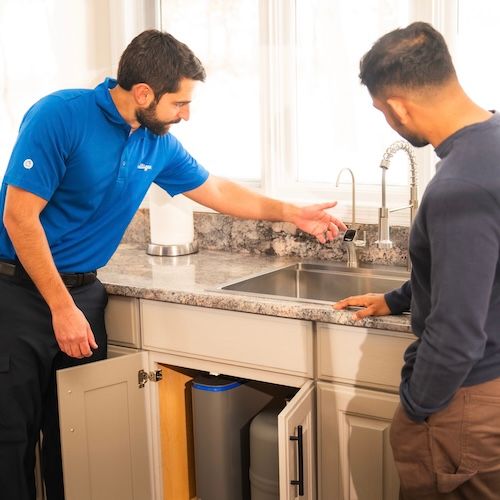
Then test at your tap. Our free in-home test measures hardness, chlorine, total dissolved solids, pH and iron in about 20 minutes. If you want lab results for bacteria, nitrate, lead, arsenic or PFAS, we arrange certified lab testing. Well owners should also follow the Indiana Department of Health’s well testing guidance, which calls for at least annual testing. Our water testing page has more on what each test covers, and our filtration page covers what to do with the results.
Schedule your free water test with Culligan of Valparaiso
Culligan of Valparaiso has served homes and businesses in Valparaiso, Chesterton, Portage, Kouts, Rensselaer and Winamac for decades. We know the difference between Valparaiso’s well water and Indiana American Water’s Lake Michigan supply, and we test private wells across four counties. Rental and purchase options are available for every system we install, and we offer salt delivery and bottled water delivery.
Frequently asked questions about Valparaiso tap water
Has Valparaiso had any recent drinking water violations?
Valparaiso City Utilities says its water meets or exceeds all state and federal requirements. A July 2024 coliform result was confirmed as a false positive by repeat samples.
Is there PFAS in Valparaiso tap water?
Not in recent monitoring. The utility reports that none of 29 PFAS compounds were detected in samples from October 2023 and April 2024.
Why does my Chesterton water smell like a swimming pool?
Indiana American Water disinfects with chloramine. A catalytic carbon filter or reverse osmosis system removes the taste and smell.
Should I worry about lead in my Valparaiso home?
Lead comes mainly from service lines and older plumbing. If your home predates the late 1980s, a lab lead test at your tap gives a definite answer, and reverse osmosis reduces lead by 99.7 percent.
Does a softener make tap water safer?
No. A softener removes hardness minerals. For lead, PFAS or taste, a filter or reverse osmosis system is the right tool.
Ready for better water? Schedule your free in-home water test and consultation with Culligan of Valparaiso today.