Quick answer: Well water around Valparaiso can be safe to drink, but only testing tells you whether yours is. Private wells are not regulated under the Safe Drinking Water Act, so no utility or agency checks them unless the owner arranges it. The Indiana Department of Health recommends testing every private well at least once a year for bacteria and nitrate. In Porter, Jasper, Starke and Pulaski counties, the most common problems we find are hardness and iron, followed by sulfur odor, and the biggest health risks are bacteria and nitrate in shallow wells drilled into the sandy Kankakee aquifer.
Drive south out of Valparaiso toward Kouts, or west of Rensselaer into the farm country of Jasper County, and you leave city water behind fast. Homes there depend on wells, and those wells draw from the same glacial sand and gravel that feeds the municipal systems, without the treatment plant in between. Some wells deliver clean water for decades. Others carry iron that turns fixtures orange, sulfur that smells like rotten eggs, or bacteria and nitrate that cannot be seen or tasted at all. This guide covers how wells here differ from city water, the issues we see most often, and how to find out what is in yours.
Municipal water vs. private well water: what is different
When you are on a public system such as Valparaiso City Utilities, Indiana American Water in Chesterton and Portage, or the town systems in Kouts and Winamac, the utility treats the water, disinfects it, tests it on a federal schedule and publishes an annual report. If something goes wrong, it must notify you.
With a private well, every one of those jobs belongs to you. Purdue University reports that groundwater supplies more than 60 percent of Indiana’s drinking water and that about half of it comes from private wells, so a large share of Hoosiers are in this position. The good news is that the job is manageable: test on a regular schedule, keep the wellhead in good condition, and treat for what the test finds.
It also helps to know your aquifer. The Indiana Department of Natural Resources describes three main aquifer systems in Porter County. The Valparaiso Moraine aquifer system is outwash sand and gravel mixed with clay and silt lenses, between about 10 and more than 130 feet thick, and its susceptibility to surface contamination ranges from low to high depending on how much clay sits above it. The Kankakee aquifer system to the south is unconfined fine to medium sand, where wells are typically shallow and few exceed 50 feet, and the DNR rates it highly susceptible to surface contamination because there is no clay layer to protect it. Near the lakeshore, the Calumet aquifer is also sandy and highly susceptible. Valparaiso’s own city wells draw from the Lake Michigan Basin and Kankakee Basin aquifers, as its 2025 Water Quality Report notes.
Common well water problems around Valparaiso, Kouts and Rensselaer
1. Hard water
Indiana groundwater is hard almost everywhere. A USGS statewide groundwater quality summary reports median hardness of 286 to 340 mg/L across Indiana’s aquifer units, or roughly 17 to 20 grains per gallon, well above the 180 mg/L threshold the USGS calls very hard. Valparaiso’s city wells, drawing from the same glacial deposits as many private wells, test at 23 to 28 grains per gallon according to the utility’s posted water analysis. Expect scale in water heaters, spots on dishes and crust on fixtures. Softening fixes it, and the Aquasential® Smart High Efficiency Water Softener is sized to handle hardness at this level efficiently.
2. Iron and manganese
Iron is the problem we are called about most often on wells here. Dissolved iron is invisible when it comes out of the tap, then oxidizes into orange-brown particles that stain sinks, toilets, laundry and siding. Manganese leaves darker brown or black stains. The same USGS summary reports iron as high as 3,000 micrograms per liter in some Indiana groundwater, ten times the 0.3 mg/L secondary standard, with a median near 1,900 micrograms per liter in till aquifers. Valparaiso’s raw city well water carries 1.7 to 2 ppm iron and 0.2 ppm manganese before treatment. Iron-Cleer® and Iron-OX5 systems remove it, and a Softener-Cleer can handle moderate iron and hardness together.
3. Hydrogen sulfide (rotten-egg odor)
A sulfur smell is common in some wells. The Indiana Department of Health lists naturally occurring sulfate and sulfide minerals among the factors that affect Indiana groundwater. If the odor appears only in hot water, the water heater anode is often the source. If it is in hot and cold, it is likely coming from the well. Sulfur-Cleer® and Sulfur-OX3 systems treat it at the point of entry.
4. Bacteria (total coliform and E. coli)
The Indiana Department of Health names failing septic systems, livestock and landfills as sources of bacteria in wells. Coliform bacteria are an indicator that surface water or waste may be reaching the well, and E. coli indicates fecal contamination. Shallow wells in sandy soil are most at risk, which describes much of the Kankakee lowland. Purdue advises shock-chlorinating the well and plumbing after a positive result and then retesting. For ongoing protection, UV disinfection treats bacteria at the point of entry, and a reverse osmosis system with the Advanced Post Tank Filter is certified to NSF P231 to reduce bacteria by more than 99.9999 percent at the kitchen tap.
5. Nitrate
Nitrate comes from fertilizer, manure and septic systems, and it is a particular concern for infants. Purdue reports that statewide surveys found 3.5 to 4.5 percent of private wells above the 10 ppm nitrate-nitrogen standard, but that 12.2 percent of wells shallower than 50 feet exceeded it, compared with 0.9 percent of wells deeper than 100 feet. Purdue also identifies northwest and north-central Indiana as highly vulnerable areas. With so many shallow sand wells and so much farmland in Porter, Jasper and Pulaski counties, a yearly nitrate test is important. A Nitrate Reduction Conditioner treats the whole house, and reverse osmosis reduces nitrate at the sink.
6. Arsenic
The Indiana Department of Health notes that arsenic is associated with glacial deposits found throughout Indiana. Arsenic has no taste, color or smell. Winamac’s deep municipal wells, for comparison, report 1.78 ppb, well under the 10 ppb limit, but private wells vary. The IDOH laboratory recommends testing for arsenic every five years. Reverse osmosis reduces arsenic at the tap. If a lab result comes back above 10 ppb, use bottled water for drinking and cooking until treatment is in place.
7. Lead and corrosion
Low-pH well water can dissolve metals from plumbing. The Indiana Department of Health lists lead and heavy metals from corrosive water among well concerns, and the IDOH laboratory recommends lead and copper testing every five years or after major well work. Correcting low pH protects plumbing, and reverse osmosis reduces lead by 99.7 percent at the faucet.
8. PFAS
The public systems around Valparaiso report PFAS not detected in recent monitoring, but private wells have not been tested the same way. If your well is near an industrial site, airport or landfill, a certified PFAS lab test is reasonable. The Whole Home PFAS Water Filter reduces PFAS by more than 99 percent, and Aquasential® Smart Reverse Osmosis with Total Defense reduces total PFAS by more than 99.99 percent.
How to check your well water quality
Follow the state schedule. The IDOH laboratory recommends testing for bacteria and nitrate every year, and for fluoride, arsenic, lead and copper every five years or whenever major maintenance is done. Test sooner if the taste, smell or color changes, after flooding, after work on the well or septic system, or when a baby is coming. The Indiana Department of Health also notes that drought can concentrate contaminants and reduce a well’s output.
The Porter County Health Department does not run its own lab, so samples go to certified laboratories. It notes that most residential wells are tested at minimum for E. coli, total coliform, nitrate and nitrite, and lead.
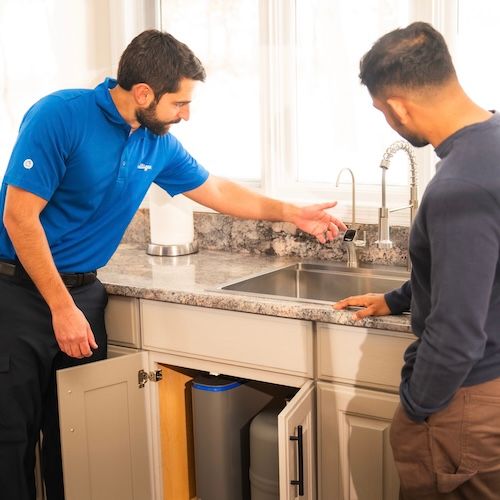
We make it simpler. Our free in-home test checks hardness, iron, pH, chlorine and total dissolved solids at your tap in about 20 minutes, which covers most of what drives treatment decisions. We then arrange certified lab testing for bacteria, nitrate, arsenic, lead and PFAS as needed. See our water testing page for details, and our well water solutions page and filtration page for equipment options.
Local well water expertise from Culligan of Valparaiso
Culligan of Valparaiso has worked on wells across Porter, Jasper, Starke and Pulaski counties for decades, from the moraine north of Valparaiso to the sand country around Kouts, Rensselaer and Winamac. Our technicians see iron, hardness and sulfur on a weekly basis and know how they combine. We size every system from your test results, install it, and service it locally. Rental and purchase options are available, along with salt delivery for softeners and softener options for every budget. Bottled water delivery is available while you wait on lab results.
Frequently asked questions about private wells around Valparaiso
How often should I test my well near Valparaiso?
Every year for bacteria and nitrate, per the Indiana Department of Health, and every five years for arsenic, lead, copper and fluoride. Test again after flooding or well repairs.
Why are my sinks turning orange on well water?
Dissolved iron oxidizes when it meets air. Indiana groundwater commonly carries iron, and an Iron-Cleer or Softener-Cleer system removes it once a test confirms the level.
Are shallow wells near Kouts riskier?
Generally, yes. The Indiana DNR rates the Kankakee aquifer highly susceptible to surface contamination, and Purdue found nitrate problems far more often in wells under 50 feet deep.
What should I do after a flood?
Use bottled water, have the well tested for bacteria, and sanitize it if the result is positive. The Indiana Department of Health notes that wells may need sanitizing after flooding.
Do I need a softener on my well?
Most Indiana wells are hard, with USGS statewide medians of about 17 to 20 grains per gallon. A test tells you your number and whether iron needs to be handled first.
Ready for better water? Schedule your free in-home water test and consultation with Culligan of Valparaiso today.