Quick answer: Yes, and not by a little. Texas State University’s water system, which pumps the same Edwards Aquifer that supplies the city’s wells, reported total hardness of 315 mg/L in 2025 (about 18 grains per gallon) and 358 mg/L in 2024 (about 21 gpg). The City of Kyle’s 2025 report lists 275 to 295 mg/L (16 to 17 gpg) and labels anything above 180 mg/L very hard. Canyon Lake surface water blended into the system reads lower but is still very hard: Martindale’s river-sourced supply came in at 259 mg/L, about 15 gpg. Trinity Aquifer wells in Wimberley and Dripping Springs run just as high. A free in-home test tells you the number at your own tap.
Most people in San Marcos do not need a chemistry report to know the water is hard. The evidence is on the shower door in Blanco Gardens, on the faucet aerators in a Plum Creek kitchen in Kyle, and inside the three-year-old water heater in Sunfield that already rumbles when it fires. The crust is calcium carbonate, dissolved out of limestone and dropped again the moment the water evaporates or gets hot. Here is where that mineral load comes from, how to measure it and what a softener changes.
Why San Marcos water is so hard: a limestone aquifer and a limestone lake
San Marcos sits on the Balcones Fault Zone, where the Edwards Aquifer surfaces as San Marcos Springs at Spring Lake, the second-largest spring in Texas according to the Texas Water Development Board. The Edwards is 200 to 600 feet of partially dissolved limestone, and TWDB describes its water as hard but fresh, with total dissolved solids below 500 mg/L. Rain recharges it quickly through caves and fractures, dissolving calcium and magnesium on the way. The U.S. Geological Survey’s Hays County study put it plainly: Edwards water is commonly very hard but otherwise good for most uses.
The numbers bear that out. Texas State University’s 2025 Consumer Confidence Report for its three Edwards wells on campus lists calcium at 94.5 mg/L, magnesium at 17.3 mg/L and total hardness of 315 mg/L, with a range of 302 to 328 mg/L through the year. Divide by 17.1 and that is 17.7 to 19.2 grains per gallon. The prior year ran higher, 297 to 419 mg/L, or roughly 17 to 24 gpg. Kyle, which pumps the Edwards from four wells and the Barton Springs segment from a fifth, reports 275 to 295 mg/L for 2025.
The city’s other source does not rescue the situation. The rest of what the San Marcos system distributes is surface water from Canyon Reservoir, released into the Guadalupe River, pumped from Lake Dunlap and carried 24 miles to the San Marcos Water Treatment Plant, which the city owns and the Guadalupe-Blanco River Authority operates. The Guadalupe drains Hill Country limestone too. Martindale Water Supply Corporation, whose treatment plant takes San Marcos River and Lake Dunlap water, reported total hardness of 259 mg/L in 2025, about 15 gpg. So depending on the season and which source is flowing to your neighborhood, the water at a San Marcos tap swings between about 15 and 21 gpg. All of it is very hard.
City water or well water: which is harder around San Marcos?
Here the usual answer flips. In many parts of the country, wells are harder than city water. Around San Marcos they are roughly equal, because the city’s wells and the private wells draw from the same kind of rock. East of Interstate 35, in Martindale, Maxwell and toward Lockhart, shallower wells reach the Edwards or the Taylor marl and river alluvium, which USGS describes as generally hard with locally excessive nitrate. West of the interstate, in Wimberley, Driftwood, Dripping Springs and Blanco, wells tap the Trinity Aquifer. TWDB calls Trinity water fresh but very hard where it outcrops, and notes that dissolved solids, sulfate and chloride all rise with depth.
Trinity numbers from the Wimberley area match Edwards numbers from campus. Two Middle Trinity test wells drilled for the Woodcreek utility system in 2023 measured 311 and 316 mg/L of hardness, about 18 gpg. A 1989 TWDB study of Hays County found Trinity water typically very hard and often high in sulfates, with total dissolved solids reaching 3,000 mg/L in some wells near Dripping Springs. None of the utilities in the area soften at the plant; treatment removes turbidity and disinfects, and calcium and magnesium pass through. Private wells receive no treatment unless the owner installs it.
What 18 grains per gallon does inside a San Marcos home
Hardness is not a health issue. It is a maintenance and comfort issue, and at these levels a persistent one. These are the three complaints we hear most between Buda and New Braunfels.
1. Scale in water heaters, dishwashers and tankless units
What you notice: A water heater that pops and rumbles, a tankless unit that throws an error code or loses hot-water flow, a dishwasher that runs longer and cleans worse, and a slow decline in pressure at the showerhead.
What causes it: Heating hard water drives dissolved calcium carbonate out of solution. At 18 gpg, every 100 gallons carries roughly a quarter pound of dissolved mineral, and the share that drops out settles on the heating element, the bottom of the tank or the narrow passages inside a tankless heat exchanger.
Why it matters: Scale insulates the element from the water, so the heater burns more gas or electricity to deliver the same temperature, and tankless units in untreated water of this hardness need descaling every year.
2. White film, spots and soap scum
What you notice: Cloudy glassware, chalky rings in toilets, a haze on shower glass that returns days after cleaning and crust around every faucet base.
What causes it: Calcium and magnesium react with soap to form an insoluble curd, and plain evaporation leaves carbonate behind wherever water dries.
Why it matters: Cleaning takes longer, and the household goes through more detergent, shampoo and dish soap chasing lather the minerals keep killing.
3. Dry skin, flat hair and stiff laundry
What you notice: Skin that feels tight after a shower, hair that will not rinse clean, and towels that come out of the dryer rough and gray.
What causes it: The same soap curd that coats the shower door coats skin, hair and fabric, and it does not rinse away.
Why it matters: Residue blocks moisturizers and conditioners, and fabric holding mineral deposits wears out sooner.
A whole-house ion-exchange softener such as the Aquasential® Smart High Efficiency Water Softener removes the calcium and magnesium at the point where water enters the house, so every fixture and appliance downstream sees soft water. Because San Marcos hardness is so high, we size these systems carefully; an undersized unit regenerates constantly and wastes salt. You can read about the models we install on our water softeners page.
How to find your own hardness number
Read the utility report, with a caveat. Texas water quality reports cover regulated contaminants and do not always publish hardness. Kyle’s and Texas State’s do, and both are good proxies for Edwards water here. New Braunfels Utilities’ 2024 report does not list hardness at all, even though its wells draw the Edwards and Trinity aquifers.
Look at your fixtures. Scale on a showerhead within months of cleaning, spotted glassware and a water heater that needs flushing are reliable signs the water is above 10 gpg.
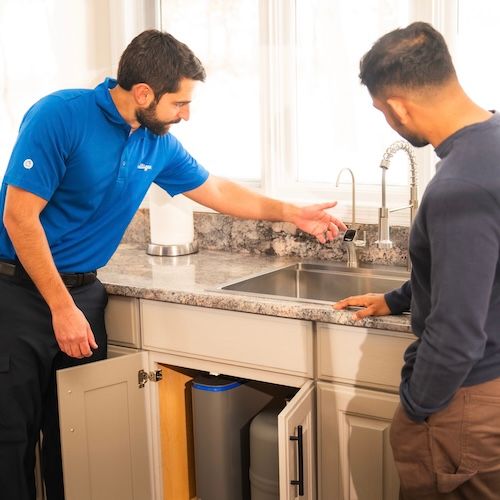
Test the tap. This is the only measurement that reflects your house, your source blend and your plumbing. Our free in-home water test reads hardness, chlorine, total dissolved solids, pH and iron in about 20 minutes, and we explain each number before anyone talks about equipment. Well owners in Wimberley or Driftwood get the same test, plus certified lab options through our well water solutions.
Frequently asked questions about hard water in San Marcos
How many grains per gallon is San Marcos water?
Published Edwards Aquifer measurements in and around San Marcos range from about 16 to 21 grains per gallon: 275 to 295 mg/L in Kyle’s 2025 report and 315 mg/L (2025) and 358 mg/L (2024) in Texas State’s reports for its campus wells. Canyon Lake surface water blended into the system is lower but still very hard, about 15 gpg at Martindale.
Does the City of San Marcos soften the water?
No. The city and GBRA treat for safety: disinfection, turbidity removal and corrosion control. Calcium and magnesium pass through to your tap. Any softening happens at the house.
Is Trinity Aquifer well water in Wimberley softer than city water?
No. Middle Trinity test wells in the Woodcreek area measured 311 to 316 mg/L of hardness in 2023, about 18 gpg, essentially the same as Edwards water. Deeper Trinity wells often carry more sulfate and dissolved solids as well.
Will a salt-free conditioner work on San Marcos water?
Conditioners change how minerals crystallize but leave the calcium in the water, so spotting, soap scum and dry skin remain. Above 15 gpg, an ion-exchange softener is the only approach that removes hardness.
Start with a free hardness test from Culligan of San Marcos
For decades our technicians have worked on Edwards water in San Marcos, Kyle, Buda, Mountain City and Niederwald, Trinity wells in Wimberley, Driftwood, Dripping Springs and Blanco, and the river-fed systems in Martindale, Lockhart and Luling. We measure the water in your kitchen and leave you with a written quote covering rental and purchase, with salt delivery and service spelled out. See our filtration options if chlorine taste is on your list too.