Quick answer: Yes, with context. City of San Marcos water is treated at the GBRA-operated San Marcos Water Treatment Plant and at the city’s Edwards Aquifer well sites, disinfected with chlorine and sampled against federal limits all year. Lead results across the area are low. One number did cross a line: 2025 data shows a total trihalomethane running average of 81 ppb at the 345 Champions Blvd sampling site for the fourth quarter of 2025, just over the 80 ppb limit, and the city has said it is flushing lines, adjusting its source blend and sampling more often. Beyond compliance, San Marcos water is very hard, carries a chlorine residual averaging 2.68 mg/L and shows trace short-chain PFAS in neighboring systems. None of that makes it unsafe, but it is why people ask what is in the glass.
If you pay a San Marcos utility bill, your water passed through a treatment plant and a disinfection step before it reached your street, whether it came from an Edwards well near Spring Lake or from Canyon Reservoir by way of a 24-mile pipeline. The question homeowners actually ask is different: what rides along with it, and does any of it matter to my family, my plumbing or my coffee? Here is what residents of San Marcos, Kyle, Buda, New Braunfels and the Hays and Caldwell County towns around them should know.
What a passing grade on a water report does and does not mean
The U.S. Environmental Protection Agency regulates more than 90 contaminants in public water, and Texas utilities publish their results each year in a Consumer Confidence Report. Meeting those limits is a real accomplishment and a real protection. It is also a narrower statement than most people assume, for three reasons.
First, limits are set with cost and treatment feasibility in mind, not only health; the trihalomethane limit of 80 ppb, for example, is a running annual average that allows individual samples to run higher. Second, utilities sample at the plant and at a handful of distribution sites, such as 345 Champions Blvd in San Marcos or 310 Ayers Rd in Kyle, not the service line under your yard or the fixtures in a 1970s house near the Texas State campus. Third, the report is silent on what drives most complaints: hardness, chlorine taste and the musty note of summer lake water. Hardness alone sits at roughly 16 to 21 grains per gallon in Edwards-fed systems here, and no utility removes it.
City water and private wells: different rules
Everything above applies to public systems. A private well in Driftwood, Wimberley or the ranch country east of Lockhart answers to no utility and no annual report. The homeowner tests it, maintains it and treats it. The Texas Well Owner Network and the Barton Springs/Edwards Aquifer Conservation District both advise annual testing for coliform bacteria, E. coli, nitrate and total dissolved solids, because none of those can be seen or tasted. We cover well water in detail on our well water solutions page and in our Hill Country well water guide.
Where San Marcos drinking water comes from
Two sources, blended. The city’s wells draw from the Edwards Aquifer, the same limestone that discharges at San Marcos Springs, which the Texas Water Development Board ranks as the second-largest spring in the state. The rest is surface water from Canyon Reservoir, released down the Guadalupe River to Lake Dunlap and pumped to the San Marcos Water Treatment Plant, a 21-million-gallon-per-day facility that the city owns and the Guadalupe-Blanco River Authority has operated since it started up in 2000. The same plant supplies Kyle, Buda, Goforth Special Utility District and Texas Water Utilities, so a glass of water in Sunfield or Plum Creek has much in common with one downtown.
Neighbors use different mixes. Kyle adds its own Edwards wells and Carrizo Aquifer groundwater from the Alliance Regional Water Authority. New Braunfels Utilities treats mostly Guadalupe River water at its Gruene Road plant and supplements with Edwards and Trinity wells. Lockhart and Luling receive San Marcos River water from GBRA’s Luling plant, and Martindale treats river water alongside three wells classified as groundwater under the direct influence of surface water. After decades of testing water in these towns, the issues below are the ones we encounter most.
1. Chlorine taste and odor
What you notice: A pool smell at the kitchen tap or in the shower, stronger on some days than others.
What causes it: San Marcos and Kyle disinfect with free chlorine. The 2025 data published in Kyle’s report lists the San Marcos residual at an average of 2.68 mg/L with a range of 0.089 to 5.37 mg/L; Kyle’s own wells average 1.43 mg/L. Lockhart and Luling use chloramine, a chlorine-ammonia compound that smells less but is harder to filter.
Why it matters: The residual protects water in the pipes, and the limit is 4 mg/L as a running average. Summer surface water needs more disinfectant than winter well water, which is why the smell changes with the season.
How to fix it: The Aquasential® Smart Reverse Osmosis System removes chlorine and its taste from drinking water. For showers and laundry, a whole-house carbon filter such as the Aquasential® Smart HE Water Filter does the same at every tap, with media matched to chlorine or chloramine.
2. Trihalomethanes from surface water
What you notice: Nothing. TTHMs have no taste or smell at these levels.
What causes it: Chlorine reacts with natural organic matter, which lake and river water carry and groundwater largely does not. The result shows up wherever surface water sits longest in the pipes. The 2025 data reports a locational running annual average of 81 ppb at 345 Champions Blvd in San Marcos, over the 80 ppb limit for the fourth quarter, with 68 ppb at 1175 Hilltop and 61 ppb at 3939 S. IH-35. Kyle’s highest site was 67 ppb, the GBRA site in Buda 57 ppb, and New Braunfels Utilities reported a 76 ppb running average with single samples to 90.9 ppb in 2024.
Why it matters: The limit is based on long-term exposure. Even in compliance, these numbers run closer to the ceiling than in most groundwater-only systems.
How to fix it: Reverse osmosis with activated carbon pre-filtration reduces TTHMs in drinking water, and a whole-house carbon filter reduces them throughout the home.
3. Hard water
What you notice: Spotted glassware, crust on faucets, a water heater that rumbles and skin that feels tight after a shower.
What causes it: Limestone. Texas State University’s 2025 report for its Edwards wells lists 315 mg/L of total hardness (about 18 gpg) and 384 mg/L of total dissolved solids; Kyle reports 275 to 295 mg/L and calls it very hard; Martindale’s river-sourced water measured 259 mg/L.
Why it matters: Not a health concern, but a steady tax on water heaters, dishwashers, tankless units and cleaning time. We cover the details in our San Marcos hard water article and on the water softeners page.
How to fix it: A whole-house softener such as the Aquasential® Smart High Efficiency Water Softener, sized for 18-grain water.
4. PFAS
What you notice: Nothing; PFAS have no taste, smell or color.
What causes it: Decades of use in firefighting foam, coatings and consumer products. Area utilities tested under the federal UCMR 5 program. New Braunfels Utilities found PFHxS at 3.7 parts per trillion (its federal limit is 10 ppt) along with PFBA at 10.2 ppt, PFHxA at 3 ppt and PFPeA at 3.4 ppt. The CRWA plant that supplies Martindale detected PFPeA at 3.20 ng/L and PFBS at 3.14 ng/L in 2023. Kyle reported trace amounts of three short-chain compounds and no regulated contaminant. PFOA and PFOS, the two compounds with a 4 ppt limit, were not among the detections in any of those reports.
Why it matters: The levels are low, and they are a snapshot. Many households prefer to remove the category rather than track it.
How to fix it: The Aquasential® Smart Reverse Osmosis System with Total Defense is certified to reduce total PFAS by more than 99.99 percent. For every tap, the Whole Home PFAS Water Filter is certified to reduce total PFAS by more than 99 percent.
5. Lead from household plumbing
What you notice: Nothing detectable by the senses.
What causes it: Water leaves the plant lead-free and picks it up, if at all, from solder, brass fixtures or old service lines inside the property. Utility sampling here is reassuring: Kyle’s 90th percentile was 1.91 ppb with no site above the 15 ppb action level, New Braunfels Utilities reported 1.7 ppb, Lockhart 1.56 ppb, Texas State 1.3 ppb and Martindale zero.
Why it matters: Those are system averages. A pre-1986 house in the older blocks of San Marcos or Lockhart can read differently from the sampling sites, and infants and pregnant women are most affected.
How to fix it: The Aquasential® Smart Reverse Osmosis System is certified to reduce lead by 99.7 percent at the tap where you drink and cook.
How to check the water in your San Marcos home
Read the reports. The City of San Marcos publishes its annual water quality report on the city website each summer. Kyle, New Braunfels Utilities and the GBRA-served cities of Lockhart and Luling post theirs online, and because the systems share sources, reading two or three together gives a fuller picture than one alone.
Watch for signs. Chlorine smell, spotting on dishes, scale on fixtures, a musty taste in July or August, cloudy water after hydrant flushing. None signals danger, but each points to something a specific filter or softener can fix.
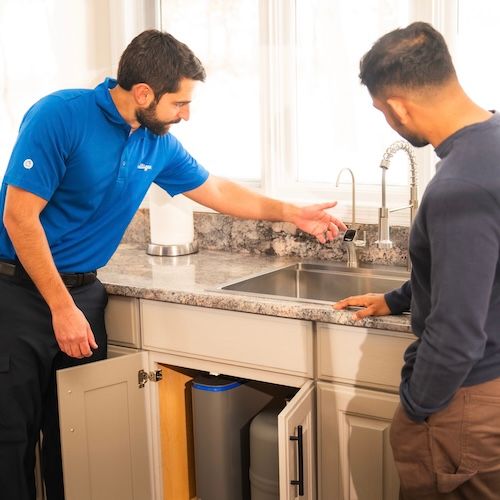
Test the tap. Our free in-home water test measures hardness, chlorine, total dissolved solids, pH and iron in about 20 minutes, in your kitchen. For lead, bacteria, nitrate, arsenic or PFAS, we collect a sample for a certified laboratory and walk you through the results. Testing is especially worthwhile if your home predates 1986, if you are on a private well, if you have a newborn in the house, or if the water has changed in taste or appearance.
Frequently asked questions about San Marcos tap water
Can I drink San Marcos tap water without a filter?
Yes. It is treated, disinfected and monitored, and lead results in the area are low. A filter addresses taste, hardness, disinfection byproducts and trace PFAS, which are quality-of-life and precautionary concerns rather than acute ones.
What was the TTHM issue in San Marcos?
Total trihalomethanes at the 345 Champions Blvd sampling site averaged 81 ppb over the four quarters ending December 2025, above the 80 ppb limit. TTHMs form when chlorine meets organic matter in surface water. The city reported flushing lines, changing its source blend and increasing sampling.
Does San Marcos use chlorine or chloramine?
Free chlorine, averaging 2.68 mg/L in the 2025 data. Lockhart and Luling use chloramine; Dripping Springs Water Supply Corporation reports both because it blends Trinity well water with Lake Travis water.
Is San Marcos water fluoridated?
Fluoride is present at low natural levels: 0.21 ppm for San Marcos in the 2025 data and 0.19 ppm in Texas State’s Edwards wells. Kyle reports 1.83 ppm and describes it as naturally occurring and not added. Reverse osmosis removes it for those who prefer; a softener does not.
Schedule your free water test with Culligan of San Marcos
You should not have to guess about your water. For decades, Culligan of San Marcos has tested and treated water for homes and businesses across San Marcos, Kyle, Buda, Martindale, Lockhart, Luling, Wimberley, Dripping Springs, Blanco and New Braunfels. We explain your results in plain terms before recommending anything, and if treatment makes sense you will see rental and purchase options side by side, with installation, salt delivery and service spelled out. Browse our water filtration options to see what is available.
Ready for better water? Schedule your free in-home water test with Culligan of San Marcos today.