Quick answer: Yes, well water in the Hill Country around San Marcos can be safe to drink, provided it is tested and, where the tests call for it, treated. Private wells in Hays, Caldwell, Comal and Blanco counties are not monitored by any utility. The Middle Trinity Aquifer under Wimberley and central Hays County delivers water the Barton Springs/Edwards Aquifer Conservation District describes as very good, but very hard, about 18 grains per gallon in recent test wells. Other zones are less dependable: the U.S. Geological Survey has documented Glen Rose limestone water with more than 500 ppm sulfate and over 1,000 ppm dissolved solids in parts of Hays County, plus locally high nitrate, and the Texas Water Development Board has recorded Trinity wells near Dripping Springs at 3,000 mg/L of dissolved solids. Annual screening for bacteria, nitrate and salinity is the starting point; the results decide the treatment.
West of Interstate 35, the water company stops at the city limit. From Driftwood and Wimberley out to Dripping Springs and Blanco, and in the ranch country around Martindale, Maxwell and Lockhart, a drilled well is how many homes get water. The Texas Water Development Board’s study of Hays County found the Trinity Aquifer supplies most of the western half of the county, and the subdivisions that have grown up since, from Woodcreek to the ranchettes along Ranch Road 12, still depend on it. This guide covers what the agencies that study these aquifers have found, what we see on service calls, and how to keep a well safe.
Why a private well is different from city water
Public systems in San Marcos, Kyle and New Braunfels operate under the federal Safe Drinking Water Act and report results every year. Private wells are outside that framework. Texas rules address construction and spacing, and the Hays Trinity and Barton Springs/Edwards Aquifer groundwater districts register and permit wells, but no agency samples a household well on a schedule. Testing and treatment belong to the owner.
Water quality also varies lot to lot. Two wells a quarter mile apart near Driftwood can be completed in different formations: one in the Upper Trinity, which the Barton Springs district notes often stops producing in drought, and one in the Middle Trinity’s Cow Creek limestone, the most productive zone and about 90 to 100 feet thick in central Hays County. A neighbor who drilled into the Lower Trinity may have plenty of water with far more dissolved minerals; the district’s 2022 memo calls Lower Trinity quality poor in many places and variable.
Conditions change too. Heavy rain on the Blanco or San Marcos rivers, a failing septic drainfield uphill, drought drawdown that pulls from a deeper zone, or a crack in a 30-year-old casing can alter what comes out of the tap with no visible warning. That is why the Texas Well Owner Network, run by Texas A&M AgriLife Extension, and the Barton Springs/Edwards Aquifer Conservation District both put annual testing first.
For decades, Culligan of San Marcos has treated wells across this country. These are the issues that come up most often.
Common well water problems around San Marcos and the Hill Country
1. Very hard water
What you notice: Heavy scale on fixtures and inside the water heater, cloudy glassware, stiff laundry and dry skin.
What causes it: Every aquifer here is limestone or lime-cemented sand. The Texas Water Development Board describes Trinity water as fresh but very hard where the formation outcrops, and the USGS county study calls Edwards water commonly very hard. Two Middle Trinity test wells drilled for the Woodcreek utility system in Wimberley in 2023 measured 311 and 316 mg/L of hardness, about 18 gpg, with calcium around 86 mg/L and magnesium around 24 mg/L.
Why it matters: At 18 gpg, scale forms in a tankless heater within months and a conventional tank loses efficiency yearly. Not a health risk, but the most expensive nuisance a Hill Country well delivers.
How to fix it: The Aquasential® Smart High Efficiency Water Softener, sized for high-grain water. If iron is present as well, the Softener-Cleer handles both in one system. Details are on our water softeners page.
2. Sulfate and high dissolved solids
What you notice: A bitter, salty or mineral taste; a laxative effect in sensitive people; gritty white deposits harder than ordinary scale.
What causes it: Gypsum and anhydrite in the Glen Rose limestone and the deeper Trinity zones. USGS found Glen Rose water in Hays County exceeding 500 ppm sulfate and 1,000 ppm total dissolved solids in places, and TWDB’s Hays County study recorded TDS up to 3,000 mg/L near Dripping Springs and described Trinity water as often high in sulfates. TWDB notes that sulfate, chloride and dissolved solids all increase with depth across the aquifer.
Why it matters: The Barton Springs district notes that water above 500 mg/L TDS can taste salty and stain fixtures. Neither sulfate nor TDS is acutely dangerous at these levels, but the water is unpleasant to drink and hard on plumbing.
How to fix it: Reverse osmosis at the kitchen sink. The Aquasential® Smart Reverse Osmosis System or the compact Aquasential® Tankless RO removes dissolved solids and sulfate from drinking and cooking water, which is where taste matters; a softener upstream protects the membrane from hardness.
3. Coliform bacteria and E. coli
What you notice: Usually nothing. Bacteria have no taste or smell.
What causes it: Karst limestone moves water fast. Runoff, septic effluent and animal waste can reach a well through a cracked casing, a loose cap or a poorly sealed annulus, especially after flooding on the Blanco, San Marcos or Guadalupe rivers. The Edwards Aquifer Authority’s monitoring detects wastewater indicators such as sucralose and caffeine in San Marcos Springs water under normal conditions, and Martindale Water Supply Corporation’s three Caldwell County wells are formally classified as groundwater under the direct influence of surface water.
Why it matters: Total coliform signals a pathway; E. coli signals fecal contamination and a real risk of illness. The Texas Well Owner Network screens for both at its Hays County events, held with the Hays County AgriLife Extension office in Wimberley and the two groundwater districts.
How to fix it: Find and correct the entry point, shock-chlorinate the well, then retest. For continuous protection, UV disinfection at the point of entry. For drinking water, the Aquasential® Smart Reverse Osmosis System with the Advanced Post Tank Filter is certified under NSF Protocol P231 to reduce bacteria by more than 99.9999 percent.
4. Nitrate
What you notice: Nothing; nitrate is colorless and tasteless.
What causes it: Septic systems, fertilizer and livestock. USGS reported locally high nitrate in Glen Rose wells and locally excessive nitrate in the Taylor marl and river-terrace deposits east of the fault zone, around Martindale, Maxwell and toward Lockhart. Martindale WSC’s 2025 report shows nitrate up to 6.9 ppm in its river-influenced supply, well above the 1 to 2 ppm typical of deep Edwards water.
Why it matters: The federal limit is 10 ppm. Above it, nitrate interferes with oxygen transport in infants under six months, a condition the Texas Well Owner Network specifically warns about. Only a lab test detects it.
How to fix it: The Aquasential® Smart Reverse Osmosis System for drinking water, or the Nitrate Reduction Conditioner for the whole house where levels and household needs call for it.
5. Low yield and drought
What you notice: Pressure that fades during a long shower, air in the lines, a pump that cycles or runs dry in late summer.
What causes it: The Trinity is thick but stingy. TWDB’s Hays County study observed that most Trinity wells yield little, and the Barton Springs district reports Upper Trinity wells going dry in drought and pumping near Jacob’s Well in Wimberley that can stop the spring from flowing.
Why it matters: Quantity and quality move together. A well that changes taste in August is drawing from somewhere new, and that is a reason to retest.
How to fix it: Treatment should be sized for low-flow wells, and a storage tank with a booster pump often makes a marginal well livable. We design softener and filter systems around the flow a well can actually deliver.
6. Iron and hydrogen sulfide
What you notice: Orange stains in toilets and on laundry, a metallic taste, or a rotten-egg smell from the tap or the hot water.
What causes it: Dissolved iron in some sand and shale zones, and hydrogen sulfide from sulfur bacteria or reactions inside a water heater. The Woodcreek test wells showed iron below 0.01 mg/L, so iron is not universal here, but it appears in individual wells and the staining is unmistakable when it does.
Why it matters: Stains, odor and fouled softener resin. A smell only in hot water usually points to the heater’s anode rod rather than the well.
How to fix it: Iron-Cleer® or Iron-OX5 for iron, Sulfur-Cleer® or Sulfur-OX3 for hydrogen sulfide, and the Softener-Cleer where iron and hardness arrive together.
How to check your well water near San Marcos
Look for signs. Scale, stains, odor, gritty sediment, a salty taste, or a change in any of those after rain or drought.
Use the local screening programs. The Texas Well Owner Network holds Hays County screenings with sample drop-off at the AgriLife Extension office in Wimberley and the two groundwater district offices, testing total coliform, E. coli, nitrate-nitrogen and salinity. The Barton Springs/Edwards Aquifer Conservation District lists year-round labs as well, including the Edwards Aquifer Research and Data Center in San Marcos and the LCRA Environmental Laboratory in Austin.
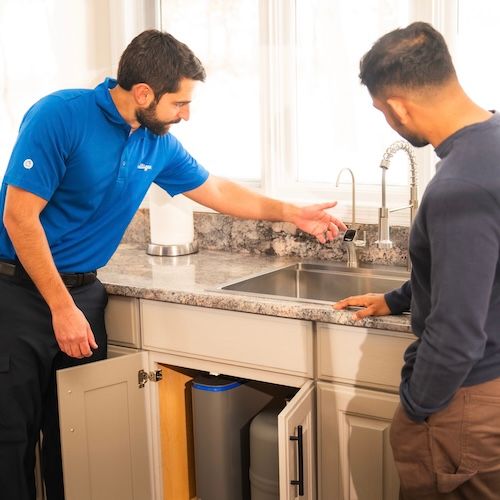
Test on a schedule, and after events. Annually for coliform, E. coli, nitrate, TDS and pH, per both TWON and the district. Add a test whenever the well has been flooded or repaired, when taste or color changes, when a pregnant household member or infant will drink the water, or if the well has never been tested. Our free in-home test covers hardness, iron, TDS, pH and chlorine on the spot, and we collect certified lab samples for bacteria, nitrate, arsenic and PFAS.
Frequently asked questions about wells around San Marcos
Which aquifer does my well near Wimberley or Dripping Springs use?
Almost certainly the Trinity. Shallow wells sit in the Upper Trinity, most dependable domestic wells in the Middle Trinity’s Cow Creek limestone, and deeper wells in the Lower Trinity. East of Interstate 35, wells tap the Edwards, the Taylor marl or river alluvium, and toward Lockhart the Wilcox and Carrizo sands.
How often should I test a Hays County well?
Once a year for coliform bacteria, E. coli, nitrate, total dissolved solids and pH, and again after flooding, well work or any change in taste, odor or color.
Why does my Hill Country well water taste salty?
Dissolved solids and sulfate from the Glen Rose and deeper Trinity zones. The Barton Springs district notes that water above 500 mg/L TDS tastes salty; TWDB has recorded Trinity wells near Dripping Springs at 3,000 mg/L. Reverse osmosis corrects the taste at the kitchen tap.
Is Trinity well water harder than San Marcos city water?
About the same. Woodcreek test wells measured 311 to 316 mg/L in 2023, roughly 18 gpg, compared with 315 mg/L for Texas State’s Edwards wells and 275 to 295 mg/L for Kyle.
Local well water expertise from Culligan of San Marcos
Every well is its own case. For decades, Culligan of San Marcos has helped well owners in Wimberley, Driftwood, Dripping Springs, Blanco, Martindale, Maxwell, Uhland and the country around Lockhart and Luling read their test results and choose treatment that fits the water and the household. We install and service softeners, iron and sulfur filters, reverse osmosis and UV systems, deliver salt on a route, and come back when something needs attention. Start on our well water solutions page, or have us come out and test.