Quick answer: Yes, San Diego’s water is very hard. The City of San Diego’s 2025 Annual Drinking Water Quality Report lists total hardness averaging 237 to 243 parts per million at its three treatment plants, roughly 13.8 to 14.2 grains per gallon, with readings through the year from 11.7 to 16.6 gpg. Anything over 10.5 gpg is classified as very hard. Santa Fe Irrigation District in Solana Beach averaged 16.1 gpg in 2024, and Sweetwater Authority’s blended supply for Chula Vista and National City has ranged from about 5.5 to 17.5 gpg. East County wells run from barely hard to extremely hard depending on the rock. The only way to know your number is to test at the tap.
The signs are everywhere once you look: the white crust at the base of the kitchen faucet, the haze on a Clairemont condo’s shower door that comes back three days after you squeegee it, the dishwasher in Chula Vista that leaves every glass cloudy, the water heater in a La Mesa garage that rumbles when it fires. Those are all calcium and magnesium, left behind wherever water dries or heats.
Here is where that mineral comes from, how the water agencies across the city, South County and East County compare, how to check your own home, and what a softener does about it.
Where San Diego’s hardness comes from: the Colorado River
San Diego’s hardness is imported. The City of San Diego Public Utilities Department buys most of its raw water from the San Diego County Water Authority, a blend of Colorado River and Northern California State Water Project water that sits in local reservoirs before the Alvarado, Miramar and Otay plants filter and disinfect it. The Colorado River picks up calcium and magnesium as it cuts through the mineral-rich basin upstream, and treatment plants are built to remove particles and pathogens, not dissolved hardness.
The city’s 2025 report shows how consistent that is. Alvarado, serving central and southern neighborhoods, averaged 237 ppm (13.8 gpg). Miramar, serving the north from Mira Mesa to Rancho Bernardo and La Jolla, averaged 242 ppm (14.1 gpg). Otay, serving the far south and supplying Coronado and Imperial Beach through California American Water, averaged 243 ppm (14.2 gpg). The companion data table breaks that down to 54 to 59 ppm of calcium and 22 to 26 ppm of magnesium, and total dissolved solids ran 532 to 585 ppm, which is why the water tastes flat even when it is perfectly safe. The small share of purchased treated water, including desalinated seawater from Carlsbad, is blended in system-wide, so no neighborhood gets consistently softer water from it.
Is municipal or well water harder in San Diego?
For most of the county, municipal water is reliably very hard and well water is a coin toss.
Every public agency in our service area draws on the same imported supply, so their hardness clusters together. Santa Fe Irrigation District, which treats Lake Hodges water blended with 75 percent imported water at the R.E. Badger plant for Solana Beach, reported 250 to 300 ppm (14.6 to 17.5 gpg) in 2024. Helix Water District, which treats a 58 percent Colorado River, 25 percent Lake Cuyamaca and 17 percent State Water Project blend at its R.M. Levy plant for El Cajon, La Mesa and Lemon Grove, does not print a hardness figure in the summary we could read; check its annual report or test, since the source blend is the same one the city treats. Carlsbad Municipal Water District’s 2023 report shows its imported supply at 165 to 291 ppm, averaging 228 ppm (13.3 gpg), with the 17 percent from the Claude “Bud” Lewis Carlsbad Desalination Plant much lower in minerals, so Carlsbad homes see hardness swing with the blend.
Sweetwater Authority has a different mix. For National City, western Chula Vista and Bonita it combines Sweetwater Reservoir runoff, deep wells in National City, brackish Chula Vista groundwater desalted at the Richard A. Reynolds facility, and imported water. Its treated-water hardness has ranged from 94 to 300 ppm, averaging 196 ppm (about 11.5 gpg), so two homes a mile apart in Chula Vista can test quite differently.
Private wells are another matter. The County of San Diego notes that wells are the only potable supply in much of the rural backcountry, and the State Water Board’s sampling of 137 county domestic wells found total hardness anywhere from 24 to 1,000 mg/L. Wells in Alpine, Jamul, Ramona and Dulzura sit in fractured granite and valley alluvium; some are far harder than city water, a few are not hard at all, and nobody tests them but the owner.
Hard water problems San Diego homeowners run into
Hardness is not a health issue. It is a maintenance issue that compounds quietly for years. These are the three complaints we hear most often.
1. Scale inside water heaters and appliances
What homeowners notice: A water heater that pops and rumbles, takes longer to recover, or fails early; a tankless heater that throws error codes and needs descaling; reduced flow from showerheads; dishwashers and washing machines wearing out ahead of schedule.
What causes it: Heating hard water forces calcium carbonate out of solution onto the hottest surface available, the heating element or heat exchanger. At 14 grains per gallon, a family of four runs tens of pounds of dissolved mineral through the water heater every year.
Why it matters: Scale insulates the element, so the heater burns more gas or electricity for the same hot water, and tankless units lose efficiency fast. Many San Diego heaters sit in garages or outdoor closets where nobody hears the rumble until they fail.
2. Film and spots on glass, tile and dishes
What homeowners notice: Cloudy glassware out of the dishwasher, a white haze on shower doors and faucets, and soap scum on tile that needs real scrubbing.
What causes it: When a droplet of 14-grain water dries, the minerals stay behind. Calcium and magnesium also bond with soap to make a sticky curd instead of lather.
Why it matters: Hard-water homes burn through more detergent, shampoo and rinse aid, and glass shower enclosures etch permanently if deposits are left long enough.
3. Dry skin and hair
What homeowners notice: Skin that feels tight or itchy after a shower and hair that never feels fully rinsed.
What causes it: The same mineral-and-soap film that coats the shower door coats skin and hair and does not rinse off cleanly.
Why it matters: In a dry coastal climate that residue is one more thing pulling moisture out. Most people notice the change within a couple of weeks of softening.
A whole-home softener such as Culligan’s Aquasential® Smart High Efficiency Water Softener exchanges the calcium and magnesium for sodium where water enters the house, so every shower, appliance and faucet gets soft water. Because San Diego also disinfects with chloramine, many customers pair the softener with a carbon filter or add reverse osmosis at the kitchen sink. See the options on our San Diego water softeners page.
How to check your home’s water hardness in San Diego
Three steps, from least to most precise.
Read your utility’s annual report. The City of San Diego posts its report each June at sandiego.gov, with hardness by plant in both ppm and grains per gallon. Sweetwater, Helix, Otay, Santa Fe and Carlsbad each publish their own. These give the system number, not your tap.
Look for the signs. Scale on the showerhead, spots the dishwasher cannot beat, soap that will not lather, a noisy water heater. Any two together are a reliable tell.
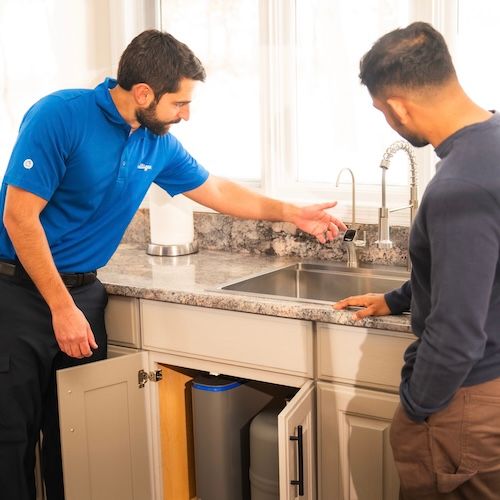
Test at your own tap. This decides how a softener is sized. A Chula Vista home on Sweetwater water and a Solana Beach home on Santa Fe water can differ by several grains, and a Jamul well can be anything. Culligan of San Diego’s in-home test is free, takes about 20 minutes and measures hardness along with chloramine, total dissolved solids, pH and iron. Read more on our water testing page.
FAQs about San Diego water hardness
How hard is the water in San Diego, CA?
Very hard. The City of San Diego’s 2025 report shows 11.7 to 16.6 grains per gallon across its three plants, averaging about 14 gpg. Santa Fe Irrigation District in Solana Beach averaged 16.1 gpg in 2024, and Sweetwater Authority in Chula Vista and National City has ranged from about 5.5 to 17.5 gpg depending on the blend.
Will a filter pitcher soften San Diego water?
No. Pitcher filters reduce taste and certain contaminants in the water you pour through them, not calcium and magnesium, and they never touch the shower, water heater or dishwasher where hardness does its damage. Softening the house takes an ion-exchange water softener.
Does the City of San Diego soften the water?
No. The plants remove particles and pathogens and add chloramine and fluoride, but hardness is not a health standard and the city does not treat for it. Neither do Sweetwater, Helix, Otay or Santa Fe.
Is well water in East County harder than city water?
Sometimes much harder, sometimes not. State sampling of San Diego County domestic wells found hardness from 24 to 1,000 mg/L. Wells in Alpine, Jamul and Ramona often add iron and manganese to the picture, so a combined softener-and-filter system is common there. Only a test tells you.
Start with a free hard water test from Culligan of San Diego
Culligan of San Diego has been treating imported Colorado River water and East County well water for homes across San Diego, Chula Vista, National City, Coronado, El Cajon, La Mesa, Lemon Grove, Santee, Carlsbad, Encinitas and Solana Beach for decades. Our technicians work on City of San Diego, Sweetwater, Helix, Otay and Santa Fe water every day and know what size system a given home needs. When you schedule a free in-home test, a local specialist measures your water at the tap, explains the results plainly and, if a softener makes sense, lays out rental and purchase options with a written quote. No obligation.
Ready for better water? Schedule your free in-home water test and consultation with Culligan of San Diego today.