Quick answer: Yes, well water in San Diego County’s backcountry can be safe to drink, provided it is tested regularly and treated for whatever the tests find. No utility monitors a private well; the owner is responsible. That matters here because the State Water Resources Control Board’s sampling of 137 domestic wells across the county found nitrate above the legal limit in 18 percent, total coliform bacteria in 26 percent, manganese above the guideline in a third, and uranium above the limit in 30 percent of the wells checked for it. None of those can be tasted or seen. Annual testing for bacteria and nitrate is the minimum; treatment follows the results.
Inside the City of San Diego and the incorporated suburbs, nearly every home is on a public water system. Drive east past Santee and El Cajon, though, and the picture changes. The County of San Diego’s Department of Environmental Health and Quality describes wells as the only potable supply in much of the rural county, and the State Water Board counts roughly 16,000 domestic wells here, enough to make San Diego the second-largest county in California for domestic well use. Alpine, Jamul, Dulzura, Ramona, parts of Lakeside and the valleys south toward the border are where most of them sit.
A private well draws from groundwater under your own property, which means it skips the Colorado River, the treatment plants and the chloramine that define city water, but also skips every safeguard that comes with them. Here is what well owners in the San Diego County backcountry should know about their water, what the state’s sampling has actually found, and how each problem is fixed.
Municipal water vs. private well water: what’s the difference?
Public systems such as the City of San Diego, Sweetwater Authority, Helix Water District and Otay Water District are regulated under the Safe Drinking Water Act and California’s stricter rules, tested continuously and required to publish results every year. Private wells are not covered by any of that. The County of San Diego requires a permit to construct, modify, deepen or destroy a well under County Code sections 67.401 through 67.424, and the permit rules focus on construction standards and setbacks from septic systems. Once the well is built, water quality is the owner’s job.
East County geology makes that job more interesting than it would be in a flat sedimentary basin. Most backcountry wells here are drilled into fractured granite and the alluvium of narrow valleys, so two neighbors can tap different fractures with different chemistry. Depth, the condition of the casing and cap, nearby septic systems and livestock, and the state’s drought-then-deluge rainfall pattern all change what comes up. A clear test last year is not a guarantee this year.
Culligan of San Diego has treated well water in Alpine, Jamul, Ramona, Lakeside and Dulzura for decades. The issues below are the ones the state’s data and our own service calls agree on.
Common well water quality issues in San Diego County
1. Nitrate
What homeowners notice: Nothing. Nitrate is colorless, odorless and tasteless.
What causes it: Fertilizer, livestock and horse operations, and septic systems leaching into shallow groundwater. In the state’s county sampling, 25 of 137 wells (18 percent) exceeded the 45 mg/L limit, with results as high as 249 mg/L.
Why it matters: Elevated nitrate is a serious risk for infants under six months and for pregnant women. Only a lab test detects it.
How to fix it: Culligan’s Aquasential® Smart Reverse Osmosis System reduces nitrate in drinking water at the kitchen tap, and the Nitrate Reduction Conditioner treats every tap in the house where whole-home reduction is needed.
2. Bacteria (total coliform and E. coli)
What homeowners notice: Usually nothing, which is why annual testing matters.
What causes it: Coliform bacteria live in soil and surface water and reach a well through a cracked casing, a poorly sealed cap, a low wellhead that floods in a winter storm, or a nearby septic system. The state found total coliform in 36 of 137 county wells (26 percent); none had fecal coliform, but total coliform signals a pathway that disease-causing organisms could use.
Why it matters: E. coli or fecal indicators mean stop drinking the water untreated and contact the County of San Diego Well Program at (858) 505-6688 for guidance.
How to fix it: Find and fix the entry point, shock-disinfect the well following the county’s disinfection guide, and retest. For ongoing protection, a UV disinfection system treats all water entering the home, and Culligan’s Aquasential® Smart Reverse Osmosis System with the Advanced Post Tank Filter is certified under NSF Protocol P231 to reduce bacteria by more than 99.9999 percent for drinking water.
3. Manganese and iron
What homeowners notice: Black or dark-brown staining on fixtures, toilets and laundry from manganese; reddish-orange rust stains and a metallic taste from iron; water that comes out clear and then discolors in the glass.
What causes it: Both metals dissolve out of the granite and alluvium that backcountry wells draw from. Manganese was the single most common problem in the state’s San Diego County sampling: 45 of 137 wells (33 percent) exceeded the 50 µg/L secondary standard and four exceeded the 500 µg/L health notification level. Iron exceeded its 300 µg/L standard in 21 wells (15 percent).
Why it matters: Staining is the visible cost. High manganese is also a health concern at the notification level, especially for infants.
How to fix it: Culligan’s Iron-Cleer® and Iron-OX5 whole-home filters oxidize and remove iron and manganese. Wells with both hardness and iron are often served by a single Softener-Cleer system.
4. Uranium and other radionuclides
What homeowners notice: Nothing. Uranium is invisible in water.
What causes it: Granitic rock across the Peninsular Ranges contains naturally occurring uranium that dissolves into groundwater. Of 54 county wells the state tested for radionuclides, 16 (30 percent) exceeded the 20 pCi/L uranium limit, with results from 24 to 168 pCi/L.
Why it matters: Long-term exposure to uranium in drinking water affects the kidneys and raises cancer risk. This is one of the most under-tested issues in East County wells because most homeowners do not know to ask for it.
How to fix it: Reverse osmosis at the drinking tap removes uranium along with other dissolved metals. Ask for a radionuclide panel when you order your lab test.
5. Hard water and high dissolved solids
What homeowners notice: Chalky buildup on fixtures, spotted glassware, stiff laundry, scale in the water heater, and a flat or salty taste.
What causes it: Groundwater dissolves calcium, magnesium and salts from the rock it moves through. The state’s county sampling found total hardness anywhere from 24 to 1,000 mg/L and total dissolved solids above the 1,000 mg/L secondary standard in 21 wells (15 percent), with values as high as 1,830 mg/L.
Why it matters: Some East County wells are far harder than city water, which already runs about 14 grains per gallon. Scale shortens appliance life and high TDS makes the water unpleasant to drink.
How to fix it: A Culligan Aquasential® Smart High Efficiency Water Softener removes hardness at the point of entry; reverse osmosis removes the dissolved solids from drinking water. Softener options are on our water softeners page.
6. Arsenic, boron and fluoride
What homeowners notice: Nothing.
What causes it: Natural mineral deposits. These are less common here than in some California basins, but the state found arsenic above the 10 µg/L limit in 3 county wells (2 percent), boron above the 1 mg/L notification level in 4 (3 percent) and fluoride above 2 mg/L in one.
Why it matters: Arsenic is a known carcinogen with no safe taste or smell cue. A one-time lab test rules it in or out.
How to fix it: Reverse osmosis at the drinking tap reduces arsenic and fluoride; whole-home arsenic reduction filters are available where a lab result calls for them.
How to check your well water quality in San Diego County
Look for the signs around the house. Black or orange stains, chalky scale, cloudy water after a storm, a metallic or salty taste, or a change in any of these.
Check county and state resources. The County of San Diego Department of Environmental Health and Quality publishes private well sampling guidance and a well disinfection guide through its Water Well Program. The State Water Board’s GAMA domestic well report for San Diego County is the source for the percentages in this article and shows what has turned up in wells near yours.
Test on a schedule, and after changes. Test every year for total coliform bacteria and nitrate, and every few years for arsenic, manganese, uranium, total dissolved solids and pH. Test right away if the well has never been tested, if the water changes in taste, smell or appearance, after flooding or repairs to the well or plumbing, or if a pregnant household member or an infant will drink the water. Culligan of San Diego’s in-home test covers hardness, iron, pH and dissolved solids on the spot, and we collect samples for certified lab analysis of bacteria, nitrate, arsenic, uranium and PFAS. Details are on our water testing page.
Frequently asked questions about private wells in San Diego County
Where does East County well water come from?
From groundwater in fractured granite and the alluvial fill of valleys such as the Santa Maria Valley near Ramona, the El Cajon Valley and the San Diego River Valley, all of which appear in the state’s sampling. Most backcountry wells sit outside any large defined basin, which is why chemistry changes so much from property to property.
How often should I test my well in San Diego County?
Every year for total coliform bacteria and nitrate, every few years for arsenic, manganese, uranium and dissolved solids, and immediately after flooding, well work or a change in the water. The County Well Program at (858) 505-6688 can advise on additional tests for your area.
Why does my well water in Jamul or Alpine stain everything black?
Manganese, the most frequent problem the state found in county wells. It dissolves out of local granite and oxidizes into dark deposits on fixtures and laundry. An Iron-Cleer® or Iron-OX5 filter removes it along with iron.
Is uranium really a concern in San Diego County wells?
Yes. Nearly a third of the wells the state tested for radionuclides exceeded the uranium limit. It has no taste or color, so ask for it specifically when you order a lab test. Reverse osmosis at the drinking tap removes it.
Can I just boil my well water to be safe?
Boiling kills bacteria but does nothing for nitrate, uranium, arsenic or manganese, and it concentrates them slightly. A lab test and the right treatment are the only reliable answer.
Get local well water expertise with Culligan of San Diego
Understanding your well is the first step toward fixing it. Culligan of San Diego has helped private well owners across Alpine, Jamul, Ramona, Lakeside, Dulzura and the rest of East County address their water for decades, alongside our city-water customers in San Diego, Chula Vista, El Cajon, La Mesa and Santee.
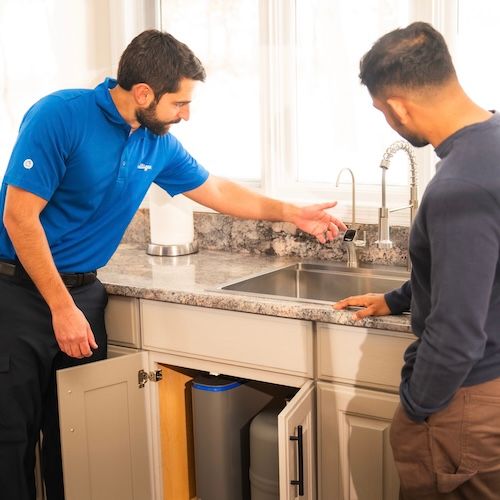
Every well is different, and in fractured granite country even neighbors can differ. Our technicians read your lab results with you, explain which findings matter for your household, and design treatment around them, whether that is a UV system and RO for bacteria, an Iron-Cleer for staining, a softener for scale or a combination. We install, maintain and service what we sell, and we deliver salt so the system keeps running. You can see the full lineup on our well water solutions page.
Ready for better well water? Schedule your free in-home water test and consultation with Culligan of San Diego today.