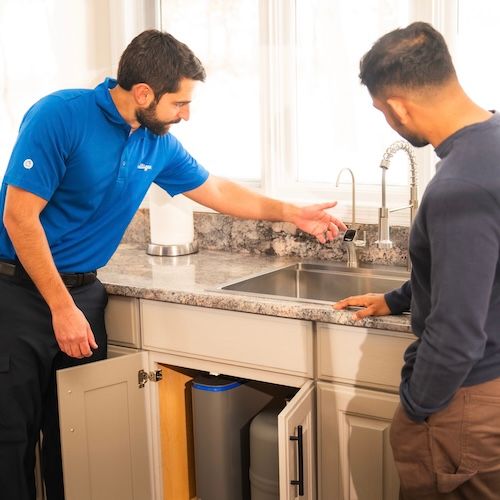
Quick answer: Yes. According to the City of San Diego Public Utilities Department’s 2025 Annual Drinking Water Quality Report, the city’s water met every federal and state drinking water standard: no violations, lead not detected at the 90th percentile in 56 sampled homes, nitrate and hexavalent chromium not detected at any plant, and 29 PFAS compounds below reporting levels. Sweetwater Authority, Helix Water District, Otay Water District, Santa Fe Irrigation District and Carlsbad Municipal Water District report the same compliance for their latest years. Meeting standards is not the same as having nothing in the water, though. San Diego’s imported supply is very hard, carries more than 500 parts per million of dissolved solids and is disinfected with chloramine, and what reaches your glass also depends on the pipes between the main and your faucet.
San Diego imports almost all of its water from hundreds of miles away, blends it from several sources, and moves it through a very long distribution system. Each step shapes what comes out of the tap in Point Loma, Chula Vista, El Cajon or Encinitas. Here is what homeowners across the city, South County and East County should know.
What municipal water testing does, and does not, tell you
The U.S. Environmental Protection Agency regulates more than 90 contaminants under the Safe Drinking Water Act, and California’s State Water Resources Control Board Division of Drinking Water layers stricter limits and notification levels on top. Every utility in our area passed both. Three things keep that from being the whole story. First, the limits balance health against cost and feasibility; a maximum contaminant level is not zero. Second, utilities sample at the plant and at points in the system, not at your sink; the city’s report also notes an ongoing State Water Board finding on its cross-connection control program, with 6,385 of 11,543 required backflow surveys completed so far. Third, utilities treat for health, not comfort. Hardness, dissolved solids and chloramine taste are not violations, so nobody is required to fix them.
Municipal water vs. private well water in San Diego County
Inside the city and the incorporated suburbs, almost everyone is on a public system. The County of San Diego notes that private wells are the only potable supply in much of the rural backcountry, and the State Water Board counts roughly 16,000 domestic wells in the county, concentrated around Alpine, Jamul, Ramona, Dulzura and the unincorporated edges of Lakeside and El Cajon. Nobody tests those wells but the owner, and when the state sampled 137 of them, 18 percent exceeded the nitrate limit, 26 percent carried total coliform bacteria and a third exceeded the manganese guideline. Our well water page covers testing and treatment for well owners; the rest of this article is about public water.
Where does San Diego’s drinking water come from?
Almost entirely from outside the county. The City of San Diego buys raw water from the San Diego County Water Authority, a blend of Colorado River and Northern California State Water Project water, stores it in local reservoirs and treats it at three plants: Alvarado (ozone; central and southern city), Miramar (ozone; the north from Mira Mesa to La Jolla and Rancho Bernardo) and Otay (chlorine dioxide; the far south plus Coronado and Imperial Beach through California American Water). Less than 10 percent is purchased already treated from the Skinner, Twin Oaks and Carlsbad Desalination plants. All of it is finished with chloramine. Pure Water San Diego, a purified recycled water program, is about 90 percent through Phase 1, expected to deliver water to the reservoirs in early 2027 and to supply nearly half the city’s water by the end of 2035.
Sweetwater Authority serves National City, western Chula Vista and Bonita from Sweetwater Reservoir, National City wells, brackish Chula Vista groundwater desalted at the Richard A. Reynolds facility, and imported water, treated at the Robert A. Perdue plant. Helix Water District serves El Cajon, La Mesa, Lemon Grove and Spring Valley from a 2024 blend of 58 percent Colorado River, 25 percent Lake Cuyamaca and local creeks, and 17 percent State Water Project, treated at the R.M. Levy plant in Lakeside. Otay Water District buys treated water from the Water Authority and Helix for eastern Chula Vista, Otay Mesa and Jamul. Santa Fe Irrigation District treats Lake Hodges and imported water at the R.E. Badger plant for Solana Beach, and Carlsbad Municipal Water District imports 83 percent and takes 17 percent from the Carlsbad Desalination Plant. Across all of them, these are the issues our technicians see most.
1. Chloramine
What homeowners notice: A chemical or swimming-pool taste and smell, especially in a hot shower, and water that does not improve after sitting in a pitcher overnight.
What causes it: The city, Sweetwater, Helix and Santa Fe all disinfect with chloramine, chlorine plus ammonia, which holds a residual across long pipelines better than chlorine alone. The city reports an average residual of 1.75 parts per million with readings up to 3.80 ppm; Sweetwater’s running average was 2.9 ppm and Santa Fe’s 2.81 ppm.
Why it matters: Chloramine does not evaporate or boil off the way chlorine does, is harder on rubber gaskets and aquarium fish, and must be removed for home dialysis. For most people it is the taste.
How to fix it: Culligan’s Aquasential® Smart Reverse Osmosis System removes chloramine taste from drinking water through its carbon stages. For showers and laundry, a whole-home catalytic carbon filter such as the Aquasential® Smart HE Water Filter treats every tap.
2. Hard water
What homeowners notice: White crust on faucets, cloudy glassware, soap that will not lather, dry skin and a water heater that rumbles.
What causes it: The Colorado River carries dissolved calcium and magnesium, and treatment does not remove them. The city’s 2025 report lists hardness averaging 237 to 243 ppm, about 14 grains per gallon, at all three plants, with a range of 11.7 to 16.6 gpg. Santa Fe Irrigation District averaged 275 ppm (16.1 gpg) in 2024; Sweetwater’s blend has ranged from 94 to 300 ppm.
Why it matters: Anything over 10.5 gpg is very hard, scale shortens appliance life, and the city does not soften.
How to fix it: A Culligan Aquasential® Smart High Efficiency Water Softener removes the hardness where water enters the home. See the options on our water softeners page.
3. Dissolved solids, chloride and sodium
What homeowners notice: A flat, mineral or faintly salty taste, spots on glass, and coffee that never tastes quite right.
What causes it: Imported river water is naturally salty. The city’s 2025 report lists total dissolved solids averaging 532 to 585 ppm, sodium of 86 to 111 ppm and chloride averaging 156 ppm (high of 204 ppm) at the Otay plant. Sweetwater reported TDS averaging 518 ppm and chloride 170 ppm; Santa Fe reported TDS of 630 ppm.
Why it matters: All sit under their secondary standards (1,000 ppm for TDS, 500 ppm for chloride), but they define the taste of San Diego water, and sodium matters on a restricted diet.
How to fix it: Reverse osmosis is the only common home treatment that removes dissolved solids. The Aquasential® Smart RO or the compact Aquasential® Tankless RO fits under a kitchen sink, including in condos.
4. Disinfection byproducts
What homeowners notice: Nothing. Trihalomethanes and haloacetic acids have no taste or smell at these levels.
What causes it: Disinfectant reacting with natural organic matter in reservoir water. The city’s highest running annual average for total trihalomethanes was 55 ppb against an 80 ppb limit, with individual samples from 8.6 to 87 ppb; haloacetic acids ran 15 ppb against a 60 ppb limit. Sweetwater’s highest TTHM average was 60 ppb and Santa Fe’s samples ranged from 11 to 85 ppb. The city also reported one chlorate sample at the Otay plant above California’s 800 ppb notification level, with the confirmed average below it.
Why it matters: Compliance is based on running averages, so a single high sample is not a violation, but these are the regulated contaminants that run closest to their limits here.
How to fix it: Reverse osmosis with carbon pre-filtration reduces trihalomethanes in drinking water; a whole-home carbon filter reduces them at every tap, including the shower.
5. Lead from household plumbing
What homeowners notice: Nothing. Lead cannot be seen, smelled or tasted.
What causes it: Fixtures, solder and brass inside the home, not the source. The city’s 2023 sampling found lead not detected at the 90th percentile with no sites above the action level, and Otay Water District’s inventory found no lead service lines. Pre-1986 homes in North Park, Point Loma, National City and La Mesa can still have leaded solder or brass.
Why it matters: Infants and children are most at risk, and the utility’s result does not describe your plumbing.
How to fix it: Culligan’s Aquasential® Smart Reverse Osmosis System is certified to reduce lead by 99.7 percent. A certified lab test tells you whether you need it.
6. PFAS
What homeowners notice: Nothing. PFAS have no taste, odor or color.
What causes it: Industrial, firefighting-foam and consumer-product chemicals that persist in the environment.
Why it matters: San Diego’s readings are reassuring. The city’s UCMR5 testing found 29 PFAS compounds not detected above reporting levels, with only PFBA, an unregulated short-chain compound, at 5.4 parts per trillion. Carlsbad reported non-detects for all 29. Santa Fe Irrigation District detected PFOS averaging 0.24 ppt and PFOA at low single-digit ppt, below the 4.0 ppt limit. Sweetwater found none in finished water but noted some source wells above state notification levels.
How to fix it: The Aquasential® Smart Reverse Osmosis System with Total Defense is certified to reduce total PFAS by more than 99.99 percent, and the Whole Home PFAS Water Filter is certified to reduce total PFAS by more than 99 percent.
How to check your home’s water quality in San Diego
Read your utility’s report. The City of San Diego’s 2025 report is posted at sandiego.gov; Sweetwater, Helix, Otay, Santa Fe and Carlsbad each post their own every summer, and the State Water Board’s Division of Drinking Water publishes data for every public system in California.
Look for the signs. White scale on fixtures, spotted glassware, a pool smell in the shower, a salty or flat taste, dry skin after bathing, blue-green stains on a tub (copper corrosion), or cloudy water after a main repair.
Test at your own tap. Culligan of San Diego’s free in-home test measures hardness, chloramine, total dissolved solids, pH and iron in about 20 minutes; for lead, bacteria, nitrate, arsenic or PFAS we collect samples for a certified laboratory. Testing is especially worth it in an older home, when someone pregnant or an infant drinks the water, on a private well, or when the water has changed. See our water testing page and water filtration page.
Frequently asked questions about San Diego tap water
Is San Diego tap water safe to drink straight from the tap?
Yes, by every regulated measure. The city’s 2025 report shows no violations, lead not detected at the 90th percentile and PFAS below reporting levels. It cannot tell you the condition of your building’s plumbing or how the water tastes to you.
Does San Diego use chlorine or chloramine?
Chloramine. The city, Sweetwater, Helix and Santa Fe all use it, with the city averaging 1.75 ppm in 2025. Catalytic carbon filtration removes it; letting water sit does not.
Why does San Diego water taste salty?
Imported Colorado River water carries 530 to 585 ppm of dissolved solids and up to 204 ppm of chloride at the Otay plant. It is within limits, and reverse osmosis is the home fix.
Was there a boil-water notice in the San Diego area recently?
Not in the city system in 2025. California American Water’s Coronado system, which buys city water for Coronado and Imperial Beach, issued a boil-water advisory from August 24 to 26, 2023 after an E. coli result and completed the required corrective actions.
Does the City of San Diego soften its water?
No. The plants remove particles and pathogens and add chloramine and fluoride, but the roughly 14 grains per gallon of hardness passes straight through. A home softener is the only way to get soft water here.
Schedule your free water test with Culligan of San Diego
You should not have to guess what is in your water. Culligan of San Diego has helped homeowners across San Diego, Chula Vista, National City, Coronado, El Cajon, La Mesa, Lemon Grove, Santee, Carlsbad, Encinitas and Solana Beach understand and improve their water for decades, and we deliver bottled water and salt for homes and businesses that want them. Our local experts test your water, explain the results plainly and, if treatment makes sense, lay out rental and purchase options so you can choose what fits.
Ready for better water? Schedule your free in-home water test with Culligan of San Diego today.