Quick answer: Yes. Mishawaka’s water comes from the Saint Joseph Aquifer, and groundwater in this part of Indiana is very hard. Mishawaka Utilities does not print a hardness number in its annual report, but a U.S. Geological Survey study of wells in northeastern St. Joseph County measured a median of 275 mg/L, roughly 16 grains per gallon, and neighboring South Bend Water Works puts its own average at 19 to 24 grains per gallon. Private wells around Granger, Osceola and the rest of the county run in the same range or higher. A free in-home test gives you the exact figure for your house.
Most people in Mishawaka find out about hard water from their house before anyone tells them. Glasses come out of the dishwasher with a cloudy film. The showerhead starts spraying sideways. A white crust forms where the faucet meets the sink, and the water heater starts popping and rumbling after a few years. It is calcium and magnesium picked up from the sand and gravel under the St. Joseph River valley, and it costs time, soap and appliance life until something removes it.
Is city water or well water harder in Mishawaka?
In this area, city water and well water start from the same place, so the comparison is closer than many people expect. Both are hard. The difference is mostly in what happens to the water before it reaches you.
Mishawaka Utilities pumps 23 wells in three well fields that tap the Saint Joseph Aquifer, according to its annual water quality report covering 2025. The water is treated at the Virgil Street, Division Street and Juday Creek plants. The city describes the Juday Creek plant, which serves the north side, as filtering out naturally occurring iron, manganese and arsenic. None of the three plants is described as softening the water, and the report does not list a hardness result, so the calcium and magnesium that come out of the aquifer go into the mains largely as they are.
The geology explains why that matters. The St. Joseph aquifer system is a thick layer of glacial outwash, sand and gravel left behind as the ice sheets retreated, with a clay-rich unit in places separating a shallow aquifer from a deep one. When the USGS sampled 30 wells in northeastern St. Joseph County, the median hardness was 275 mg/L as calcium carbonate, and water from every well but one was classified as very hard, meaning above 180 mg/L. An Indiana DNR basin assessment described the groundwater the same way: high alkalinity, high hardness.
Neighboring systems that draw from the same formations publish figures that line up. South Bend Water Works says its average hardness is usually between 330 and 410 mg/L, or 19 to 24 grains per gallon. LaPorte, which pumps from the Kankakee River Basin Aquifer to the west, lists about 330 ppm, or 19.2 grains per gallon. Elkhart and Niles, Michigan, do not publish hardness, but both pump groundwater from glacial deposits, and Purdue Extension notes that virtually all of Indiana’s groundwater falls in the very hard range.
Private wells are a separate case. If your home in Granger, Osceola, New Carlisle or Walkerton is on a well, no utility treats or tests it. Hardness in a private well depends on how deep it is drilled, whether it draws from the shallow or deep part of the aquifer, and local differences in the sediment. Testing is the only way to know where yours falls, and the Indiana Department of Health recommends checking a private well at least once a year.
Hard water problems Mishawaka homeowners run into
Hard water is not considered a health concern. It is a household concern, and at the levels common here the effects show up quickly and keep adding up.
1. Scale in the water heater and appliances
What you notice: A water heater that takes longer to recover, makes popping or rumbling sounds, or needs replacing sooner than expected. Dishwashers and washing machines that need repairs. Lower water pressure at fixtures over time.
What causes it: When hard water is heated, dissolved calcium and magnesium come out of solution as solid scale. In a tank water heater it settles on the bottom and coats heating elements. In a tankless heater it lines the narrow heat exchanger passages.
Why it matters: Scale works as insulation, so the heater burns more energy to warm the same water. It also restricts flow in pipes, valves and appliance parts, which is where many service calls start.
2. Spots, film and soap scum
What you notice: White spots on glassware and silverware, a cloudy haze on shower doors, a chalky ring around faucets and drains, and soap scum that comes back days after cleaning.
What causes it: When hard water dries, it leaves the minerals behind. Calcium and magnesium also react with soap to form a sticky curd instead of lather.
Why it matters: Cleaning takes longer and needs stronger products, and households tend to use more soap, shampoo and detergent to get the same result.
3. Dry skin, dull hair and stiff laundry
What you notice: Skin that feels tight after a shower, especially in a northern Indiana winter, hair that looks flat, and towels and clothes that feel rough or fade faster.
What causes it: Mineral residue and soap curd cling to skin, hair and fabric instead of rinsing clean.
Why it matters: It is often the first thing people notice after moving from a softened home.
How to check your home’s water hardness
Read your utility’s annual report. Mishawaka Utilities, South Bend Water Works, the City of Elkhart, LaPorte Water Works and the City of Niles all post annual water quality reports. Mishawaka’s does not list hardness, so if you are on Mishawaka water, the report will not answer the question by itself. South Bend and LaPorte publish their averages, and any utility can tell you more about the system data if you call.
Watch for the signs. Spots on dishes, crust on faucets and a noisy water heater are reliable clues that your water is hard. They do not tell you how hard.
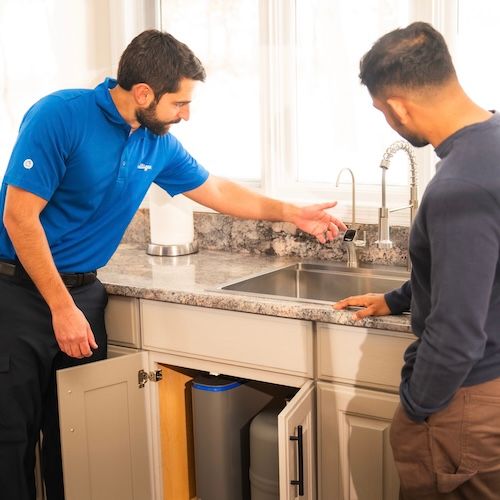
Get a free in-home test. Our technicians measure hardness, iron, chlorine, pH and total dissolved solids at your tap in about 20 minutes. For a well, knowing the iron level along with hardness is important, because it changes which softener fits. Once you have the number, a water softener can be sized to your water and household instead of guessed at.
What a water softener does with Mishawaka water
A softener passes water through a bed of resin beads that trade sodium or potassium for calcium and magnesium. The minerals stay in the tank, and soft water goes to the rest of the house. When the resin fills up, the softener rinses it with brine from the salt tank and starts over.
With water this hard, two things matter more than usual: enough capacity, and efficient regeneration. A high-efficiency model such as the Aquasential Smart High Efficiency Water Softener tracks how much water you use and regenerates only when needed, which saves salt over a year. The Aquasential Select Series covers a range of household sizes. Homes on wells with both hardness and iron often do well with Softener-Cleer, which handles both in one tank.
South Bend Water Works makes a point worth repeating: softened water adds sodium, and the city advises against using it for drinking and cooking. Many households pair a softener with a reverse osmosis system at the kitchen sink for that reason. You can read more about drinking water filtration options, or about treatment for private well water.
FAQs about water hardness in Mishawaka
What is the hardness of Mishawaka city water?
Mishawaka Utilities does not publish a hardness figure. Its water comes from the Saint Joseph Aquifer, where USGS measured a median of 275 mg/L, about 16 grains per gallon, and nearby South Bend reports 19 to 24 grains per gallon. Your home’s number can differ, so test at the tap.
Does Mishawaka soften the water at the treatment plant?
The city’s report and its description of the Juday Creek plant mention removing iron, manganese and arsenic, not hardness. The minerals that come from the aquifer reach your tap.
What should I set my softener to in Mishawaka?
Set it to your measured hardness, plus extra if your water has iron. South Bend suggests its customers start at 19 grains per gallon and adjust. Since Mishawaka does not publish a figure, an in-home test is the reliable way to set it.
Is well water in Granger harder than Mishawaka city water?
It can be, and it often carries more iron. USGS found iron and manganese much higher in the deep part of the St. Joseph aquifer system than in the shallow part. Each well is different.
Find out your number with a free test from Culligan Water of Mishawaka
Culligan Water of Mishawaka has been working on water in Mishawaka, South Bend, Granger, Osceola, Elkhart, Bristol, LaPorte and Niles for decades. Our technicians see city water from five different systems and private wells across three counties, and we know how hard water from the St. Joseph aquifer system can be on a house.
Your free in-home test covers hardness, iron, chlorine, pH and total dissolved solids, with a plain explanation of the results and a written quote if a softener makes sense. Rental and purchase options are both available, along with salt delivery and local service.
Ready for better water? Schedule your free in-home water test and consultation with Culligan Water of Mishawaka today.