Quick answer: A private well around Mishawaka can provide safe drinking water, but only testing tells you whether yours does. No agency monitors private wells after they are drilled. Wells in St. Joseph, Elkhart and LaPorte counties draw from glacial sand and gravel that is very hard and often high in iron and manganese, and state and county health officials point to arsenic, nitrate and bacteria as the health-related risks to check. The Indiana Department of Health recommends testing at least once a year.
Drive a few miles out of Mishawaka toward Granger, north toward the Michigan line, or west toward New Carlisle and Walkerton, and the city water mains thin out. Many homes and farms there rely on their own wells. Across Indiana, the U.S. Geological Survey estimated that about one in four residents supplied their own household water in 2015, around 1.68 million people. In southwest Michigan, around Niles, the share is similar at 26%.
Owning a well means you are the water utility for your house. This guide covers how that differs from city water, the problems wells in this area tend to have, how to test, and what treatment fits each issue.
How a private well differs from city water
Mishawaka Utilities, South Bend Water Works and the City of Elkhart pump from the same aquifer system many private wells tap. The difference is what happens next. City water passes through treatment plants that, in Mishawaka’s case, filter iron, manganese and arsenic, then gets chlorinated and tested thousands of times a year. Mishawaka Utilities alone runs about 18,250 tests annually.
A private well delivers the water straight from the ground to your pressure tank. Nobody adds disinfectant, nobody removes minerals, and nobody tests it unless you ask. The St. Joseph County Department of Health requires a certified lab test for total coliform, E. coli, nitrate and arsenic within 30 days of installing a new well and again when a property with a well is sold, according to its testing requirements. Between those events, the responsibility sits with the homeowner.
That is not a reason to worry. It is a reason to know your numbers.
Where well water around Mishawaka comes from
Most wells in the St. Joseph River valley draw from the St. Joseph aquifer system, a thick deposit of sand and gravel laid down by meltwater from retreating glaciers. In much of northeastern St. Joseph County, a clay-rich layer splits it into a shallow aquifer and a deep aquifer, according to a USGS groundwater-quality study that sampled 30 wells across the area. The two layers produce noticeably different water, which is one reason two neighbors can have such different well tests. West toward LaPorte, wells tap the Kankakee River Basin Aquifer, also sand and gravel.
The Indiana Department of Natural Resources describes groundwater in the St. Joseph River basin as high in alkalinity and hardness, with iron, manganese and total dissolved solids commonly above federal recommended limits.
Common well water problems around Mishawaka
1. Hard water
What you notice: White crust on faucets, spotted dishes, soap that will not lather and a water heater that rumbles.
Why it happens: Groundwater dissolves calcium and magnesium as it moves through the glacial sediment. The USGS study found a median hardness of 275 mg/L, about 16 grains per gallon, with every well but one in the very hard range. Purdue Extension says virtually all Indiana groundwater is very hard and recommends a softener above 180 ppm.
What helps: A water softener sized for your hardness and household. If iron is also present, Softener-Cleer handles both.
2. Iron and manganese
What you notice: Orange or rust-colored stains in sinks, toilets and laundry, a metallic taste, or black specks and smudges from manganese. Water may run clear from the tap and turn color after sitting.
Why it happens: The USGS study found median iron of about 470 micrograms per liter and manganese of about 130 micrograms per liter in the deep aquifer, compared with almost none in the shallow aquifer. Purdue Extension says iron above 0.3 ppm stains fixtures and laundry, and manganese above 0.05 ppm forms black flakes. The deep-aquifer medians are above both.
What helps: Iron-Cleer or Iron-OX5 for moderate to high iron, and Softener-Cleer for lower iron combined with hardness.
3. Hydrogen sulfide (rotten-egg smell)
What you notice: A sulfur odor, sometimes only from the hot water, and tarnished silverware.
Why it happens: The Indiana Department of Health describes sulfates and sulfides as naturally occurring minerals in Indiana groundwater. Purdue Extension notes that hydrogen sulfide causes the rotten-egg smell. If the odor comes only from hot water, a reaction inside the water heater may be the cause rather than the well.
What helps: Sulfur-Cleer or Sulfur-OX3 for whole-house odor once testing confirms the source.
4. Arsenic
What you notice: Nothing. Arsenic has no taste, color or smell.
Why it happens: The Indiana Department of Health says glacial deposits of arsenic exist throughout the state. The St. Joseph County Department of Health states that arsenic exceeds the federal limit of 10 parts per billion in several areas of the county, which is why it is on the county’s required test list. Mishawaka Utilities treats for it at the Juday Creek plant.
What helps: A lab test first. Reverse osmosis at the kitchen sink is the usual choice for drinking and cooking water, and whole-house options depend on the level and the form of arsenic present.
5. Nitrate
What you notice: Nothing. Nitrate is invisible and tasteless.
Why it happens: Fertilizer, manure and septic systems are the usual sources. In the USGS study, nitrate was the only constituent above a federal drinking water limit, in two wells, and it was much higher in the shallow aquifer, with a median of 2.5 mg/L. Purdue Extension says nitrate above 2 ppm usually indicates human-caused contamination. Infants and pregnant women are most at risk from high nitrate.
What helps: A Nitrate Reduction Conditioner for the whole house, or reverse osmosis for drinking water. Deeper or relocated wells are sometimes an option.
6. Bacteria
What you notice: Usually nothing, though sometimes a change in taste or cloudiness after heavy rain.
Why it happens: Bacteria can enter through a damaged well cap, cracked casing, nearby septic system or floodwater. Purdue recommends testing for total coliform bacteria every year and shock chlorinating the well and plumbing if a test comes back positive.
What helps: Fixing the entry point, shock chlorination, and UV disinfection if contamination keeps returning. A reverse osmosis system with the Advanced Post Tank Filter is certified to NSF P231 to reduce bacteria by more than 99.9999% at the drinking water tap.
7. Road salt and solvents near developed areas
USGS found chloride much higher in the shallow aquifer, a median of 32 mg/L, and tied it to road deicing salt and softener salt discharged to septic systems. Near Elkhart, the U.S. EPA oversees several groundwater cleanup sites; at the North Shore Drive site, chlorinated solvents reached residential wells and the state provides point-of-entry carbon filters to affected homes. If your well is near one of these areas, ask about lab testing for volatile organic compounds.
How to check your well water
Test every year. The Indiana Department of Health recommends annual testing at a minimum, and Purdue Extension advises yearly tests for bacteria and nitrate.
Add arsenic. Given the county health department’s findings, arsenic belongs on the list, especially if you have never tested for it.
Test after changes. Flooding, well repairs, a new pump, or changes in taste, smell or color are all reasons to test again.
Look at the wellhead. A loose cap, a cracked casing or water pooling around the top of the well are common entry points for bacteria and surface runoff, and they are usually simple to fix once spotted.
Keep your results. Comparing each year’s test with the last shows whether nitrate or iron is creeping up, which tells you more than any single number.
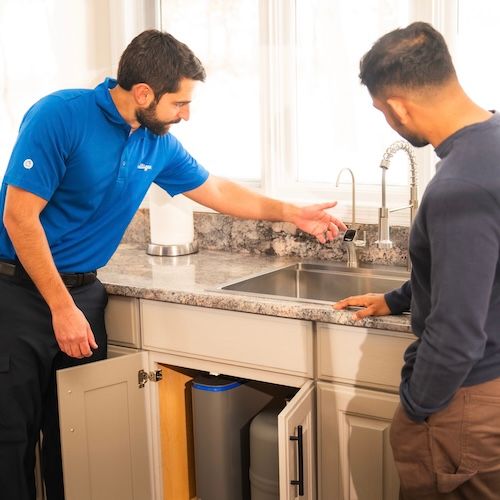
Start with a free in-home test. Our technicians measure hardness, iron, pH, total dissolved solids and chlorine on the spot in about 20 minutes, and we arrange certified lab testing for bacteria, nitrate, arsenic, lead and PFAS. See our water testing page for details, or our well water solutions once you know what you are treating.
Local well water help from Culligan Water of Mishawaka
Culligan Water of Mishawaka has been treating well water in Granger, Osceola, Bristol, New Carlisle, Walkerton and the rural areas around Mishawaka, South Bend, Elkhart, LaPorte and Niles for decades. We see the full range here, from shallow wells with nitrate to deep wells heavy with iron. Every system we install is matched to your test results, and a well often needs more than one piece of equipment working together, such as an iron filter ahead of a water softener with reverse osmosis at the kitchen sink. Rental and purchase options are available, along with salt delivery and bottled water delivery.
Frequently asked questions about private wells around Mishawaka
How often should I test my well in St. Joseph County?
At least once a year for bacteria and nitrate, according to the Indiana Department of Health and Purdue Extension. Add arsenic, and test again after flooding, repairs or any change in the water.
Is my well water safe if it looks and tastes fine?
Not necessarily. Arsenic, nitrate and bacteria cannot be seen, smelled or tasted. Only a lab test confirms them.
What should I do after flooding near the St. Joseph River?
Use bottled water until a test comes back clean. The Indiana Department of Health notes wells may need sanitizing after floods, and Purdue recommends shock chlorination when bacteria are found.
Why is my well water so much harder than my friend’s on city water?
It may not be. City water in Mishawaka is not softened either. Well water often has more iron, though, especially from the deep aquifer, which makes problems more visible.
Does Indiana require testing when I sell a house with a well?
St. Joseph County requires a certified lab test for total coliform, E. coli, nitrate and arsenic when a property with a well changes hands. Check with your county health department if you are in Elkhart or LaPorte County.
Ready for better water? Schedule your free in-home water test and consultation with Culligan Water of Mishawaka today.