Quick answer: Yes, Mishawaka’s tap water meets federal and Indiana drinking water standards. Mishawaka Utilities’ annual report covering 2025 shows no violations, and South Bend, Elkhart and Niles, Michigan, also reported none in their latest reports. Meeting the standards does not mean the water is free of everything, though. Local reports list lead in some homes’ plumbing, chlorine, sodium, very hard water and trace PFAS. Whether any of that matters for your family depends on what reaches your own tap, which is what a home water test measures.
Ask ten people in Mishawaka whether they drink the tap water and you will hear a range of answers. Some fill a glass at the sink without thinking about it. Others keep a pitcher filter in the fridge because of the chlorine taste, or switched to bottled water after reading about lead or PFAS. Most of them are on the same city system. The difference is in what each household cares about and what is going on in their own pipes.
This guide walks through what the local utilities report, what their testing does and does not cover, the issues that come up most often in Mishawaka, South Bend and Elkhart, and how to check your water at home.
What city water testing covers, and what it leaves out
Public water systems in Indiana are regulated under the federal Safe Drinking Water Act and overseen by the Indiana Department of Environmental Management. They test for dozens of contaminants on set schedules and publish the results every year in an annual water quality report, also called a Consumer Confidence Report. Mishawaka Utilities says it runs about 18,250 tests a year, roughly 52 a day.
Those tests describe the water leaving the treatment plants and moving through the city’s mains. They cannot describe what happens after the water passes your meter. Your service line, the solder and fixtures in your home, a water heater full of sediment, or a softener that needs service can all change what comes out of the faucet. That last stretch of pipe is the homeowner’s responsibility, and the city’s sampling only touches a small number of homes on a rotating schedule.
Many substances that affect taste, smell or appliances are not regulated at all, or only have non-enforceable secondary guidelines. Hardness is the biggest example here. A utility can be in full compliance while its water still spots every glass in the cabinet.
City water vs. private wells around Mishawaka
If you pay a water bill to Mishawaka Utilities, South Bend Water Works, the City of Elkhart, LaPorte Water Works or the City of Niles, your water is treated, disinfected and tested by that utility. If you live outside those systems, in parts of Granger, Osceola, New Carlisle, Walkerton or the townships around Bristol, there is a good chance your home is on a private well. The U.S. Geological Survey estimated that about 25% of Indiana residents, roughly 1.68 million people, supplied their own household water in 2015.
No agency tests a private well unless the owner asks. The St. Joseph County Department of Health requires a lab test when a new well is installed and when a home with a well is sold, but between those events, testing is up to you. The Indiana Department of Health recommends testing a private well at least once a year. Our well water page and companion well water guide cover that side in detail. The rest of this article focuses on city water.
Where Mishawaka’s drinking water comes from
Every utility in our service area pumps groundwater. None draws from the St. Joseph River or Lake Michigan.
Mishawaka Utilities operates 23 wells in three well fields drawing on the Saint Joseph Aquifer, treated at the Virgil Street, Division Street and Juday Creek plants, according to its annual water quality report. The water division serves more than 50,000 residents and averages about 8 million gallons a day through 323 miles of main. The Juday Creek plant, which opened to improve pressure and supply on the north side, filters naturally occurring iron, manganese and arsenic.
South Bend Water Works serves about 115,000 customers from nine wellfields, with wells 104 to 237 feet deep in the St. Joseph Tributary Valley System and the St. Joseph and Hilltop aquifers, per its 2024 water quality report.
The City of Elkhart pumps from three wellfields: Northwest, North Main and South. According to the U.S. EPA, the Main Street Well Field supplies about 70 percent of the city’s public drinking water.
LaPorte Water Works uses eight wells in four well fields in the Kankakee River Basin Aquifer, and the City of Niles pumps from its own wells on the Michigan side of the line.
Common tap water concerns in Mishawaka and nearby cities
1. Chlorine
Chlorine is added to keep bacteria from growing in the mains on the way to your house. Mishawaka reported an average of 0.90 ppm in 2025, with a range of 0.20 to 1.4 ppm. South Bend and Elkhart each reported a highest running annual average of about 1 ppm. All are under the 4 ppm limit. Chlorine is doing a necessary job, but some people find the taste and smell noticeable, especially close to a treatment plant. Carbon filtration reduces it at a single tap or for the whole house.
2. Lead from service lines and home plumbing
Lead does not come from the aquifer. It enters water from lead service lines, older solder and some brass fixtures. Mishawaka’s 2023 sampling found a 90th percentile of 8.9 ppb, with one of 30 sites above the 15 ppb action level and a highest result of 22 ppb. South Bend reported a 90th percentile of 4.1 ppb, with five of 176 samples over the action level. Elkhart reported 2 ppb with none over. Niles reported 2 ppb and lists 448 lead service lines and 782 of unknown material among 5,659 total.
Mishawaka, Elkhart, LaPorte and Niles have posted service line inventories, and South Bend is asking residents to report their service line material. If your home was built before the late 1980s, check it, and consider a lab test for lead. The Aquasential Smart Reverse Osmosis system reduces lead by 99.7%.
3. Hard water
Hardness is not a health issue, but it is the most common water complaint in this area. Mishawaka does not publish a hardness figure. South Bend says its water averages 19 to 24 grains per gallon, and a USGS study of St. Joseph County wells found a median of 275 mg/L, about 16 grains per gallon. Our water softener page and the companion hard water guide go into detail.
4. PFAS
PFAS are long-lasting manufactured chemicals found in many consumer and industrial products. Local reports show trace amounts. Mishawaka’s 2025 report lists PFOS up to 4.2 parts per trillion, PFHxS up to 5.9 ppt and PFBS up to 3.4 ppt. South Bend’s 2024 report lists PFOA up to 10.0 ppt with an average of 1.5 ppt, and PFHxS up to 25.6 ppt with an average of 2.9 ppt. Elkhart’s 2025 report shows a highest PFOA result of 5.1 ppt and a running annual average of 2.4 ppt, against a 4.0 ppt limit printed in the report, and a PFHxS average of 8.1 ppt against 10 ppt. Niles tested seven PFAS compounds and detected none.
Elkhart says it intends to meet federal limits ahead of the deadline. Federal PFAS rules and timelines have been under revision, so check your utility’s latest report. The Aquasential Smart Reverse Osmosis system with Total Defense reduces total PFAS by more than 99.99%, and the Whole Home PFAS Water Filter reduces PFAS by more than 99% at every tap.
5. Solvents in groundwater around Elkhart
Elkhart’s industrial history left several groundwater cleanup sites that EPA continues to oversee. A trichloroethylene plume sits near the Main Street Well Field, and remedies are in place to keep it away from the city’s wells. At the North Shore Drive site, chlorinated solvents reached residential wells, and the state provides point-of-entry carbon filters to affected homes. South Bend’s 2024 report also lists trichloroethylene at up to 1.8 ppb, under the 5 ppb limit. City water is tested for these compounds. If you are on a private well near one of the EPA sites, ask about lab testing.
6. Sodium
Mishawaka’s report lists sodium from 15 to 44 ppm. There is no federal limit, but people on low-sodium diets may want to know. South Bend notes that softening adds sodium and advises against using softened water for drinking and cooking. A reverse osmosis system at the kitchen sink handles both.
7. Boil water advisories
South Bend explains that it issues precautionary boil advisories after water main repairs, asking residents to boil water or use bottled water for 72 hours. Elkhart issued a temporary systemwide advisory on October 17, 2024, and lifted it two days later after all tests passed, stating there was no public health concern. Keeping some bottled water on hand is a simple precaution.
How to check your home’s water quality
Read your utility’s annual report. It lists what was found in the city system, and where. It will not show what your own plumbing adds.
Look up your service line. Check your utility’s service line inventory, or ask the utility what is on record for your address.
Pay attention to changes. New tastes, odors, cloudiness or stains are worth a test.
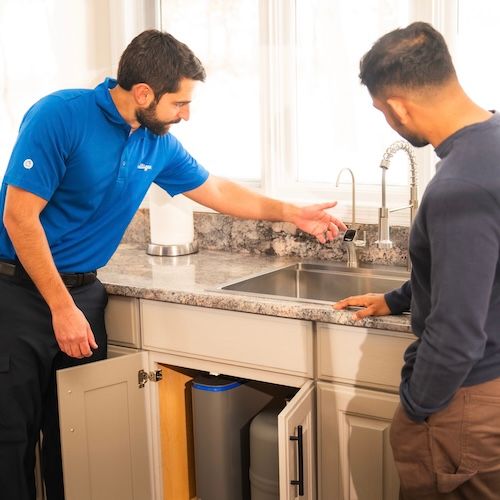
Get a free in-home test. We measure hardness, chlorine, total dissolved solids, pH and iron at your tap in about 20 minutes. For lead, bacteria, nitrate, arsenic or PFAS, we arrange certified lab testing. See our water testing page, or compare filtration options once you have results.
Frequently asked questions about Mishawaka tap water
Has Mishawaka had any water violations?
Mishawaka Utilities’ report covering 2025 lists no violations for any regulated substance. LaPorte reported one monitoring and reporting violation in 2024 for failing to submit coliform results on time, a paperwork issue rather than a contaminant over its limit.
Is there fluoride in Mishawaka water?
Yes. Mishawaka reported 0.61 ppm in 2024. South Bend averages 0.7 ppm, Elkhart reported 0.94 ppm and Niles 0.92 to 1.00 ppm, all under the 4 ppm limit.
Why does my Mishawaka water smell like chlorine?
Chlorine is the disinfectant, averaging 0.90 ppm in 2025. Levels can run higher near a treatment plant. A carbon filter removes the taste and smell.
Does South Bend or Mishawaka water have arsenic?
At low levels. Mishawaka reported 1.4 ppb and South Bend ranged from non-detect to 4.7 ppb, both under the 10 ppb limit. Mishawaka’s Juday Creek plant filters arsenic along with iron and manganese.
Is bottled water better than Mishawaka tap water?
Not necessarily. Filtered tap water handles most local concerns. We also deliver bottled water and coolers for homes and offices that prefer it.
Schedule your free water test with Culligan Water of Mishawaka
Culligan Water of Mishawaka has served homes and businesses in Mishawaka, South Bend, Granger, Osceola, Elkhart, Bristol, LaPorte, New Carlisle, Walkerton and Niles for decades. We know the local systems, the aquifer they draw from, and what tends to show up at the tap. Testing, installation and service are handled by our own technicians. Rental and purchase options are available, along with salt delivery and bottled water delivery.
Ready for better water? Schedule your free in-home water test and consultation with Culligan Water of Mishawaka today.