Quick answer: Very likely, yes, though Kendallville’s own utility does not put a number on it. The Kendallville Water Department does not publish a finished-water hardness figure in its annual water quality report, so for city customers the number depends on the well field and your plumbing, and a home test is how you get it. The data that does exist for Northeast Indiana is consistent. The U.S. Geological Survey describes Indiana groundwater as usually very hard, above 180 mg/L, and the City of Angola measures its raw well water at 18 to 31 grains per gallon before treatment. Private wells across Noble, DeKalb, Steuben and LaGrange counties draw from the same glacial sand and gravel.
Hard water rarely announces itself with a number. It shows up as a white ring around the base of the faucet, a shower door that clouds over a week after cleaning, a coffee maker that needs descaling more often than the manual says, or a water heater that starts to pop and rumble. Each of those is calcium and magnesium carbonate left behind after the water is gone. Below we cover why water in this corner of the state carries so much of it, what it does inside a house, how city and well water compare, and how to find your own reading.
Why groundwater in Northeast Indiana is hard
Every public water system in our area runs on wells. The Indiana Finance Authority’s Northeast Indiana Regional Water Study found that 72 of the region’s 76 public water suppliers rely only on groundwater. That groundwater moves through sand, gravel and clay left by the glaciers, and the state’s St. Joseph River basin assessment describes it as calcium bicarbonate water with high alkalinity and high hardness. The longer water sits in those sediments, the more calcium and magnesium it carries.
USGS put numbers to that statewide in its Indiana ground-water quality summary: median hardness of 286 mg/L in glacial-outwash aquifers and 320 mg/L in Wisconsin-age till aquifers, which works out to roughly 17 and 19 grains per gallon. Purdue Extension’s guide to interpreting water test reports gives a typical Indiana range of 20 to 400 ppm, and anything over 180 mg/L, or 10.5 grains, falls in the very hard category.
The Indiana Department of Natural Resources maps the aquifers here by name. Its LaGrange County aquifer summary includes a Kendallville Aquifer System along with the Howe Outwash, Natural Lakes and Moraines, and Topeka systems, and its Noble County mapping describes the water-bearing layers as mostly sand and gravel, with about 80 percent of wells under confined or semi-confined conditions. Those are the formations feeding both the city wells and the private wells around Avilla, Rome City and Albion.
Is city water or well water harder around Kendallville?
Untreated, they start from the same place, because the cities pump from the same kind of aquifer a rural well does. The difference is what happens before the water reaches you.
Kendallville. The Kendallville Water Department pumps from nine active wells and lists chlorine as its treatment in the 2025 report. The report does not describe softening and does not list hardness, so we do not quote a number for city water. Hardness varies by source and by what happens between the plant and your tap; your water test, or a call to the utility for system data, gives you your home’s figure.
Auburn and Garrett. Auburn’s 2024 water quality report describes ten production wells in North and South well fields drawing from a sand and gravel aquifer. Like Kendallville, it does not publish a hardness figure or describe softening.
Angola. Angola is the one nearby city that publishes the number. Its water department page states that raw water from its ten wells runs 18 to 31 grains per gallon, and that ion exchange softening at the Mill Street and Pokagon Trail plants brings it to an average of about 5 grains. That is still in the moderately hard range, and the raw figure is a fair picture of what an untreated well in Steuben County can look like.
Private wells. No one treats a private well but the owner. A well near Wolcottville, Fremont or out toward Shipshewana delivers whatever the aquifer holds, which is often hard water with iron alongside it.
What hard water does to a home in Kendallville
1. Scale in water heaters, pipes and appliances
Heat drives calcium carbonate out of solution, so the water heater collects more scale than anything else in the house. A layer of mineral on the bottom of the tank or on an electric element insulates it from the water, which means the heater runs longer to deliver the same hot shower. Tankless heaters, dishwashers, coffee makers and ice makers build up scale in their small passages, and faucet aerators and showerheads clog until the flow drops off.
2. Spots, film and soap scum
Hard water reacts with soap to form a sticky curd that clings to tubs, tile and shower doors. Glasses come out of the dishwasher cloudy, and stainless sinks show white water marks. Many families use more detergent and cleaner and still fight a film.
3. Dry skin, dull hair and stiff laundry
The same soap residue stays on skin and hair after a shower, which many people describe as tight or itchy skin and hair that feels heavy. In the laundry room, minerals lodge in fabric fibers, so towels come out scratchy and darks fade faster.
4. Iron stains that come along for the ride
In this region, hardness and iron often arrive together. USGS reports that large iron concentrations are common in Indiana groundwater, with median values of 900 micrograms per liter in outwash aquifers and 1,900 in till aquifers, against a 300 microgram guideline for staining. Iron leaves orange marks in toilets and on light-colored laundry. A softener handles small amounts of dissolved iron; higher levels need dedicated iron filtration ahead of it.
How a water softener handles Kendallville’s hard water
A softener passes water through a bed of resin beads that trade sodium or potassium for calcium and magnesium. When the resin fills up with hardness minerals, the softener rinses it with brine and starts again. The key is sizing: the unit needs enough capacity for your grain level and the number of people in the house, or it either runs out of soft water or wastes salt.
The Aquasential Smart High Efficiency Water Softener measures how much water you actually use and regenerates only when needed, which saves salt and water compared with a timer-based unit. The Aquasential Select Series and Aquasential Advantage Whole Home softeners cover a range of capacities. For wells with heavy iron or a sulfur smell, we usually pair the softener with an Iron-Cleer, Iron-OX5 or Sulfur-Cleer system, which you can read about on our well water solutions page. Softened water is not a substitute for drinking water filtration, so many homes add reverse osmosis at the kitchen sink as well.
We offer both rental and purchase, and our drivers deliver softener salt across Noble, DeKalb, Steuben and LaGrange counties.
How to check your home’s water hardness in Kendallville
Read your utility’s report. Kendallville, Auburn and Angola post annual water quality reports online. Kendallville’s and Auburn’s do not list hardness, but you can call the utility and ask for system data. Angola’s water page lists its raw and treated figures.
Watch for the signs. White crust on faucets, cloudy glassware, soap that will not lather, and a noisy water heater all point to hard water, though none tells you how hard.
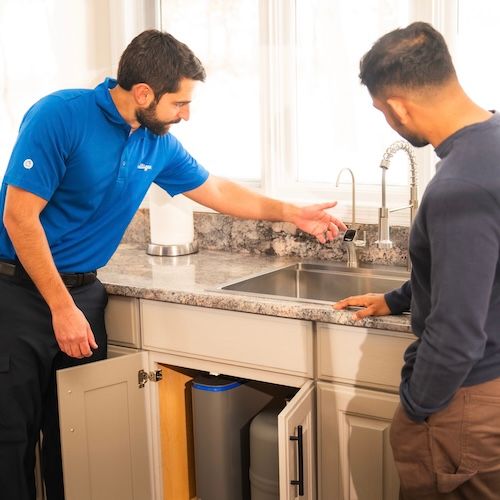
Get a real number. Our free in-home test measures hardness, iron, chlorine, pH and total dissolved solids at your sink in about 20 minutes. We explain what each number means and, if a softener makes sense, size it to your actual grain load. Details are on our water testing page.
FAQs about hard water in Kendallville
How hard is Kendallville city water?
The Kendallville Water Department does not list a hardness figure in its annual report. Regional groundwater is usually very hard according to USGS, and a home test gives you your own reading.
Does Kendallville soften its water at the plant?
The city’s 2025 report describes chlorine disinfection and does not mention softening. Angola is the nearby system that softens at the plant, bringing raw water of 18 to 31 grains down to about 5.
Is well water harder than city water near Kendallville?
Untreated, both come from similar glacial aquifers. A private well gets no treatment at all, so it delivers the full hardness and iron the aquifer holds.
Will a softener fix orange stains?
It can handle small amounts of dissolved iron. Heavier iron, common in Northeast Indiana wells, needs an iron filter such as Iron-Cleer ahead of the softener.
Start with a free hard water test from Culligan Water Conditioning of Northeast Indiana
Culligan Water Conditioning of Northeast Indiana has worked on water in this region for decades from our office on West North Street in Kendallville. We serve Kendallville, Avilla, Rome City and Albion, Auburn, Garrett and Butler, Angola and the homes around Lake James, Fremont, LaGrange, Wolcottville and Shipshewana. Our technicians see city water and rural wells in the same week, so we know which areas run hard, which stain orange, and what size system a household actually needs. A local specialist tests your water, explains the results plainly, and lays out rental and purchase options with a written quote.
Ready for better water? Schedule your free in-home water test and consultation with Culligan Water Conditioning of Northeast Indiana today.