Quick answer: Many private wells around Kendallville produce good water, but no one checks them for you. IDEM states that private well quality in Indiana is not regulated, and the Indiana Department of Health recommends testing at least once a year. Hardness and iron are the most common issues in Northeast Indiana, followed by hydrogen sulfide odor, manganese and, in the outwash areas of LaGrange and Steuben counties, nitrate. Bacteria can turn up in any well after flooding or a damaged cap. A test is the only way to know which of these apply to yours.
A lot of our customers live on wells: farms between Kendallville and LaGrange, homes on the lakes around Rome City and Angola, newer houses on acreage outside Auburn and Avilla, and Amish and English households alike in LaGrange County. This guide covers how a private well differs from city water, the problems we see most often in Noble, DeKalb, Steuben and LaGrange counties, and how to check and treat your water.
Municipal water vs. private well water: what’s the difference?
City water in Kendallville, Auburn and Angola comes from wells too, but those wells are operated by licensed staff, disinfected, sampled on a schedule, and reported publicly every year in documents like Kendallville’s annual water quality report. A private well gets none of that unless the owner arranges it.
Private wells are common here. USGS estimated in its Indiana ground-water quality summary that groundwater supplies nearly 60 percent of Indiana residents and that about half of those people use their own wells. The state’s Northeast Indiana Regional Water Study shows LaGrange County with the largest self-supplied household water demand of our four counties, ahead of Noble, Steuben and DeKalb. We could not find a county-by-county share of homes on wells from a government source, but outside the town limits, a well is the norm.
Where does well water around Kendallville come from?
Nearly every well in the area taps glacial deposits. The Indiana Department of Natural Resources describes Noble County’s water-bearing layers in its potentiometric surface mapping as mostly sand and gravel, averaging about 20 feet thick, with about 80 percent of wells under confined or semi-confined conditions, meaning a layer of clay or till sits above the water. Its LaGrange County aquifer summary lists the Kendallville, Howe Outwash, Natural Lakes and Moraines, Topeka, Nappanee and St. Joseph aquifer systems. The surface deposits of the Howe Outwash and St. Joseph systems are rated highly susceptible to contamination, while the Kendallville system is less prone because its sand and gravel is discontinuous.
That geology explains most of what follows. Sediment rich in limestone and dolomite makes the water hard. Iron and manganese stay dissolved underground and only show themselves once the water meets air in your sink, toilet tank or laundry. And where sand and gravel reach the surface, whatever is applied to the land can reach the water.
Common well water quality issues around Kendallville
1. Hard water
USGS reports that Indiana groundwater is usually very hard, above 180 mg/L, with median values of 286 mg/L in outwash aquifers and 320 mg/L in till aquifers, about 17 and 19 grains per gallon. The City of Angola, on its water department page, puts its raw well water at 18 to 31 grains per gallon before treatment. A private well gets no treatment, so it delivers the full amount. Expect scale on fixtures, spotty dishes, and a water heater working harder than it should. A properly sized softener is the answer.
2. Iron and manganese
Iron is the problem we see most on wells here. USGS found that large iron concentrations are common in Indiana groundwater, with median values of 900 micrograms per liter in outwash aquifers and 1,900 in till aquifers, three to six times the 300 microgram level where staining starts. Purdue Extension gives a typical range of 0.1 to 3.0 ppm. The water may look clear from the tap and then turn orange in the toilet tank or leave rust stains on laundry. Manganese, often found alongside iron, leaves black or brown specks. Fremont’s town water plant runs hypochlorite and five greensand filters just to remove iron and manganese, according to its 2025 water quality report, which gives a sense of how much is in local groundwater.
3. Hydrogen sulfide (rotten-egg odor)
The Indiana Department of Health’s guidance on sulfates and sulfides explains that hydrogen sulfide can come from natural minerals, decaying plant material or sulfur-reducing bacteria. It is not typically a health risk, but it causes rotten-egg odors and a bitter taste, and Purdue notes it tarnishes silver at levels as low as 0.05 ppm. If the smell shows up only in hot water, the water heater’s anode rod is a likely cause. The department also advises measuring the concentration before buying treatment, which is exactly what we do.
4. Nitrate
Nitrate is a health concern, especially for infants, and the federal limit is 10 mg/L. In the regional water study, state groundwater sampling from 2010 to 2018 found nitrate in 41 percent of 79 LaGrange County samples, with a mean of 2.88 mg/L, a high of 15 mg/L and three samples over the limit. Steuben County samples averaged about 1 mg/L, and Noble County samples were very low. All nine samples in the region that exceeded the limit came from outwash counties. Shallow wells near fields, feedlots or septic systems deserve an annual nitrate test.
5. Bacteria
Coliform bacteria can enter a well through a cracked casing, a loose or damaged cap, surface water pooling around the wellhead, or a failing septic system nearby. You cannot see, smell or taste it. The Indiana Department of Health recommends bacteria testing at least annually and notes that a well may need sanitization after flooding.
6. Arsenic and other metals
Arsenic occurs naturally in some Indiana groundwater. The LaGrange town system reported 3.1 ppb in its 2023 report, under the 10 ppb limit, which tells us it is present in the area at low levels. We did not find county-wide private well data, so arsenic belongs on a one-time lab test rather than an assumption either way.
What treatment do Kendallville-area wells usually need?
Most wells here need two things: a softener for hardness and iron treatment. For light iron, a properly sized softener can handle it. For heavier iron and manganese, we install Iron-Cleer or Iron-OX5 ahead of the softener. For sulfur odor, Sulfur-Cleer or Sulfur-OX3. If testing finds bacteria, UV disinfection treats every drop as it enters the house, and the Nitrate Reduction Conditioner addresses high nitrate. For drinking and cooking water, an Aquasential Smart Reverse Osmosis system adds another layer; with the Advanced Post Tank Filter, it is certified to NSF P231 to reduce bacteria by more than 99.9999 percent. See our well water solutions, water softeners and water filtration pages for details.
How to check your well water quality in Kendallville
Test every year. At minimum, test for bacteria and nitrate annually, as the Indiana Department of Health recommends. Test again after flooding, well repairs, or any change in taste, smell or color.
Use the county health department or a certified lab. The Noble County Health Department collects samples on Tuesdays by noon and sends them to Hoosier Microbiology Laboratory, with separate bottles for bacteria, for nitrate and fluoride, and for metals including arsenic, lead, iron and manganese. The state’s well testing page lists certified drinking water labs.
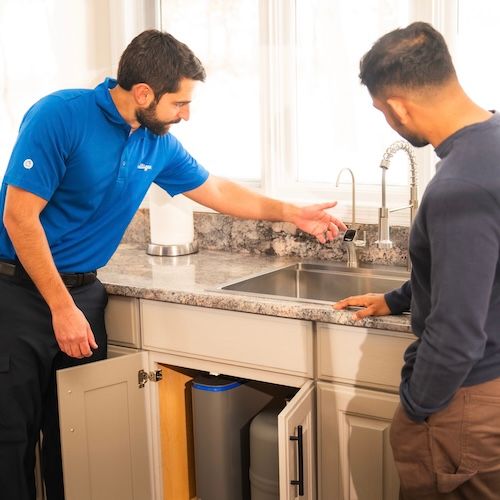
Add a free in-home test. Our technicians measure hardness, iron, pH, total dissolved solids and chlorine at your tap in about 20 minutes, which gives us what we need to size treatment. We can also arrange certified lab testing for bacteria, nitrate, lead, arsenic and PFAS. Our water testing page has the details.
Sample the right way. Take the sample from a cold-water tap that does not run through a softener or filter, follow the lab’s bottle instructions exactly, and deliver it within the time the lab requires. A sample taken after treatment tells you about the equipment, not the well. If you already have equipment, we can test both before and after it to see whether it is still doing its job.
Keep a record. Save every result with its date. A slow rise in nitrate, or a change in iron after a new pump, is much easier to spot when you can compare one year to the next.
After storms and flooding
Heavy spring rain and snowmelt can push surface water toward a wellhead, especially in low ground near lakes and streams. If floodwater reached your well, use bottled water until a test confirms the well is safe. Have the well disinfected, typically by shock chlorination and flushing, then retest for bacteria. Check that the cap is tight and that soil slopes away from the casing. Treatment equipment that was submerged may need service or new media.
Get local well water expertise from Culligan Water Conditioning of Northeast Indiana
For decades, Culligan Water Conditioning of Northeast Indiana has worked on private wells across Noble, DeKalb, Steuben and LaGrange counties from our office on West North Street in Kendallville. We serve Avilla, Rome City, Albion, Auburn, Garrett, Butler, Angola, Fremont, LaGrange, Wolcottville and Shipshewana, and we know how much the water can change from one road to the next. A local specialist will test your well, explain the results, and lay out a treatment plan with rental and purchase options, salt delivery and bottled water delivery if you need it while you wait.
Frequently asked questions about private wells near Kendallville
How often should I test my well near Kendallville?
At least once a year for bacteria and nitrate, per the Indiana Department of Health, and again after flooding or repairs.
Why does my well water stain orange?
Iron. It is common in Northeast Indiana groundwater, and heavier amounts need an iron filter ahead of the softener.
Is nitrate a problem in LaGrange County wells?
It can be. State sampling found three LaGrange County samples above the 10 mg/L limit. Wells near fields should be tested yearly.
Should I test my well for PFAS?
Utility PFAS testing does not cover private wells. A one-time certified lab test is a reasonable step, and RO with Total Defense reduces total PFAS by more than 99.99 percent.
Can a softener fix rotten-egg smell?
No. Hydrogen sulfide needs its own treatment, such as Sulfur-Cleer, sized to the measured concentration.
Ready for better water? Schedule your free in-home water test and consultation with Culligan Water Conditioning of Northeast Indiana today.