Quick answer: Yes. In the Kendallville Water Department’s 2025 annual water quality report, every contaminant in the results table came in below its federal limit: nitrate at 0.89 ppm against a 10 ppm limit, a lead 90th percentile of 4.06 ppb against a 15 ppb action level, and PFAS below reporting levels in 2023 testing. The one violation listed was administrative, a report delivered a few days late. Meeting standards at the system level is not the whole story, though. Service lines, household plumbing, chlorine taste and hard water all shape what comes out of your faucet, and those are the things a home test and the right filter address.
People ask us whether Kendallville tap water is safe for lots of reasons. Some just moved here from a city with softer water and are surprised by the spots on their dishes. Some live in the older part of town and have heard about the lead service line project. Some notice a chlorine smell in the shower. This guide walks through where the water comes from, what the city’s testing covers, the handful of issues that matter most locally, and how to check your own water.
Where does Kendallville’s drinking water come from?
Kendallville runs entirely on groundwater. The Kendallville Water Department pumps from nine active wells, numbered 2A, 3A, 8 and 10 through 15, and has retired well 9. The water is disinfected with chlorine and stored in towers on Drake Road, Krueger Street and Marion Drive before it reaches homes.
The wells draw from glacial deposits of sand and gravel. The Indiana Department of Natural Resources maps a Kendallville Aquifer System in its St. Joseph River basin aquifer summary and rates it less prone to contamination than many nearby systems, because its sand and gravel layers are discontinuous and surface deposits are largely absent. The same assessment describes the region’s groundwater as calcium bicarbonate water with high hardness, which is why spots and scale are so familiar here.
Neighboring towns work the same way. Auburn’s 2024 report describes ten wells in two well fields drawing from a sand and gravel aquifer. Angola pumps from ten wells between 80 and 244 feet deep, and Fremont uses two gravel-packed wells about 176 feet deep. Across the region, 72 of 76 public water suppliers rely only on groundwater, according to the state’s Northeast Indiana Regional Water Study.
What municipal testing does and does not tell you
A utility samples water at the treatment plant, in the distribution system and at a set of homes for lead and copper, then reports the results once a year. That testing tells you the system as a whole met federal and state rules. It does not tell you what happens inside your service line, your home’s pipes, or your water heater.
Kendallville’s 2025 report is a good example. It shows one routine total coliform sample tested positive in June 2025, out of at least ten samples a month, which triggers a follow-up assessment under federal rules. It lists one copper sample above the 1.3 ppm action level even though the 90th percentile, 0.57 ppm, was well below it. Copper at a single tap usually comes from that building’s plumbing, which is the point: results can vary house to house.
The report also leaves things out. It does not list hardness, iron, sodium or total dissolved solids, which are the numbers that determine whether your water spots, stains or scales. Those are easy to measure at your sink.
City water vs. private well water around Kendallville
Inside city limits, the utility handles disinfection, monitoring and reporting. Outside them, the homeowner does it all. IDEM states plainly on its private well information page that private water well quality is not regulated. USGS has estimated that groundwater supplies nearly 60 percent of Indiana residents and that about half of those people get it from their own wells. If you live on a rural road between Kendallville and Wolcottville, or in the lake country around Sylvan Lake and Lake James, there is a good chance you are one of them. Our well water solutions page and our companion well water guide cover what to test for.
Common tap water concerns in Kendallville
1. Chlorine taste and smell
Chlorine keeps water safe as it travels through miles of main. Kendallville’s highest running annual average in 2025 was 1.43 ppm, with individual samples ranging from 0.5 to 2.5 ppm, under the 4 ppm limit. Many people notice it in a glass of cold water, in coffee, or as a pool smell in a hot shower. Activated carbon removes it, either at the kitchen sink with reverse osmosis or for the whole house with a carbon filter. The city reports chlorine, not chloramine, which makes carbon filtration simple.
2. Lead from service lines and older plumbing
Kendallville’s lead results are good at the system level: a 90th percentile of 4.06 ppb with no sites over the action level in 2023 to 2025 sampling. The risk sits in older service lines and household fixtures. The city’s Lead Line Replacement Program submitted its service line inventory to the state in October 2024, and Phase 1 covers the oldest part of town, where about 545 lines need replacing. Work began in April 2026 at no extra fee to customers who sign the city’s right-of-entry form, and the city offers a free lead test three to six months after replacement. In the meantime, run the cold tap for a minute after water has sat overnight, use cold water for cooking, and consider an NSF-certified filter. Our Aquasential Smart Reverse Osmosis system reduces lead by 99.7 percent.
Auburn’s 2023 sampling shows why this matters at the home level: its 90th percentile was 4.0 ppb, yet two of 30 homes tested above the action level, with a high of 32 ppb.
3. Hard water
Hardness is not a health concern, but it is the issue we hear about most. Kendallville does not publish a hardness figure. USGS reports that Indiana groundwater is usually very hard, and Angola measures 18 to 31 grains per gallon in its raw well water. If you are fighting white crust and spotty dishes, a water softener is the fix, and our companion article on Kendallville hard water explains how to size one.
4. PFAS
Kendallville tested for 29 PFAS compounds in March, September and November 2023 under EPA’s national monitoring rule, and every result was below the minimum reporting level. Auburn ran the same testing and directs customers to call the utility for its results. IDEM also facilitated PFAS monitoring at every community water system in the state between 2021 and 2023. Private wells are outside all of that. For extra protection, the Aquasential Smart RO with Total Defense reduces total PFAS by more than 99.99 percent, and our Whole Home PFAS Water Filter reduces PFAS by more than 99 percent at every tap.
5. Nitrate and other agricultural chemicals
Kendallville’s nitrate was 0.89 ppm in 2025, under a tenth of the limit. Nitrate is more of a concern in the outwash aquifers to the north and west. State groundwater sampling summarized in the regional water study found three LaGrange County samples above the 10 mg/L limit, with a high of 15 mg/L. The LaGrange town system reported 0.464 mg/L in its 2023 report, along with arsenic at 3.1 ppb, under the 10 ppb limit. If you are on a well near farm fields, nitrate belongs on your test list.
6. Fluoride
Kendallville’s report lists fluoride at 0.677 ppm, well under the 4 ppm limit, without saying whether it is added or natural. Angola adjusts to 0.7 mg/L and LaGrange reports adjusted fluoride at 0.57 mg/L, while Auburn’s 1.02 ppm is listed as natural. Reverse osmosis reduces fluoride if you prefer less of it.
How to check your water quality in Kendallville
Start with the annual report. Kendallville posts its consumer confidence report online. It tells you what the city tested for and what it found.
Check your service line. The city’s lead service line inventory and replacement program page tell you whether your street is in Phase 1. Older homes should consider a certified lead test either way.
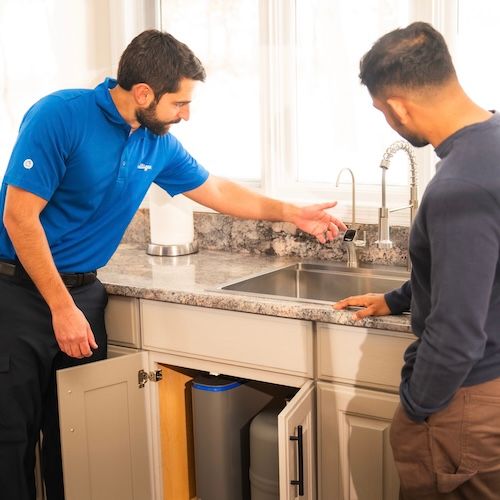
Test at your tap. Our free in-home test measures hardness, chlorine, total dissolved solids, pH and iron in about 20 minutes. For lead, bacteria, nitrate, arsenic or PFAS, we can arrange certified lab testing. Learn more on our water testing page, and see filter options on our water filtration page.
Schedule your free water test with Culligan Water Conditioning of Northeast Indiana
For decades, Culligan Water Conditioning of Northeast Indiana has helped families and businesses across Noble, DeKalb, Steuben and LaGrange counties understand their water. From our office on West North Street, we serve Kendallville, Avilla, Rome City, Albion, Auburn, Garrett, Butler, Angola, Fremont, LaGrange, Wolcottville and Shipshewana. Whether you want better-tasting drinking water, a plan for lead in an older home, or bottled water and cooler delivery for the office, a local specialist will test your water, explain the results, and give you a written quote with rental and purchase options.
Frequently asked questions about Kendallville tap water
Can I drink Kendallville tap water without a filter?
Yes. The city’s 2025 results were under federal limits for every contaminant listed. A filter improves taste and adds protection against lead from older plumbing, and it is the easiest upgrade for renters.
Why does my water smell like chlorine?
Kendallville disinfects with chlorine, averaging up to 1.43 ppm in 2025. Carbon filtration or reverse osmosis removes the taste and smell.
Is Kendallville water treated with chloramine?
No. The 2025 report lists chlorine as the disinfectant, which standard carbon filters remove easily.
Does Kendallville have lead pipes?
Some older service lines are lead. The city is replacing about 545 lines in its oldest area in Phase 1 and must replace all lead lines by 2037.
Why is my water hard if it meets standards?
Hardness is not regulated as a health issue. Kendallville’s groundwater carries calcium and magnesium from glacial sediments, and the city does not soften it.
Ready for better water? Schedule your free in-home water test and consultation with Culligan Water Conditioning of Northeast Indiana today.