Quick answer: Yes. Fort Wayne’s city water is hard. Fort Wayne City Utilities reports that finished water from the Three Rivers Filtration Plant averaged 130 mg/L of hardness in 2025, about 7.6 grains per gallon (gpg), and reached 174 mg/L, about 10.2 gpg, at its highest. That is after the plant lime-softens the St. Joseph River. Private wells across Allen County draw from groundwater the Indiana DNR describes as generally hard to very hard. City customer or well owner, a test at your own tap is the way to get your number.
People who move to Fort Wayne from somewhere else tend to notice the water within a month. The kettle grows a white lining. Glasses come out of the dishwasher with a haze no detergent seems to fix. The showerhead starts spraying sideways. None of this is a health problem, but it costs money over time, mostly in water heaters, dishwashers and fixtures that wear out early. Here is where Fort Wayne’s hardness comes from, how it compares around the region, what it does inside a house, and how to measure it at home.
Is city water or well water harder around Fort Wayne?
Usually the well water, though both are hard enough to cause trouble.
Fort Wayne is unusual among Indiana cities its size because it drinks river water. The Three Rivers Filtration Plant pulls about 36 million gallons a day from the St. Joseph River and treats it with lime (calcium hydroxide), which knocks out part of the hardness before the water ever leaves the plant. Even so, the city’s 2026 Annual Drinking Water Quality Report lists an average of 130 mg/L for 2025. On the hardness scale most water professionals use, anything above about 7 gpg is considered hard, so the average sits just over that line and the high end, near 10.2 gpg, sits well above it. River water also changes with the seasons, which is why some months feel harder than others.
Groundwater is a different story. The Indiana Department of Natural Resources’ Maumee River basin water resource assessment says groundwater across the basin, which takes in most of Allen County, is generally hard to very hard. That water moves slowly through glacial sand and gravel and through the limestone bedrock below it, picking up calcium and magnesium along the way. The U.S. Geological Survey has mapped those buried outwash aquifers around Fort Wayne, and to the north and west of the city they merge into a single aquifer more than 100 feet thick. Private wells in Huntertown, Leo-Cedarville, Grabill and the farm country around Monroeville tap the same kind of water.
The neighboring city systems also run on groundwater. Decatur pumps six wells in two well fields from a bedrock aquifer, according to its 2025 water quality report. Huntington’s 2025 report lists wells in the Upper Wabash Basin aquifer. Bluffton is on groundwater too. None of those three reports publishes a finished-water hardness figure, and neither does Van Wert, Ohio, which lime-softens Town Creek reservoir water. Hardness in those towns varies by source and by what happens between the plant and your tap, so check the utility’s annual report or contact the utility for system data. A free in-home test gives your home’s number in minutes.
Hard water problems Fort Wayne homeowners run into
Hard water does its damage slowly, which is why it is easy to ignore until something breaks.
Scale on fixtures and glass
When hard water dries, the calcium and magnesium stay behind. On faucets and shower doors that shows up as a chalky white crust. On dishes it is spotting and a cloudy film. Cleaning removes it for a week or two, and then it is back, because every gallon brings more minerals.
Water heaters and appliances
Heat makes hardness minerals drop out of solution, so the water heater takes the worst of it. Scale collects on the bottom of a tank heater, insulating the water from the burner and forcing it to run longer. Tankless units can clog their heat exchangers. Dishwashers, washing machines, coffee makers and ice makers all collect scale in valves and lines, which shortens their service life and drives up repair calls.
Soap, skin and laundry
Hard water reacts with soap to form a sticky curd instead of lather. You use more shampoo and detergent, towels come out stiff, and many people notice dry skin and dull hair, especially in a northeast Indiana winter when the furnace already dries the air.
Plumbing in older neighborhoods
Older houses in West Central and other established parts of Fort Wayne may still have galvanized steel lines somewhere in the house. Hard water scale narrows those pipes over the years and lowers water pressure. Newer copper and PEX holds up better, but scale still builds at fixtures and in appliances.
What a water softener does with Fort Wayne water
A softener uses ion exchange: water passes through resin beads that hold sodium or potassium, and the beads trade those for calcium and magnesium. The resin periodically rinses itself with brine and starts over. At around 7.6 gpg on city water, a properly sized softener stops new scale from forming and slowly clears the existing film from fixtures. For wells, where hardness and iron often come together, the softener may need an iron filter ahead of it. Our water softener options include the Aquasential Smart High Efficiency Water Softener, which regenerates based on how much water your household actually uses, and we deliver salt across our service area so you do not have to haul it home.
How to check your home’s water hardness
Read your utility’s report. Fort Wayne posts its annual report and current water quality data online. Remember that the report gives a citywide average; your tap may run higher or lower depending on the month.
Watch for the signs. White crust on faucets, spotted glasses, scale in the kettle and a water heater that rumbles or pops all point to hardness.
Use test strips. Hardware-store strips give a rough range. They are a reasonable first look but not precise enough to size a softener.
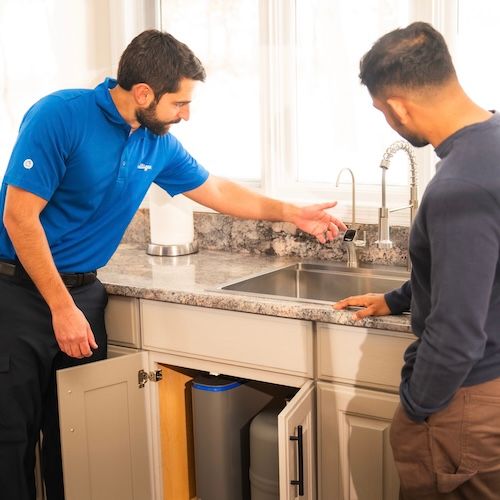
Get a professional test. Our free in-home water testing measures hardness, iron, chlorine, pH and total dissolved solids in about 20 minutes. If you are on a well, we also look at whether iron or sulfur needs to be handled before softening.
FAQs about hard water in Fort Wayne
Does the Three Rivers plant soften Fort Wayne’s water?
Partly. The plant uses lime softening as part of treatment, which removes some calcium and magnesium. Finished water still averaged about 7.6 gpg in 2025, which is hard enough to leave scale.
Is hard water in New Haven the same as in Fort Wayne?
Homes on the same system will see similar hardness, but the number at any one tap depends on the source and the season. Private wells outside town tap groundwater, which the Indiana DNR describes as generally hard to very hard in the Maumee basin. A test gives the actual figure.
Is hard water safe to drink?
Yes. Calcium and magnesium are not a health risk at the levels found here. The trouble is scale and wear on plumbing and appliances, not your health.
Can a filter pitcher fix hard water?
No. Pitchers and faucet filters improve taste and reduce certain contaminants in drinking water, but they leave hardness minerals in place and do nothing for the water heater, shower or dishwasher.
How do I know what size softener I need in Huntington or Decatur?
Size depends on your hardness, any iron present and how much water your household uses. Since neither city publishes a hardness figure, the reliable route is to test your tap and size the softener from that result.
Start with a free hardness test from Culligan Water Conditioning of Fort Wayne
Culligan Water Conditioning of Fort Wayne has been treating water in Fort Wayne, New Haven, Huntertown, Woodburn, Huntington, Decatur, Bluffton, and Paulding and Van Wert, Ohio, for decades. We work with St. Joseph River water from the Three Rivers plant, city well water in the smaller towns, and private wells that change from one road to the next. When you schedule a free in-home test, we measure your hardness, explain what it means for your house and tell you plainly whether a softener makes sense. If it does, we walk through rental and purchase options, salt delivery and service so you can choose what fits.
Ready for softer water? Schedule your free in-home water test and consultation with Culligan Water Conditioning of Fort Wayne today.