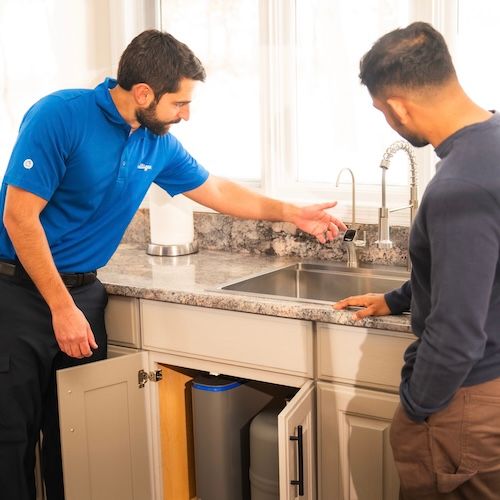
Quick answer: Well water around Fort Wayne can be safe to drink, but only testing confirms it. Private wells in Indiana are not regulated by IDEM or the EPA, so the Indiana Department of Health puts responsibility for testing on the owner and recommends doing it at least once a year. Groundwater in Allen County and the surrounding Maumee River basin is generally hard to very hard, often carries iron, and in bedrock wells can smell of hydrogen sulfide. Bacteria and nitrate are risks wherever septic systems, fields and livestock are close by.
Drive ten minutes outside Fort Wayne in almost any direction and city water mains give way to private wells. In Grabill, Harlan, Woodburn, Monroeville, Leo-Cedarville and much of the countryside toward Huntington, Decatur, Bluffton and the Ohio line, a well in the yard is how homes get their water. Owning one means you are your own water utility. This guide explains how well water differs from city water, the problems we see most in this part of northeast Indiana, how to test, and what treatment fits each issue.
Municipal water vs. private well water
City water customers in Fort Wayne get water that the utility treats at the Three Rivers Filtration Plant and tests on a federal schedule, with results published every year. Well owners get none of that by default. Nobody samples a private well unless the owner arranges it, and nobody treats it unless the owner installs equipment.
That matters more in Indiana than people realize. Purdue Extension reports that more than 60% of the state’s drinking water comes from groundwater, and about half of that comes from private wells. Testing is not complicated or expensive, but it has to be done regularly because groundwater changes, wells age, and what happens on neighboring land can reach your water.
Where does well water around Fort Wayne come from?
Most wells in Allen County tap one of two kinds of aquifer. The first is glacial sand and gravel buried under layers of clay-rich till. The Indiana Geological and Water Survey calls the Trafalgar basal outwash an important aquifer throughout the county and describes channels of sand and gravel 50 to 100 feet thick in southwest Allen County. In the north, around Huntertown, the Huntertown Formation is mostly sand. The overlying Lagro tills act as the main confining layer that helps protect those aquifers from the surface.
The second is the limestone bedrock beneath the glacial sediments. The U.S. Geological Survey modeled that limestone together with the deepest sand and gravel when it studied groundwater availability near Fort Wayne, and found the outwash layers merge into one aquifer more than 100 feet thick to the north and west of the city. City systems in the region use the same groundwater: Decatur pumps six wells from bedrock, and Huntington draws from the Upper Wabash Basin aquifer.
Common well water problems around Fort Wayne
1. Hardness
The Indiana DNR’s Maumee River basin water resource assessment describes groundwater across the basin as generally hard to very hard. Water moving through limestone and glacial deposits dissolves calcium and magnesium, and wells here often test harder than Fort Wayne’s river water, which averaged about 7.6 grains per gallon in 2025 after the plant softened it. The result is scale in water heaters, pressure tanks and fixtures, plus spotted dishes and stiff laundry. An Aquasential softener sized to your well’s hardness and iron handles it. See our water softener options.
2. Iron and rust staining
The same DNR assessment says iron in basin groundwater commonly exceeds the secondary standard, the level where it starts to cause staining and metallic taste. The Indiana Geological and Water Survey traces the iron staining found in Allen County tills to dissolved iron that probably comes from pyrite in the till. In the house, iron shows up as orange or brown stains in sinks, toilets and laundry, and can feed iron bacteria that leave slime in toilet tanks. Iron-Cleer and Iron-OX5 systems oxidize and filter iron before it reaches your fixtures.
3. Hydrogen sulfide and sulfate
If your water smells like rotten eggs, hydrogen sulfide is the likely cause. The DNR reports hydrogen sulfide is often detected in the Silurian-Devonian carbonate bedrock under the basin, and that sulfate exceeded the secondary standard in more than 70% of the bedrock wells it sampled. High sulfate can give water a bitter taste and a laxative effect for people not used to it. Sulfur-Cleer and Sulfur-OX3 systems remove hydrogen sulfide at the point of entry. If the smell appears only on the hot side, the water heater’s anode rod may be the culprit.
4. Bacteria
The Indiana Department of Health lists bacteria from human and animal waste, failing septic systems and large animal herds among the main concerns for private wells. Shallow wells, cracked casings and wells in low spots are the most vulnerable. Purdue Extension recommends shock chlorinating the well and plumbing if a test comes back positive, then retesting. For wells that keep testing positive, UV disinfection provides continuous protection.
5. Nitrate
Nitrate comes from fertilizer, manure and septic systems, and northeast Indiana has plenty of all three. Purdue Extension reports that statewide studies found nitrate above the drinking water standard in 3.5% to 4.5% of private wells. The number is small, but the stakes are high for babies, and Purdue advises that any home with a private well where an infant is present or expected should have the water tested. Reverse osmosis reduces nitrate in drinking water, and a Nitrate Reduction Conditioner treats the whole house.
6. Arsenic
Arsenic occurs naturally in glacial deposits found throughout Indiana, according to the Department of Health. It has no taste, color or smell, so a lab test is the only way to find it. Decatur’s city wells, for comparison, reported arsenic at up to 3.0 ppb, under the 10 ppb limit. Private wells can be higher or lower. A reverse osmosis system at the kitchen tap is the usual fix for drinking and cooking water.
Matching treatment to what your well actually has
Well treatment works best when each piece is chosen for a specific problem, and when the pieces go in the right order. Around Fort Wayne, a typical sequence looks like this.
Remove iron and sulfur first. Iron and hydrogen sulfide foul softener resin and stain fixtures, so an oxidizing filter such as Iron-OX5 or Sulfur-OX3 usually sits closest to the pressure tank. For lighter iron, Iron-Cleer may be enough on its own.
Soften next. Once iron is under control, an Aquasential softener can take out calcium and magnesium without clogging. Softener-Cleer keeps resin clean on wells where some iron still gets through.
Disinfect if bacteria are a risk. A UV disinfection unit treats every gallon as it passes, which suits shallow wells, older casings and properties near livestock or septic fields. UV works best on water that has already been filtered and softened, which is why it usually goes last on the main line.
Polish drinking water at the sink. Reverse osmosis at the kitchen tap reduces arsenic, nitrate, lead and many dissolved chemicals in the water you drink and cook with. The Aquasential Smart Reverse Osmosis system with an Advanced Post Tank Filter is certified NSF P231 to reduce bacteria by more than 99.9999%, which adds a second layer for families on wells.
Not every home needs every step. Some wells near Huntertown need only a softener; others near Monroeville need the full lineup. The test decides.
How to check your well water quality
Test every year. The Indiana Department of Health and Purdue Extension both recommend testing private wells at least once a year, at minimum for bacteria and nitrate.
Test when you move in. Purdue recommends testing for bacteria, nitrate and lead when you buy a home with a private well. Add iron, hardness and pH so you know what treatment the house needs.
Test after floods and repairs. When the Maumee, St. Joseph or St. Marys rivers flood, or after heavy spring rain on saturated fields, floodwater can reach wellheads. The Department of Health notes wells may need sanitizing after flooding. Retest after any well work, too.
Pair a home test with a lab test. Our free in-home water testing measures hardness, iron, pH, chlorine and total dissolved solids in about 20 minutes. For bacteria, nitrate, lead, arsenic and PFAS, we arrange certified lab analysis. The Indiana Department of Health laboratories also offer bacteria and nitrate kits for well owners.
Local well water expertise from Culligan Water Conditioning of Fort Wayne
For decades, Culligan Water Conditioning of Fort Wayne has worked on wells across Allen County and in Huntington, Decatur, Bluffton, Paulding and Van Wert. We see hard, iron-heavy water from the glacial outwash, sulfur-smelling water from the limestone, and wells that change after a wet spring. Treatment for wells is rarely one box: iron and sulfur often need to come out before a softener can do its job, and drinking water may need reverse osmosis or UV on top. Our well water solutions are built around your test results, and we offer rental and purchase so you can choose what fits.
Ready for better well water? Schedule your free in-home water test and consultation with Culligan Water Conditioning of Fort Wayne today.
Frequently asked questions about private wells around Fort Wayne
How often should I test my well near Fort Wayne?
At least once a year for bacteria and nitrate, per the Indiana Department of Health and Purdue Extension. Test again after flooding, well repairs or any change in taste, smell or color.
Why is my well water orange in Allen County?
Orange or brown staining usually means iron. The Indiana DNR reports iron commonly exceeds the secondary standard in Maumee basin groundwater. An iron filter such as Iron-Cleer or Iron-OX5 removes it.
Does a softener fix rotten-egg smell?
No. A softener removes hardness, not hydrogen sulfide gas. The smell needs its own treatment, such as Sulfur-Cleer or Sulfur-OX3, usually installed ahead of the softener.
Who regulates private wells in Indiana?
No one regulates the water itself. IDEM and the EPA do not oversee private wells, so the owner is responsible for testing and treatment, according to the Indiana Department of Health.
Can I get my well tested in Huntington or Decatur?
Yes. We provide free in-home testing throughout our service area, including Huntington, Decatur and Bluffton, and arrange certified lab testing for health-related contaminants.