Quick answer: Yes. Fort Wayne tap water meets federal and state drinking water standards. Fort Wayne City Utilities reports no violations for 2025, no E. coli in distribution samples and none of the six regulated PFAS in finished water. Meeting standards is not the same as being free of everything, though. The water is hard, it carries chlorine and chlorine dioxide, it picks up trace farm chemicals from the St. Joseph River, and lead can still come from plumbing inside older homes. A test at your own faucet shows what you are actually drinking.
Fort Wayne residents have reason to be proud of their water. The city’s supply took a gold medal for best-tasting municipal water at the 2025 Berkeley Springs competition, and the treatment plant has added layers of protection over the years. Still, a citywide report describes the water leaving the plant and moving through the mains. It cannot describe your service line, your faucet or the water heater in your basement. This guide covers what the annual report tells you, where the water comes from, the issues worth paying attention to around Fort Wayne and the surrounding towns, and how to check your own water.
What city water testing tells you, and what it leaves out
Public water systems test constantly. Fort Wayne samples for microbes, metals, disinfection byproducts, farm chemicals, radioactive elements and more, and publishes the results every year in a Consumer Confidence Report. Those results tell you that the system as a whole meets the limits the Environmental Protection Agency and the Indiana Department of Environmental Management set.
What the report cannot show is what happens after water leaves the main. Lead and copper come mostly from service lines, solder and fixtures inside individual homes. Hardness leaves scale on your fixtures regardless of whether it meets any standard, because there is no health limit for it. Taste and odor are personal. And the report averages a whole year of sampling, while water from a river changes week to week. The report is the right starting point. Your tap is the finish line.
Municipal water vs. private well water
Inside Fort Wayne, most homes are on city water, which the utility treats and tests under federal rules. Out in the county, around Grabill, Woodburn, Leo-Cedarville and Monroeville, many homes rely on private wells. The Indiana Department of Health points out that private wells are not regulated by IDEM or the EPA, so testing and treatment are up to the owner. Purdue Extension notes that more than 60% of Indiana’s drinking water comes from groundwater, and about half of that comes from private wells. If you are on a well, our well water solutions page and the well water guide cover your situation in more depth.
Where does Fort Wayne’s drinking water come from?
Fort Wayne sits where the St. Joseph and St. Marys rivers meet to form the Maumee, and its drinking water comes from the St. Joseph. The Three Rivers Filtration Plant draws about 36 million gallons a day and is built for 72 million. According to the city’s 2026 water quality report, treatment includes lime softening, filtration, orthophosphate for corrosion control, chlorine and chlorine dioxide disinfection, and ultraviolet light, which the plant added in 2014 to inactivate Cryptosporidium. Turbidity, a measure of cloudiness, averaged 0.07 NTU, and every sample met the 0.3 NTU standard.
The other towns we serve use different sources. Decatur pumps six wells from a bedrock aquifer, per its 2025 report. Huntington draws on wells in the Upper Wabash Basin aquifer, according to its 2025 report. Bluffton is on groundwater, as its 2023 report shows. Van Wert, Ohio, pumps Town Creek water into reservoirs and treats it, as described in its 2025 report. Each system publishes its own annual report, so check the one that matches your bill.
Common tap water concerns around Fort Wayne
1. Chlorine and chlorine dioxide
Fort Wayne disinfects with chlorine and also uses chlorine dioxide. The 2026 report lists chlorine at up to 2.10 ppm in 2025, under the 4 ppm limit, and chlorine dioxide at up to 228 ppb, under its 800 ppb limit. The city’s water quality data page notes that chlorine dioxide has an acrid smell and that some people are more sensitive to chlorine’s taste. Both keep the water safe as it travels through miles of pipe, and both are easy to remove at home. Activated carbon handles taste and odor at the kitchen sink or for the whole house, and our water filtration systems include both options.
2. Lead from older plumbing
The city says water leaving the plant and moving through the mains is lead-free, and it has replaced more than 3,100 lead service lines. Lead can still dissolve from remaining service lines, old solder and brass fixtures inside homes. In 2025, Fort Wayne’s 90th percentile lead result was 4.26 ppb for January through June and 2.61 ppb for July through December, both under the 15 ppb action level, but 3 of 106 samples in one round came in higher. The city posts a service line inventory map at Serviceline.cityoffortwayne.org. Decatur’s 2025 report lists a 90th percentile of 12.7 ppb with two homes above the action level, and Huntington reported 7.68 ppb with one site over. If your house is older, a certified lab lead test is worth it. The Aquasential Smart Reverse Osmosis system reduces lead by 99.7%.
3. Hard water
Hardness is not a health issue, but it is the most common complaint we hear. Fort Wayne’s water averaged 130 mg/L, about 7.6 grains per gallon, in 2025, and reached about 10.2 gpg at its highest, even after lime softening at the plant. That leaves scale on fixtures and inside water heaters. Our water softener options explain how a softener handles it.
4. Farm chemicals and nitrate from the river
The St. Joseph River drains a lot of farmland, and the city tests for what runs off it. The 2026 report lists nitrate at up to 4.774 ppm, against a limit of 10 ppm, and atrazine at up to 0.39 ppb, against a limit of 3 ppb. It also reports trace 2,4-D and the unregulated herbicide metolachlor. Levels vary with rainfall and planting season, and all were within federal limits. Van Wert reported nitrate at 3.48 ppm and atrazine at 0.30 ppb. A reverse osmosis system at the kitchen tap reduces nitrate and many dissolved chemicals in the water you drink.
5. PFAS
Fort Wayne reports that none of the six PFAS compounds EPA regulates has been detected in its finished water. Federal monitoring did find two unregulated PFAS at trace levels: PFHxA averaging 1.7 parts per trillion and PFPeA averaging 5.7 parts per trillion. Bluffton tested 29 PFAS in 2023 and found none. Decatur sampled in 2023 and offers results by phone. For homeowners who want extra protection, the Aquasential Smart Reverse Osmosis system with Total Defense reduces total PFAS by more than 99.99%, and the Whole Home PFAS Water Filter reduces PFAS by more than 99%.
6. Disinfection byproducts in nearby towns
When chlorine reacts with organic material in water, it forms byproducts called trihalomethanes (TTHMs). Fort Wayne’s TTHMs averaged 22.5 ppb in 2025, well under the 80 ppb limit. Van Wert’s 2025 report lists a running annual average of 83.65 ppb, over the limit, with public notices issued in March and June 2025. The city put mixers in its water towers in October 2025 and is designing an aeration process to bring levels down. Carbon filtration and reverse osmosis both reduce TTHMs at the tap.
How to check your home’s water quality
Start with your utility’s report. Fort Wayne, Decatur, Huntington, Bluffton and Van Wert all publish annual reports online. They tell you what the system found and whether it met standards.
Notice changes. A new taste, smell or color, or blue-green stains around fixtures, are worth a test even when the annual report looks fine.
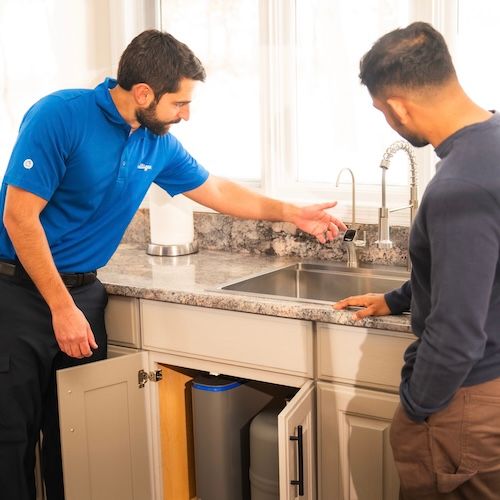
Schedule a free in-home test. Our technicians check hardness, chlorine, total dissolved solids, pH and iron at your tap in about 20 minutes and explain what each number means. Learn more on our water testing page.
Use a certified lab for health questions. For lead, bacteria, nitrate, arsenic or PFAS, we arrange testing through a certified laboratory. That is the right step for older homes, families with infants and anyone on a private well.
Schedule your free water test with Culligan Water Conditioning of Fort Wayne
For decades, Culligan Water Conditioning of Fort Wayne has helped homes and businesses in Fort Wayne, New Haven, Huntertown, Huntington, Decatur, Bluffton, Paulding and Van Wert get water they trust. We know the difference between St. Joseph River water, small-town well systems and rural private wells, and we start every recommendation with a test, not a sales pitch. We also deliver bottled water and coolers if you need drinking water while you decide.
Ready for better water? Schedule your free in-home water test and consultation with Culligan Water Conditioning of Fort Wayne today.
Frequently asked questions about Fort Wayne tap water
Can I drink Fort Wayne tap water straight from the faucet?
Yes. The water met all federal and state standards in 2025, according to Fort Wayne City Utilities. If you live in an older home or notice an off taste, a test at your faucet is a sensible next step.
Why does my Fort Wayne tap water taste like chlorine?
The city disinfects with chlorine, which it reported at up to 2.10 ppm in 2025, and uses chlorine dioxide, which has a sharp smell. A carbon filter or reverse osmosis system removes both tastes.
Does the Fort Wayne treatment plant soften the water?
It lime-softens the water as part of treatment, which lowers hardness, but finished water still averaged about 7.6 grains per gallon in 2025. Most homes still see scale.
Is Waynedale or Aboite water different from downtown?
Homes on the city system get the same treated water, though what comes out of each faucet depends on the service line and home plumbing. If your water bill comes from a utility other than Fort Wayne City Utilities, check that company’s annual report.
Should I worry about lead in a West Central Fort Wayne home?
Older homes are the most likely to have lead service lines, solder or fixtures. Check the city’s service line map and consider a certified lab lead test, especially if children or pregnant women live there.