Quick answer: It depends on your source and location. Fort Walton Beach, Destin and the rest of southern Okaloosa County draw drinking water from the Floridan Aquifer more than 600 feet down, and no local utility publishes a finished-water hardness figure in its annual report. U.S. Geological Survey studies show the aquifer’s mineral content changes across the county: the calcium-magnesium type of water under Niceville, Bluewater Bay and most of Walton County computes to about 6.5 grains per gallon, moderately hard, and some wells have measured up to roughly 280 mg/L, about 16 gpg. The coast sits over a different, sodium-rich water type. The only way to know your number is to test at your tap.
Hard water has a particular look: a haze on the shower door, a chalky crust at the faucet base, spotted glasses, a water heater that rumbles. Whether you see those signs in Fort Walton Beach depends on which utility serves you, which wells it is blending, and what happens in the pipes between the plant and your kitchen. Here is what homeowners in Okaloosa County and neighboring parts of Walton and Santa Rosa counties should know.
Where Fort Walton Beach water comes from, and why hardness varies
Every public water system in southern Okaloosa County pumps groundwater from the Floridan Aquifer. The City of Fort Walton Beach operates eight deep wells. Okaloosa County Water & Sewer runs 12 wells for the main system serving Wright, Ocean City, Shalimar, Okaloosa Island and the unincorporated areas around the city, plus three for Bluewater Bay and six for the Mid-County system around Crestview. Destin Water Users draws from six wells 606 to 746 feet deep; Niceville has nine. In every case the only required treatment is chlorine at the wellhead, so the mineral content arrives as pumped.
The U.S. Geological Survey mapped this aquifer’s chemistry in a study of southern Okaloosa and Walton counties. Hardness as calcium carbonate was measured as high as 280 mg/L, and pH sits between 7.5 and 8.5. The aquifer also holds distinct water types. In the northeastern part of southern Okaloosa County and most of Walton County it is a calcium-magnesium-bicarbonate water, with median calcium of 23 mg/L and magnesium of 13 mg/L, which computes to roughly 110 mg/L of hardness or about 6.5 gpg: moderately hard. In the south and west of the county, where Fort Walton Beach and Mary Esther sit, it shifts to a sodium-bicarbonate-chloride water with median sodium of 113 mg/L and chloride of 50 mg/L. That is why some homes here complain about a flat taste as much as scale.
The utilities’ reports agree on the sodium. The City of Fort Walton Beach’s 2024 report lists sodium up to 120 ppm and Okaloosa County’s 2025 report shows 124 ppm in the main system, both near the state’s 160 ppm guideline, while Bluewater Bay, on the calcium-magnesium side, reports just 7.4 ppm. Neither report lists hardness.
Private wells follow the same geography. In Okaloosa and Walton counties they tap the Floridan Aquifer. West of Navarre, in Santa Rosa and Escambia counties, they draw from the shallow Sand-and-Gravel Aquifer, which the Florida Department of Environmental Protection summarizes at pH 4.9 and iron of 2 mg/L: acidic and prone to orange staining. About 8 percent of Okaloosa County residents, close to 19,700 people, rely on private wells according to the Northwest Florida Water Management District, and no utility tests those wells.
Is city water or well water harder around Fort Walton Beach?
On city water it depends on the system. Niceville, Bluewater Bay and the Mid-County system around Crestview sit over the calcium-magnesium water and are more likely to see scale. Fort Walton Beach, Mary Esther and Okaloosa Island sit over the sodium-rich water and are more likely to add a salty taste to whatever hardness is present. Utilities blend several wells, so a neighborhood can land anywhere in the range.
On a private well, a Floridan well near Freeport or DeFuniak Springs may test moderately hard or hard, because a single well is never blended. A sand-and-gravel well near Pace or Jay brings iron and low pH as its main concerns. Two wells a mile apart can read differently, so we do not guess from the address.
Hard water problems homeowners in Fort Walton Beach notice
Hardness is not a health concern. It is a maintenance problem that gets more expensive the longer it runs. These three signs bring most of our hardness calls, whether the reading is 6 gpg in Niceville or 16 gpg at the top of the local range.
1. Scale inside water heaters and appliances
What homeowners notice: A water heater that recovers slowly or pops, a dishwasher that needs descaling, weak flow from a showerhead, appliances that wear out early.
What causes it: Heating or evaporating hard water drives dissolved calcium and magnesium out of solution, where they harden into scale on any surface they touch.
Why it matters: Scale on a heating element works like insulation: the element runs longer, the power bill rises and the unit wears out sooner. Scale also narrows pipes and clogs valves over time.
2. Spots, film and soap scum
What homeowners notice: Cloudy spots on glassware, a white film on shower glass and tile, chalky rings around faucet bases, and soap scum that needs scrubbing instead of wiping.
What causes it: Calcium and magnesium react with soap to form a curd rather than a lather, and the same minerals are left as deposits when droplets dry. In Fort Walton Beach’s sodium-rich water, dried spots can include sodium salts as well.
Why it matters: Homes with hard water use noticeably more soap, detergent and shampoo to get the same result.
3. Dry skin and dull hair
What homeowners notice: Skin that feels tight or itchy after a shower, and hair that never feels fully rinsed.
What causes it: Hard water keeps soap from rinsing cleanly, leaving a mineral and product film on skin and hair.
Why it matters: That film blocks moisture. Many people notice a difference within a couple of weeks of switching to softened water.
When hardness is present, a whole-house softener such as Culligan’s Aquasential® Smart High Efficiency Water Softener removes calcium and magnesium where water enters the home, so scale stops forming, soap rinses clean and existing deposits loosen over the following weeks. It regenerates on actual use rather than a timer, which saves salt and water at whatever hardness your test shows. Compare models on our Fort Walton Beach water softeners page. Where sodium is also part of the picture, a reverse osmosis system for drinking water pairs with the softener.
How to check your home’s water hardness in Fort Walton Beach
Read your utility’s report. The City of Fort Walton Beach posts its report on fwb.org, Okaloosa County Water & Sewer at myokaloosa.gov, and Niceville on nicevillefl.gov. None list hardness, but each lists sodium, which hints at which water type your system pumps; contact the utility directly for system-level hardness data. The USGS study of southern Okaloosa and Walton counties is the best public source on regional hardness.
Look for the signs. Scale on the showerhead, dishwasher spots, soap that will not lather and a noisy water heater. Two or more together usually mean hardness. Spots without scale, plus a salty taste, point to dissolved solids as well.
Test the water at your home. This settles it. Culligan of Fort Walton Beach’s in-home test is free, takes about 20 minutes, and reads hardness along with chlorine, total dissolved solids, pH and iron at your kitchen tap. That reading determines what size softener your home needs.
FAQs about Fort Walton Beach water hardness
How hard is the water in Fort Walton Beach, FL?
It depends on your source and location, and no local utility publishes a hardness figure. USGS data for the Floridan Aquifer under southern Okaloosa County shows calcium-magnesium type water at about 6.5 gpg, moderately hard, under Niceville, Bluewater Bay and inland areas, with some wells up to about 280 mg/L or 16 gpg. Coastal Fort Walton Beach sits over sodium-rich water. Contact your utility for system data and test at your tap for your home’s number.
Does Okaloosa County Water & Sewer or the City of Fort Walton Beach soften the water?
No. Both utilities disinfect with chlorine and otherwise deliver Floridan Aquifer water as pumped. Hardness is not a health standard, so utilities are not required to adjust it, and neither report lists a hardness value.
Is well water in the Fort Walton Beach area harder than city water?
In Okaloosa and Walton counties, often yes: a single Floridan well is not blended the way a utility system is, and inland wells near Crestview, Baker and Freeport sit over the calcium-magnesium water. West of Navarre, sand-and-gravel wells are acidic and high in iron, so filtration and pH correction come first there, with a softener added when the hardness reading calls for it.
Start with a free hard water test from Culligan of Fort Walton Beach
Culligan of Fort Walton Beach has treated Floridan Aquifer and sand-and-gravel water for homes across Fort Walton Beach, Mary Esther, Destin, Miramar Beach, Niceville, Crestview, Navarre, Gulf Breeze, Milton, Pensacola and DeFuniak Springs for decades. Because local hardness is not published and varies by system, we test before we recommend anything and size the system to your reading.
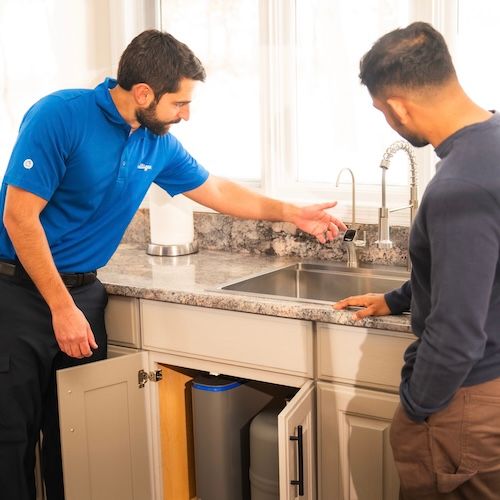
When you schedule a free in-home test, a technician from our Lovejoy Road office tests your water at the tap, explains the readings and walks you through rental and purchase options with a written quote.
Ready for better water? Schedule your free in-home water test and consultation with Culligan of Fort Walton Beach today.