Quick answer: Yes, by the federal measure. The City of Fort Walton Beach’s 2024 water quality report and Okaloosa County Water & Sewer’s 2025 report both show no health-based violations: lead at 1.7 and 2.6 parts per billion at the 90th percentile, trihalomethanes well under the 80 ppb limit, nitrate barely detectable. The same reports show why many homes here still treat their water. Sodium runs as high as 120 to 124 ppm, chlorine sits near 1 ppm, and the county recorded an odor reading of 8 against a secondary standard of 3. Compliance tells you the water is safe to drink; it does not tell you how it tastes, smells or behaves in your plumbing.
If you live in Fort Walton Beach, Mary Esther, Shalimar or on Okaloosa Island, your tap water is pumped from the Floridan Aquifer, chlorinated at the wellhead and tested on a schedule set by the Florida Department of Environmental Protection. That system is built to meet health standards, not to deliver water that tastes clean or leaves no spots on a glass, and the gap between those goals is where most of our questions come from. Here is what homeowners across Okaloosa County and the neighboring parts of Walton, Santa Rosa and Escambia counties should know.
What the water quality reports tell you, and what they leave out
Under the Safe Drinking Water Act, the EPA regulates more than 90 contaminants in public water, and every utility publishes an annual report showing how its samples compared. Three things matter when you read one.
First, the limits balance health against cost and technology; a maximum contaminant level is what a utility can reasonably achieve, not a line between risk and no risk. Second, the samples describe the system, not your faucet. Lead and copper are tested at 30 homes in Fort Walton Beach’s case and reported as a 90th percentile; your house and its plumbing are not in that number. Third, secondary standards for taste, odor, color and staining are guidelines, not enforceable limits. Okaloosa County exceeded two of them in its 2025 report, odor at 8.0 threshold odor units against 3.0 and foaming agents at 1.5 ppm against 0.5, noted it, and reported that later samples were below the limits. Hardness is not reported at all by any utility in the area.
City water vs. private wells around Fort Walton Beach
Private wells are not tested or treated by anyone but the homeowner, and about 8 percent of Okaloosa County residents, close to 19,700 people, rely on one according to the Northwest Florida Water Management District, with similar shares in Santa Rosa, Escambia and Walton counties. Okaloosa and Walton wells draw from the Floridan Aquifer and tend to be clean but variable in hardness and salt. Santa Rosa and Escambia wells, around Milton, Pace, Jay and Cantonment, draw from the shallow Sand-and-Gravel Aquifer, which is acidic and often high in iron. The Florida Department of Health recommends testing every well for bacteria and nitrate at least once a year. Our well water page covers the treatment side.
Where Fort Walton Beach’s drinking water comes from
All of it is groundwater from the Floridan Aquifer, a limestone formation more than 600 feet below the coast here, sealed under thick clay. The City of Fort Walton Beach operates eight deep wells; Okaloosa County Water & Sewer runs 12 for its main system, three for Bluewater Bay and six for the Mid-County system around Crestview; Destin Water Users pumps from six wells 606 to 746 feet deep; Niceville from nine. Chlorine is the only required treatment. A U.S. Geological Survey study found that the aquifer under the south and west of the county, including Fort Walton Beach, carries a sodium-bicarbonate-chloride water with median sodium of 113 mg/L, while the northeast and Walton County carry a calcium-magnesium water that runs moderately hard. That split explains most of the complaints we hear on city water.
1. Salty or flat taste from sodium and chloride
What homeowners notice: Water that tastes flat, slightly saline or mineral-heavy, especially noticeable in coffee, tea and ice.
What causes it: The sodium-rich water under the coastal part of Okaloosa County. The City of Fort Walton Beach reported sodium up to 120 ppm in 2024 and Okaloosa County’s main system up to 124 ppm in 2025, both near the state’s 160 ppm guideline. USGS found chloride of 25 to 75 mg/L in coastal Floridan wells, rising toward Choctawhatchee Bay.
Why it matters: Not a health concern at these levels for most people, but anyone on a sodium-restricted diet should know the number, and the taste is the most common reason Fort Walton Beach households call us about drinking water.
How to fix it: Reverse osmosis is the treatment that removes dissolved salts. Culligan’s Aquasential® Smart Reverse Osmosis system at the kitchen sink takes out most of the sodium, chloride and total dissolved solids, and the Aquasential® Tankless RO fits under a small condo sink in Destin or on Okaloosa Island.
2. Chlorine taste and smell
What homeowners notice: A pool-like smell in the shower or a chemical edge in a glass of water.
What causes it: Chlorine is the disinfectant at every local system: 0.93 ppm average in the City of Fort Walton Beach, 1.06 ppm in Okaloosa County’s main system, 1.32 ppm in Bluewater Bay and 0.74 ppm in Niceville. None of the local utilities use chloramine.
Why it matters: The residual keeps bacteria out of the pipes between the well and your home, and all of these readings are far below the 4.0 ppm maximum. Chlorine also forms trihalomethanes with natural organic matter; the City of Fort Walton Beach reported 41.78 ppb and Okaloosa County 36 ppb, both under the 80 ppb limit.
How to fix it: Because the disinfectant is free chlorine rather than chloramine, carbon handles it well. A whole-house carbon unit such as the Aquasential® Smart HE Water Filter removes chlorine for every shower and faucet; a reverse osmosis system removes it from drinking water. See the options on our Fort Walton Beach water filtration page.
3. Odor and taste compounds
What homeowners notice: A musty, earthy or sulfur-like smell that comes and goes, often stronger from the hot tap.
What causes it: Groundwater from a deep limestone aquifer can carry naturally occurring taste and odor compounds. Okaloosa County’s 2025 report recorded an odor reading of 8.0 threshold odor units in the main system against the secondary standard of 3.0, and foaming agents at 1.5 ppm against 0.5 ppm, both marked as exceedances. The utility notes that follow-up samples were below the limits.
Why it matters: These are aesthetic standards, so the exceedance was not a violation, and they are exactly the kind of complaint a utility is not required to fix.
How to fix it: Whole-house carbon filtration removes most taste and odor compounds along with chlorine. If the smell is only in hot water, the water heater is usually the source and a technician can check it before you buy anything.
4. PFAS from military firefighting foam
What homeowners notice: Nothing. PFAS have no taste, smell or color.
What causes it: Decades of firefighting-foam use at the region’s military installations, documented by the agencies involved and concentrated on the western side of our service area. The Florida DEP reports that 13 of 50 private wells sampled near NAS Pensacola’s Saufley Field exceeded the former 70 ppt health advisory, and that two ECUA public supply wells near Pensacola International Airport exceeded it; one was shut down and the other fitted with treatment. The Navy’s program around NAS Whiting Field near Milton has sampled 73 private wells and found 47 with detections requiring action. The Air Force lists one impacted off-base well near Hurlburt Field. Eglin AFB, by contrast, reports that its Floridan Aquifer drinking water tested non-detect for PFOS and PFOA in 349 samples.
Why it matters: The EPA finalized enforceable PFAS limits in April 2024 with a 2029 compliance deadline, and neither the Fort Walton Beach nor the Okaloosa County report lists PFAS results yet. Private well owners near a base are the most likely to be affected and the least likely to have been tested.
How to fix it: Culligan’s Aquasential® Smart Reverse Osmosis system with Total Defense is certified to reduce total PFAS by more than 99.99 percent. For whole-home coverage, the Whole Home PFAS Water Filter is certified to reduce total PFAS by more than 99 percent. Certified lab testing comes first so the system is sized to a real number.
Hardness, the fifth common complaint, is milder here than in most of Florida. No local utility publishes a hardness figure, and USGS shows Floridan Aquifer hardness varies by location: the calcium-magnesium type of water under Niceville, Bluewater Bay and inland areas computes to about 6.5 grains per gallon, moderately hard, with some wells up to about 16 gpg, so a tap test is the way to learn your own number. Our water softeners page and our article on local hardness cover that in detail.
How to check your water quality in Fort Walton Beach
Read your utility’s report. The City of Fort Walton Beach publishes its report at fwb.org, Okaloosa County Water & Sewer at myokaloosa.gov, Niceville at nicevillefl.gov and ECUA at ecua.fl.gov. Each covers source, treatment and results for regulated contaminants across the system.
Watch for the signs at home. A salty or flat taste, a chlorine smell in the shower, a musty odor from the hot tap, spots on glassware, scale on a showerhead. None mean the water is unsafe; all mean something is in it that treatment can remove.
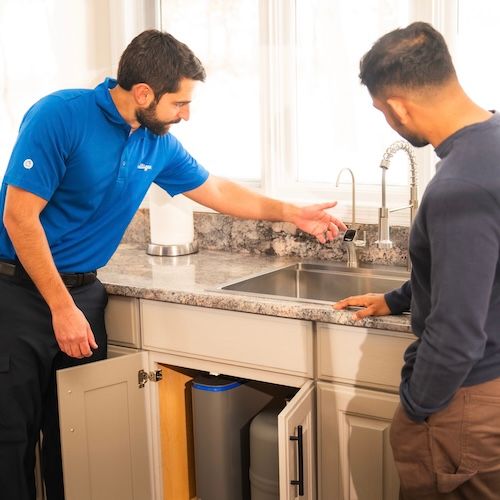
Test the water at your tap. Culligan of Fort Walton Beach’s free in-home test reads hardness, chlorine, total dissolved solids, pH and iron in about 20 minutes. For lead, nitrate, arsenic, bacteria or PFAS, we collect a sample for a certified lab. Testing is especially worthwhile if you are on a private well, live near a military installation, have an older home with original plumbing, or have noticed a change in taste or smell. Our water testing page explains both options.
Frequently asked questions about Fort Walton Beach tap water
Is Fort Walton Beach tap water safe to drink straight from the tap?
Yes. The City of Fort Walton Beach’s 2024 report and Okaloosa County Water & Sewer’s 2025 report show no health-based violations, lead well under the action level and disinfection byproducts under their limits. The reports also show sodium near the state guideline and an aesthetic odor exceedance, which affect taste rather than safety.
Does Fort Walton Beach use chlorine or chloramine?
Chlorine. The City of Fort Walton Beach averages 0.93 ppm, Okaloosa County 1.06 ppm in the main system and Niceville 0.74 ppm. Free chlorine is easier to filter than chloramine; a carbon whole-house filter or a reverse osmosis system removes it.
Does the city add fluoride to Fort Walton Beach water?
No. The City of Fort Walton Beach states that it does not add fluoride; the 0.94 ppm in its report is naturally present in the aquifer. Okaloosa County found up to 1.2 ppm, also naturally occurring. Niceville stopped fluoridating in February 2025 and ECUA in June 2025. Reverse osmosis removes most natural fluoride from drinking water if you prefer.
Why does my Fort Walton Beach tap water taste salty?
Sodium and chloride from the Floridan Aquifer under the coastal part of Okaloosa County. Both local utilities report sodium of 120 to 124 ppm. A reverse osmosis system at the kitchen sink removes most of it.
Schedule your free water test with Culligan of Fort Walton Beach
Culligan of Fort Walton Beach has helped homeowners across Fort Walton Beach, Destin, Niceville, Crestview, Navarre, Gulf Breeze, Milton, Pace, Pensacola, Santa Rosa Beach and DeFuniak Springs understand and improve their water for decades, on Floridan Aquifer city water and sand-and-gravel wells alike. A technician from our Lovejoy Road office tests your water at the tap, explains the results in plain terms and, if treatment makes sense, walks you through rental and purchase options with a written quote. If it does not, we tell you that too.
Ready for better water? Schedule your free in-home water test with Culligan of Fort Walton Beach today.