Quick answer: Yes, well water around Fort Walton Beach can be safe to drink, provided it is tested regularly and treated for whatever the tests find. No utility monitors a private well, so the owner carries that job. What a well here produces depends on which aquifer it taps: the deep Floridan Aquifer under Okaloosa and Walton counties, or the shallow Sand-and-Gravel Aquifer under Santa Rosa and Escambia counties. Each has its own typical problems, and a few areas near military installations have a documented PFAS issue on top of them. Annual testing for bacteria and nitrate, as the Florida Department of Health recommends, is the starting point.
The Northwest Florida Water Management District counts about 19,700 Okaloosa County residents on private wells, roughly 8 percent of the county, with another 18,600 in Santa Rosa, 27,800 in Escambia and 11,800 in Walton. North of Interstate 10 toward Baker, Holt and Laurel Hill, east toward Freeport and DeFuniak Springs, and west through Pace, Jay and Cantonment, the share climbs well above the county average.
A well sits outside the treatment and testing system that covers city water in Fort Walton Beach, Destin or Niceville. Here is what well owners across Okaloosa, Walton, Santa Rosa and Escambia counties, and across the line in Atmore and Brewton, Alabama, should know about what is likely in their water and how to deal with it.
City water vs. well water: the difference around Fort Walton Beach
Public systems here pump from the Floridan Aquifer, chlorinate at the wellhead and report results every year. A private well has none of that. Florida has no state requirement to test a private well, even at the sale of a home, and county rules focus on how a well is built rather than what comes out of it. Well water also changes: heavy rain, hurricane flooding, a failing septic system up the road or a cracked casing can alter it from one season to the next, and bacteria, nitrate and PFAS have no taste, smell or color. That is why the Florida Department of Health recommends testing every private well for bacteria and nitrate at least once a year and for lead every three years.
Culligan of Fort Walton Beach has tested and treated private wells across the western Panhandle for decades. These are the problems we see most, grouped by the aquifer that causes them.
Common well water problems around Fort Walton Beach
1. Iron staining (Santa Rosa and Escambia counties)
What homeowners notice: Rust-orange stains in toilets, tubs and sinks, orange-tinted laundry, a metallic taste, and water that runs clear from the tap but discolors after it sits.
What causes it: The Sand-and-Gravel Aquifer that supplies wells around Milton, Pace, Jay, Navarre and Cantonment is iron-rich. The Florida Department of Environmental Protection lists iron at 2 mg/L for this aquifer, the highest of any Florida aquifer it compares and well above the 0.3 mg/L level at which iron begins to stain. Dissolved iron is invisible in the glass; once it meets air it oxidizes into orange particles.
Why it matters: Iron is not a health hazard at these levels, but the staining is relentless and it fouls softeners and water heaters.
How to fix it: A dedicated iron filter such as Culligan’s Iron-Cleer® or Iron-OX5 oxidizes and traps the iron before it reaches the house. Where hardness is also present, the Softener-Cleer handles both in one system.
2. Acidic water and blue-green stains (Santa Rosa and Escambia counties)
What homeowners notice: Blue-green stains around drains and on tubs, a metallic taste, and in older homes pinhole leaks in copper pipe.
What causes it: The same sand-and-gravel water averages a pH of 4.9 according to FDEP, and the agency notes that some Panhandle wells run below 5.0. Water that acidic slowly dissolves copper plumbing and the lead in old solder, which is where the stains and the taste come from.
Why it matters: Corrosion shortens the life of plumbing and can carry copper and lead into drinking water, so a lab test for both at the tap is worth doing.
How to fix it: An acid-neutralizing filter raises the pH as water enters the home, which stops the corrosion at its source. It is commonly installed alongside an iron filter on wells in this part of the service area.
3. Hardness and salt (Okaloosa and Walton counties)
What homeowners notice: Scale on fixtures and in the water heater, spotted glassware, stiff laundry, or a flat, faintly salty taste.
What causes it: Floridan Aquifer wells inherit the water type under the property. A U.S. Geological Survey study of southern Okaloosa and Walton counties found hardness up to 280 mg/L, about 16 grains per gallon, in some wells, with the calcium-magnesium type of water in the northeastern part of the area and most of Walton County running moderately hard. Toward the coast the water shifts to a sodium-rich type; USGS measured chloride of 25 to 75 mg/L in coastal wells and more than 500 mg/L near the east end of Choctawhatchee Bay.
Why it matters: Hardness scales appliances; sodium and chloride affect taste and matter to anyone on a restricted-sodium diet. A single well is not blended the way a utility system is, so a well near Freeport or Crestview can test harder than city water a mile away.
How to fix it: The Aquasential® Smart High Efficiency Water Softener for hardness, sized to the tested level, and a reverse osmosis system at the kitchen sink for sodium and chloride in drinking water.
4. Bacteria (all areas)
What homeowners notice: Usually nothing, which is the problem.
What causes it: Coliform bacteria reach a well through a cracked or shallow casing, a poor cap seal, runoff after heavy rain or a nearby septic system. Shallow sand-and-gravel wells are more exposed because that aquifer has no protective clay layer above it, a point ECUA makes about its own supply wells.
Why it matters: Total coliform itself is rarely harmful, but it signals a pathway for disease-causing organisms. E. coli indicates contamination from human or animal waste. If a test finds it, stop drinking untreated water and contact the Florida Department of Health in your county for guidance on disinfecting the well.
How to fix it: Correct the source, shock-chlorinate the well, retest. For ongoing protection, a UV disinfection system treats water as it enters the home, and for drinking water Culligan’s Aquasential® Smart Reverse Osmosis system with the Advanced Post Tank Filter is certified under NSF Protocol P231 to reduce bacteria by more than 99.9999 percent.
5. PFAS near military installations
What homeowners notice: Nothing. PFAS have no taste, odor or color.
What causes it: Firefighting foam used for decades at the region’s bases. The record here is unusually well documented by the agencies involved. The Navy’s program around NAS Whiting Field, north of Milton, has sampled 73 private wells and found 47 with PFAS detections requiring action, with 12 properties above the former 70 ppt advisory; a 2022 Navy fact sheet reported that 8 of 13 wells sampled east of the base exceeded it. The Florida DEP reports that 13 of 50 private wells sampled near NAS Pensacola’s Saufley Field exceeded 70 ppt, and that two ECUA supply wells near Pensacola International Airport did as well. The Air Force lists one impacted off-base well near Hurlburt Field. Eglin AFB, which draws its own water from the Floridan Aquifer 600 to 700 feet down, reports non-detect results in 349 drinking-water samples.
Why it matters: Affected wells near Whiting and Saufley have largely been connected to public water or given treatment, but the Navy is still sampling, with appointments through September 2026, and now applies interim action levels of 12 ppt each for PFOA and PFOS. If you are on a well near any of these installations and have not been sampled, a certified lab test is the way to know.
How to fix it: Culligan’s Aquasential® Smart Reverse Osmosis system with Total Defense is certified to reduce total PFAS by more than 99.99 percent. For whole-home coverage, the Whole Home PFAS Water Filter is certified to reduce total PFAS by more than 99 percent.
6. Rotten-egg odor
What homeowners notice: A sulfur smell from faucets, sometimes only from the hot tap.
What causes it: Hydrogen sulfide gas, from sulfur bacteria in a well or water heater or dissolved naturally in groundwater. Odor only in hot water usually means the heater.
How to fix it: When testing confirms hydrogen sulfide in the source water, a Sulfur-Cleer® or Sulfur-OX3 filter removes it for the whole house. When the heater is the cause, servicing the heater comes first.
How to check your well water near Fort Walton Beach
Watch for signs. Orange or blue-green stains, a sulfur smell, scale on fixtures, a salty taste, cloudy water after rain.
Use the public resources. The Florida Department of Health’s private well page explains recommended tests and connects you to your county health office and to state-certified labs. The Navy’s Whiting Field drinking water page and the FDEP Saufley Field page show the PFAS sampling areas. The USGS study of southern Okaloosa and Walton counties maps Floridan water types.
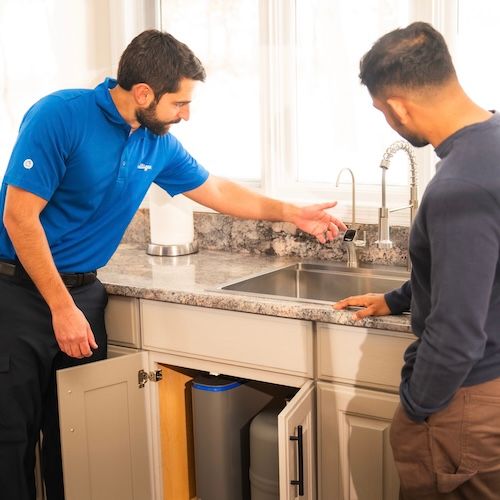
Test on a schedule, and after changes. Bacteria and nitrate every year, lead every three years, and a retest after flooding, a change in taste or smell, or work on the well or plumbing. Add a PFAS lab test once if you are near a base, and a pH, iron and copper check if you are on sand-and-gravel water. Culligan of Fort Walton Beach’s free in-home test reads hardness, iron, pH, total dissolved solids and chlorine in about 20 minutes; lab samples for bacteria, nitrate, lead, arsenic and PFAS are collected at the same visit. Details are on our water testing page.
Frequently asked questions about private wells around Fort Walton Beach
How often should I test a private well in Okaloosa County?
Every year for bacteria and nitrate and every three years for lead, per the Florida Department of Health, plus any time the water changes or after flooding or well repairs. Your county health department can recommend additional tests for local conditions.
Why does my well water near Milton stain everything orange?
Dissolved iron from the Sand-and-Gravel Aquifer, which FDEP lists at about 2 mg/L on average. The water looks clear from the tap and turns orange as the iron oxidizes. An iron filter removes it; a water test confirms the level and whether low pH is adding to the problem.
Has PFAS been found in private wells near Fort Walton Beach?
Yes, mainly on the west side of our service area. The Navy has found PFAS requiring action in 47 private wells near NAS Whiting Field, and the Florida DEP reports 13 of 50 wells near Saufley Field exceeded the former 70 ppt advisory. Eglin AFB reports non-detect results in its own drinking water. A certified lab test is the only way to know about your well.
Should I test my well after a hurricane near Fort Walton Beach?
Yes, before drinking from it again. Flooding can carry bacteria and surface contaminants into the wellhead, especially on shallow sand-and-gravel wells. Test for coliform bacteria and nitrate once the water recedes, and disinfect the well if the pump or casing was submerged.
Local well water expertise from Culligan of Fort Walton Beach
On the Emerald Coast two wells a few miles apart can sit over different aquifers with opposite problems. Culligan of Fort Walton Beach has worked on both for decades, from iron and acid on sand-and-gravel wells in Pace, Milton and Cantonment to hardness and salt on Floridan wells around Crestview, Freeport and DeFuniak Springs, and PFAS treatment for homes near the bases. Our technicians explain what the test shows, tell you whether lab work is needed, and build the treatment around the results rather than a package. Our well water solutions page lists the systems we install, and we handle installation, maintenance and service afterward.
Ready for better well water? Schedule your free in-home water test and consultation with Culligan of Fort Walton Beach today.