Quick answer: Dothan’s water carries dissolved calcium and magnesium, because every drop of it is pumped out of limestone and sand aquifers, but the city does not publish a hardness number. Dothan Utilities’ annual report lists calcium at every sampling point and alkalinity near 142 ppm, yet leaves total hardness off the table. The one public system in the area that does report it, Fort Novosel, measured 69 to 100 mg/L, which works out to roughly 4 to 6 grains per gallon and sits in the moderately hard band. Private wells vary with the formation they are screened in. For your own tap, a free in-home test is the only way to get the number.
Most people in Dothan do not go looking for a hardness figure. They notice the symptoms first: a shower door that films over a day after it is cleaned, a white crust around the base of the kitchen faucet, glasses that come out of the dishwasher dull, a water heater that has started to pop and rumble. Each of those is a mineral deposit, and the minerals rode in with the groundwater. Here is where they come from, why the city’s report does not settle the question, and what to do about it.
Where Dothan’s hardness comes from
Dothan Utilities operates 31 wells and no surface-water intake. Its 2025 water quality report names the formations those wells draw from: the Lisbon, Tallahatta, Hatchetigbee, Tuscahoma Sand, Nanafalia, Salt Mountain Limestone, Clayton and Providence Sand. Several of those are limestone or shelly sand, and groundwater that sits in limestone for decades picks up calcium and magnesium carbonate on the way through. That is the definition of hardness.
The report does not list total hardness, but it does list the ingredients. Calcium averaged 31.4 ppm across the wells with a range of 5.7 to 50.7 ppm. Alkalinity averaged 142 ppm. Total dissolved solids ran from 77 to 338 ppm depending on the well. Those ranges matter more than the averages: a home fed mainly by a low-mineral well and a home fed by a high-calcium well can have very different scale problems on the same utility, and because production shifts among wells with demand, the mix at your tap changes through the year.
The nearest published hardness figure comes from the Fort Novosel water system, which pulls from seven wells in the Tuscahoma Sand, Providence Sand, Clayton, Ripley and Nanafalia aquifers, the same formations Dothan taps. Its treatment plant measured total hardness of 99.7 mg/L with a range of 68.9 to 99.7 mg/L, about 4 to 6 grains per gallon. The USGS classes 61 to 120 mg/L as moderately hard, the point at which soap scum and spotting become routine and water-heater scale begins to build. Dothan draws from more formations than the post does, so the two will not match exactly, but it is the best public reference point in the area.
None of these utilities softens its water. Hardness is not a health standard, and Dothan Utilities’ treatment consists of chlorine, fluoride and a phosphate corrosion inhibitor. Whatever minerals come out of the ground reach your water heater.
Is municipal or well water harder in Dothan?
Usually the well, though it depends on the well. Public systems in Dothan, Enterprise and Ozark pump from deep, high-yield formations and blend many wells, which evens out the extremes. Private wells are shallower and single-source. The Geological Survey of Alabama’s groundwater assessment for southeast Alabama notes that the Tuscahoma, Tallahatta and Lisbon formations and the Providence Sand are used mostly for domestic and livestock wells here, and that the Floridan limestone supplies private wells across Houston County. A well finished in that limestone south of Dothan, toward Cottonwood, Ashford and Columbia, will generally test harder than one in a sand unit near Daleville or Slocomb, where iron is the more common complaint.
Nobody tests those wells but the owner. The state’s most recent county water-use estimate puts about 19,500 Houston County residents, nearly one in five, on their own wells, with roughly 9,100 in Dale County, 8,750 in Coffee County and about four in ten residents of Geneva County. For those households, only a tap test answers the hardness question.
Hard water problems Dothan homeowners run into
Hard water will not make anyone sick. It does cost money, steadily, through three channels.
1. Scale inside water heaters and appliances
What homeowners notice: A water heater that takes longer to recover and makes popping or rumbling sounds, a dishwasher that leaves a film, dribbling flow from showerheads, and appliances that fail years earlier than their warranty suggests.
What causes it: Heating water forces dissolved calcium and magnesium out of solution. They settle as a hard, chalky crust on the hottest surfaces: the heating element or the bottom of the tank, the dishwasher’s heater, the inside of a kettle.
Why it matters: Scale is an insulator. A layer on a water heater element makes the unit burn more energy to heat the same water, and a thick layer at the bottom of a tank is what causes the rumbling. Over years that buildup shortens the life of water heaters, dishwashers and washing machines.
2. Film and spots on glass, tile and dishes
What homeowners notice: Cloudy drinking glasses, a haze on the glass shower door, soap scum on tile that needs scrubbing rather than wiping, and a crust around faucet aerators.
What causes it: Calcium and magnesium react with soap to form a sticky curd instead of a lather. When droplets dry, the minerals stay behind as spots.
Why it matters: Hard-water homes use more detergent, dish soap and shampoo to get the same result, and the residue dulls fixtures and glass over time.
3. Dry skin and hair
What homeowners notice: Skin that feels tight or itchy after a shower, hair that feels coated, and shampoo that never seems to rinse out.
What causes it: The same soap-and-mineral curd that spots the shower door forms on skin and hair.
Why it matters: That film holds moisture out. Many customers notice their skin and hair feel different within a couple of weeks of softening.
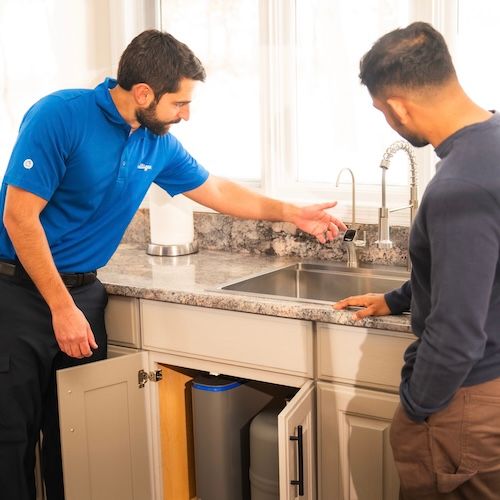
A whole-home softener such as Culligan’s Aquasential® Smart High Efficiency Water Softener exchanges calcium and magnesium for sodium where water enters the house, so every fixture and appliance downstream sees soft water. The Smart unit regenerates based on actual use and alerts you when salt runs low; the Aquasential® Select Series and Aquasential® Advantage Whole Home Water Softener suit homes that want a simpler setup. The options are on our Dothan water softeners page.
How to check your home’s water hardness in Dothan
Read the utility’s report. Dothan Utilities posts its annual report on the city’s water department page. It will not give you a hardness figure, but calcium, alkalinity and total dissolved solids by well show how much mineral the system carries. The City of Enterprise posts its own report and likewise leaves hardness off. Smaller systems in Ozark, Headland, Abbeville and Eufaula will mail theirs on request.
Look for the signs. Scale on the showerhead, spots that survive the dishwasher, a water heater that rumbles, soap that will not lather. Two or more together is hard water, whatever the report says.
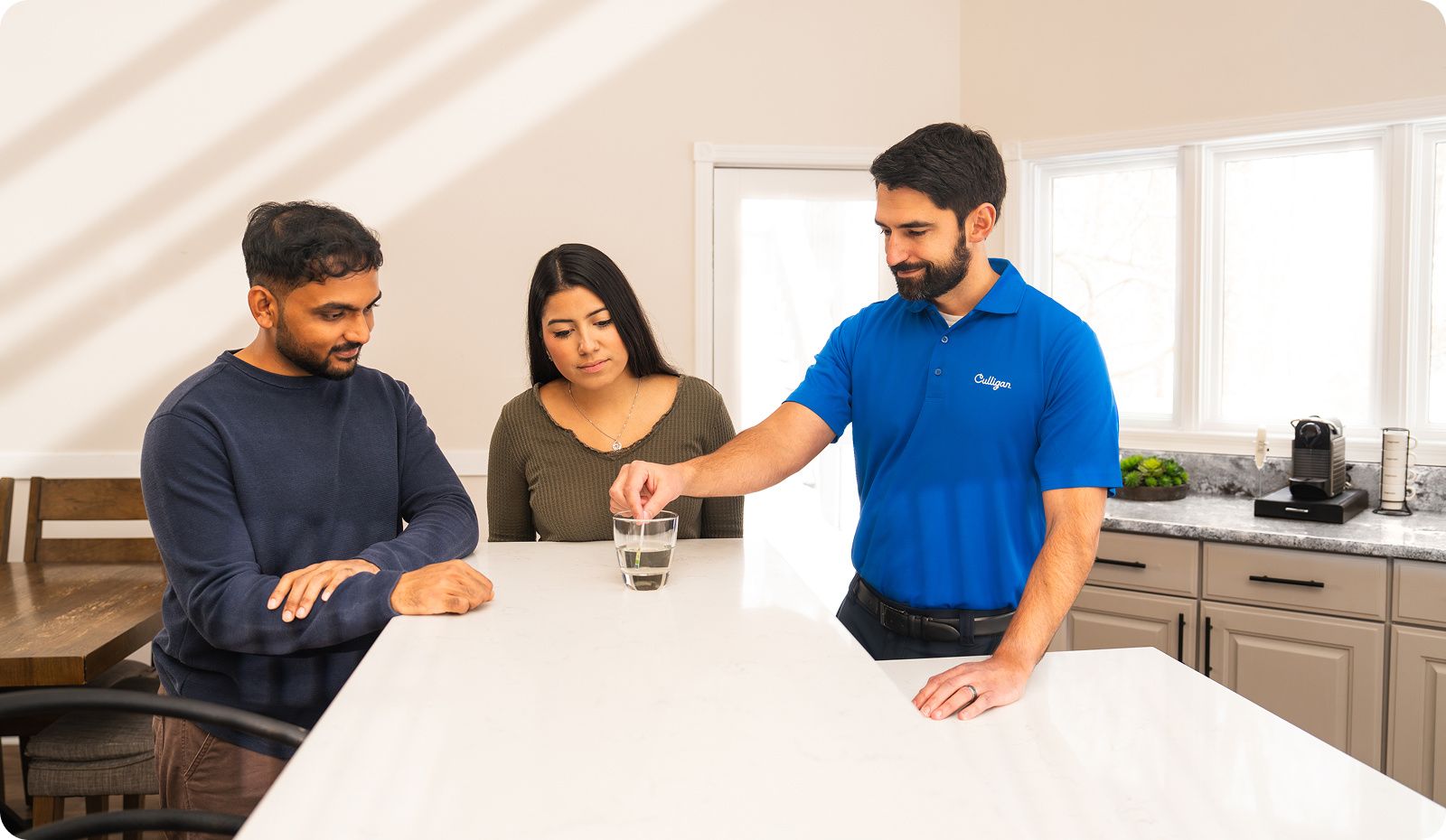
Test the water at your tap. Because Dothan’s mineral content varies well to well and private wells vary formation to formation, only a test at your kitchen sink gives the number that sizes a softener. Culligan of Dothan’s in-home test is free, takes about 20 minutes and reads hardness along with chlorine, iron, pH and total dissolved solids. Details are on our Dothan water testing page.
FAQs about Dothan water hardness
How hard is the water in Dothan, AL?
Dothan Utilities does not publish a hardness figure. Its report shows calcium averaging 31.4 ppm and alkalinity near 142 ppm, which indicates meaningful mineral content, and the nearby Fort Novosel system reports 69 to 100 mg/L, about 4 to 6 grains per gallon. Your own tap is the only reliable reading.
Will a pitcher filter soften Dothan water?
No. Pitcher and faucet filters are built for taste and certain drinking-water contaminants and do not remove calcium or magnesium. They also only treat the water you pour through them, while hardness does its damage in the water heater, dishwasher and shower. Softening the whole house takes an ion-exchange softener.
How do I know if hard water is hurting my appliances?
Chalky deposits inside a kettle or coffee maker, dishes that come out spotted, a water heater that pops and takes longer to heat, and appliances that need descaling more than once a year all point to hardness. A water test confirms it.
Does Dothan Utilities soften the water?
No. Treatment is chlorine for disinfection, fluoride and a phosphate corrosion inhibitor. Calcium and magnesium from the aquifers pass through to homes. Softening, if you want it, happens at your house.
Start with a free hard water test from Culligan of Dothan
Culligan of Dothan has treated Wiregrass water for decades from our location on Ross Clark Circle, serving Dothan, Headland, Ashford, Cottonwood, Enterprise, Ozark, Daleville, Fort Novosel, Abbeville, Geneva, Slocomb and Eufaula, with routes reaching Troy, Marianna and Donalsonville. Our technicians work on Dothan Utilities water and on private wells every week, so we know which areas scale fast and what size system a given home needs. A local specialist tests your water at the tap, explains the results plainly and, if a softener is the right answer, lays out rental and purchase options with a written quote. No obligation.
Ready for better water? Schedule your free in-home water test and consultation with Culligan of Dothan today.