Quick answer: Yes. Dothan Utilities’ 2025 water quality report shows the city’s supply met every federal drinking water standard: no violations are listed, lead came in at a 90th percentile of 3.4 parts per billion against a 15 ppb action level, nitrate averaged 0.067 ppm, trihalomethanes averaged 2.4 ppb and every PFAS compound tested was not detected. Meeting those standards is not the same as water that is free of everything you might prefer to remove. Chlorine, added fluoride, natural minerals from the aquifers and anything your own plumbing contributes all reach the tap, and none of them is covered by the utility’s compliance tables.
If you live in Dothan and use city water, it is chlorinated, tested and monitored before it leaves the wells. Yet homeowners here still ask us whether it is safe, why it tastes the way it does and what the white crust on their fixtures is. The answers are in the utility’s own data once you know where to look. Here is what households across Houston, Dale and Coffee counties should understand, whether their water comes from Dothan Utilities, Enterprise Water Works, the Ozark or Headland systems, Fort Novosel’s plant or a private well.
What municipal testing does, and does not, tell you
The Safe Drinking Water Act requires public systems to monitor more than 90 contaminants and report the results each year. Dothan Utilities’ 2025 report covers radionuclides, metals, nitrate, pesticides, volatile organics, disinfection byproducts and the 29 PFAS compounds in the EPA’s latest monitoring round. All of it passed. There are still three things that report cannot tell you.
First, federal limits weigh cost and feasibility along with health. A number under the limit means the system complied; it does not mean zero.
Second, utility sampling happens at the wells and at a few dozen selected homes. Dothan’s report lists 31 lead and copper samples for the whole system. What happens inside the plumbing of a 1960s ranch or a 1920s bungalow downtown is not in the table.
Third, the report is about health standards. Hardness is not one of them, and Dothan’s report does not list it at all. Taste, odor, spotting and scale are left for the homeowner to deal with.
Municipal water versus private wells in the Wiregrass
The dividing line is who is responsible. Dothan Utilities answers to ADEM and the EPA. A private well answers to no one but its owner. The state’s most recent county water-use estimate shows about 19,500 Houston County residents on their own wells, nearly one in five, with roughly 9,100 in Dale County, 8,750 in Coffee County, about 3,900 in Henry County and some 11,200 in Geneva County, which is about four in ten people there. Statewide, the Alabama Department of Public Health estimates around 800,000 people depend on private supplies.
Well water here varies by formation and depth. The USGS notes that the shallow Floridan limestone in southern Houston County is highly susceptible to contamination from farming, with low levels of insecticides found in a few wells. Because bacteria, nitrate and pesticides have no taste, annual testing is the only safeguard. We cover that on our Dothan well water page.
Where Dothan’s drinking water comes from
Nowhere near a river. Dothan Utilities pumps roughly 12.7 million gallons a day, about 4.6 billion gallons in 2025, from 31 wells screened in the Lisbon, Tallahatta, Hatchetigbee, Tuscahoma Sand, Nanafalia, Salt Mountain Limestone, Clayton and Providence Sand formations. The water is chlorinated, fluoridated and dosed with phosphate to protect pipes, then stored in 14 tanks and sent to homes from Ross Clark Circle out to Cowarts, Webb and Ashford. Enterprise Water Works runs 17 wells in the Nanafalia, Salt Mountain Limestone, Providence and Clayton aquifers with the same chlorine-and-fluoride treatment. Fort Novosel pumps seven wells from the same stack of formations and buys supplemental water from Daleville and Enterprise.
Groundwater of this kind is stable and well protected, which is why the compliance record is clean. It also comes with a consistent set of everyday issues.
1. Chlorine taste and odor
What homeowners notice: A swimming-pool smell when the shower runs or a glass is filled straight from the tap, most noticeable in homes near a well or storage tank.
What causes it: Dothan Utilities uses free chlorine, not chloramine, and keeps a residual in the mains to protect the water on the way to your house. The 2025 report shows an average of 1.35 ppm with a high of 2.4 ppm; Enterprise reported 1.02 to 1.50 ppm.
Why it matters: The residual is doing its job, but it does not have to be in your coffee.
How to fix it: The carbon stage in an Aquasential® Smart Reverse Osmosis system clears it from drinking and cooking water. A Select Series whole-house filter or an Aquasential® Smart HE Water Filter removes it from every tap and shower.
2. Hard water and scale
What homeowners notice: Spots on glassware, film on the shower door, white crust at the faucet base, a water heater that rumbles and skin that feels tight after bathing.
What causes it: Calcium and magnesium dissolved from the limestone and shell layers the wells draw through. Dothan’s report shows calcium at 5.7 to 50.7 ppm across its wells and total dissolved solids of 77 to 338 ppm, but does not report hardness itself. Fort Novosel’s plant, on the same formations, measured 69 to 100 mg/L, roughly 4 to 6 grains per gallon.
Why it matters: Scale insulates water-heater elements, clogs aerators and shortens appliance life, and hard water takes more soap to get anything clean.
How to fix it: An Aquasential® Smart High Efficiency Water Softener removes the minerals where water enters the home. See the Dothan water softeners page.
3. Lead from household plumbing
What homeowners notice: Nothing. Lead has no taste, color or odor.
What causes it: Dothan Utilities reports no lead service lines in its inventory, and its 90th-percentile result was 3.4 ppb. The range, however, ran up to 13 ppb at one of the 31 homes sampled, close to the 15 ppb action level. That lead came from fixtures, solder or brass inside the house, typical of homes built before 1986.
Why it matters: Lead is most harmful to infants, young children and pregnant women, and the only way to know your home’s level is to test the water that comes out of your own faucet.
How to fix it: Culligan’s Aquasential® Smart Reverse Osmosis system is certified to reduce lead by 99.7 percent at the tap you drink from.
4. Fluoride
What homeowners notice: Nothing at the tap; this is a preference question.
What causes it: Dothan, Enterprise and Fort Novosel all add fluoride. Dothan’s 2025 report shows 0.65 ppm on average with a range of 0.13 to 0.95 ppm; Fort Novosel targets 0.7 ppm.
Why it matters: Those levels are well under the 4 ppm federal maximum. Some families still prefer to control fluoride intake themselves.
How to fix it: Reverse osmosis removes most fluoride along with other dissolved minerals from drinking water.
5. Mineral taste, iron and manganese
What homeowners notice: Water that tastes flat or faintly metallic, and in some Enterprise and well homes, rust tint in the toilet tank or on laundry.
What causes it: Dissolved solids from the aquifers. Dothan’s iron averaged 0.05 ppm with a high of 0.14 ppm and manganese topped out at 0.029 ppm, both under their aesthetic limits. Enterprise’s report shows iron readings reaching the 0.3 ppm aesthetic limit at some sampling points and manganese at its 0.05 ppm limit.
Why it matters: Iron and manganese stain fixtures and fabric long before they become a health question, and dissolved solids give groundwater its characteristic taste.
How to fix it: Reverse osmosis handles taste at the kitchen sink. For staining, an Iron-Cleer® whole-house filter removes iron and manganese before they reach the laundry room.
6. PFAS
What homeowners notice: Nothing. PFAS have no taste or smell.
What causes it: Firefighting foam, industrial use and consumer products. Fort Novosel, the Army’s aviation center between Daleville, Enterprise and Ozark, is the relevant local source: the Army found PFOS and PFOA above the former 70 ppt health advisory in groundwater on the post.
Why it matters: The public results so far are reassuring. Dothan Utilities reports all PFAS not detected in its 2024 monitoring, Fort Novosel’s drinking water shows PFOA, PFOS, PFHxS, PFNA and GenX not detected, and the Army’s October 2021 sampling of 15 off-post private well locations in Dale, Coffee, Barbour and Geneva counties found no detectable PFOS or PFOA. A remedial investigation is still under way, so well owners near the installation have reason to keep watching.
How to fix it: The Aquasential® Smart Reverse Osmosis system with Total Defense is certified to reduce total PFAS by more than 99.99 percent. The Whole Home PFAS Water Filter is certified above 99 percent for every tap.
How to check your home’s water quality in Dothan
Read the report. Dothan Utilities’ current report is on the city’s water department page. Look at ranges, not just averages, since the spread between wells is what reaches different neighborhoods. The 2025 edition carries an ADEM remark about disinfection byproduct samples missing their required window; it is a monitoring-schedule item, not a contaminant exceedance. ADEM’s statewide compliance summary lists missed-sampling violations for the Abbeville system over 2023 to 2025 for the same reason: timing, not a failed test.
Watch for the signs. White buildup on fixtures, spots on glassware, chlorine smell, a flat or metallic taste, rust tint in a toilet tank. None is a safety alarm, but each points to something a specific treatment fixes.
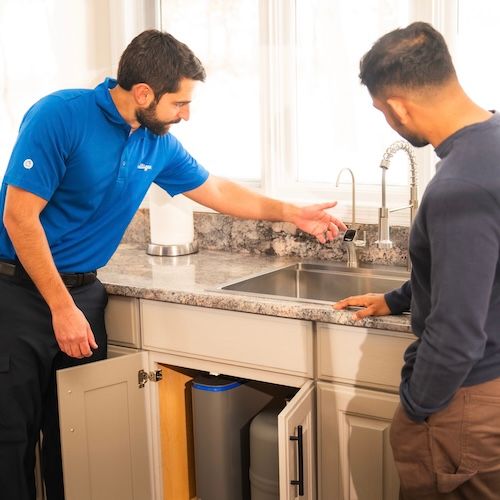
Test at your tap. Culligan of Dothan’s free in-home test measures hardness, chlorine, total dissolved solids, pH and iron in about 20 minutes. For lead, bacteria, nitrate, arsenic or PFAS we arrange certified laboratory testing and go through the results with you. Testing is especially worthwhile if you are on a well, live in a pre-1986 home or are near Fort Novosel. Our Dothan water testing page explains what each test covers, and our Dothan water filtration page shows the systems that address what the test finds.
Frequently asked questions about Dothan tap water
Can I drink Dothan tap water straight from the faucet?
Yes. The 2025 Dothan Utilities report lists no violations and shows lead, nitrate, disinfection byproducts and PFAS all well within or below federal limits. The utility does not test your home’s plumbing, so a tap test is the way to confirm lead in an older house.
Why does my water in Dothan smell like a pool?
Dothan Utilities disinfects with free chlorine and keeps a residual that averaged 1.35 ppm in its latest report, up to 2.4 ppm in places. A reverse osmosis system removes it from drinking water; a whole-house carbon filter removes it everywhere.
Does Dothan Utilities soften the water?
No. Treatment is chlorine, fluoride and a phosphate corrosion inhibitor. The utility does not publish a hardness figure, and calcium and magnesium from the aquifers pass through to your home. A softener is a homeowner decision.
Has there been PFAS in Dothan or Fort Novosel drinking water?
Not at detectable levels in the latest reports from either system, and the Army’s 2021 off-post private well sampling found no PFOS or PFOA. Groundwater on the post did exceed the former advisory level, and the investigation is continuing.
Schedule your free water test with Culligan of Dothan
You should not have to guess what is in your water. Culligan of Dothan has served homes and businesses across Dothan, Headland, Ashford, Cottonwood, Enterprise, Ozark, Daleville, Fort Novosel, Abbeville, Geneva, Hartford and Eufaula for decades, with routes reaching Troy, Marianna and Donalsonville. Our technicians know the difference between a Dothan Utilities home and a Floridan well south of Cottonwood, and they will tell you plainly whether a treatment is worth it. A specialist tests your water, explains the results and, if treatment makes sense, walks through rental and purchase options with a written quote.
Ready for better water? Schedule your free in-home water test with Culligan of Dothan today.