Quick answer: Yes. Coldwater draws all of its city water from wells in glacial sand and gravel, and Branch County groundwater is, in the words of the U.S. Geological Survey, “generally hard to very hard.” The most specific public figure for the city wells comes from a 1968 USGS summary of Michigan groundwater data, which listed hardness of 175 to 310 parts per million, roughly 10 to 18 grains per gallon. The Board of Public Utilities now runs an iron removal plant, but removing iron is not the same as softening, so the hardness minerals still travel to your tap. Private wells in the surrounding townships tend to be hard as well, often with iron on top.
Hardness rarely announces itself with a lab number. In Coldwater it shows up as the white crust around a faucet aerator, a shower door that clouds a few days after cleaning, dishwasher glasses that never come out clear and a water heater that starts to pop and rumble. All of those are calcium and magnesium carbonate coming out of the water. This guide covers where that hardness comes from, how city water compares with the wells around Bronson, Quincy and Union City, what it does to a house and how to find your own number.
Is municipal or well water harder in Coldwater?
Both start from the same geology, so the honest answer is that both are hard and the difference is usually iron rather than hardness. The USGS study of Branch County water resources found that almost all water used in the county comes from wells in glacial drift, the sand, gravel and clay the glaciers left behind, with some wells reaching fractures and sandy beds in the Coldwater Shale beneath. Water that soaks through that kind of material for years dissolves limestone fragments along the way, and those dissolved minerals are what hardness measures. The same study notes that groundwater in the county often contains excessive iron, and that salty water is mainly a problem where bedrock is the main source.
Coldwater city water
The Coldwater Board of Public Utilities serves about 13,800 people through 3,468 connections, according to EPA’s federal drinking water records. Those records list four active wells, numbered 3 through 6, feeding an iron removal plant. Treatment there uses permanganate, cascade aeration and rapid sand filtration to pull out iron and manganese, then adds chlorine for disinfection, fluoride and an orthophosphate corrosion inhibitor that helps keep lead and copper from leaching out of household plumbing. None of those steps is softening. The 1968 USGS data, collected when the city’s four wells of that era ran 121 to 132 feet deep in glacial drift and the water received no treatment at all, put hardness at 175 to 310 parts per million. The BPU’s annual water quality report is the place to check for any current mineral data the utility chooses to publish.
Bronson, Quincy and Union City
The neighboring towns run their own groundwater systems. Bronson pumps from two wells more than 60 feet deep, Quincy from two wells and Union City from two wells inside the village limits. None of their most recent reports, Bronson’s 2025 water quality report, Quincy’s 2022 report or Union City’s 2023 report, lists a hardness figure, because hardness is not a health standard and utilities are not required to report it. They draw from the same glacial aquifers, though, and we see the same scale in homes on all three systems.
Private wells
Outside the city and village limits, most homes have their own wells. In Kinderhook, Girard, Batavia and Ovid townships and around Coldwater Lake and Marble Lake, hardness varies from one well to the next with depth and the material the well is screened in. What does not vary is who is responsible: no utility tests or treats a private well, so the number at your tap is yours to find. The Branch-Hillsdale-St. Joseph Community Health Agency handles well permits and testing for the county.
Hard water quality issues in Coldwater
Hard water is not a health hazard, and the federal standards do not cover it. It is a cost problem and a cleaning problem, and the cost lands in places most people do not look until something breaks.
Scale in water heaters and appliances
When hard water is heated, calcium carbonate drops out of solution and settles in the bottom of a tank water heater or coats the heat exchanger in a tankless unit. That layer acts like insulation, so the burner or element runs longer to heat the same water. The popping sound many Coldwater homeowners hear is water trapped under scale flashing to steam. Dishwashers, washing machines, coffee makers and humidifiers collect the same deposits in their valves and spray arms.
Spots, film and soap scum
Hard water reacts with soap to form a sticky curd instead of lather. That residue is the gray ring in the tub, the film on shower glass and the dullness on glasses straight out of the dishwasher. You end up using more detergent and more cleaner to get less result.
Laundry, skin and hair
Minerals left in fabric make towels stiff and colors fade faster. On skin and hair the same soap residue can leave a tight, dry feeling after a shower. Many people notice the difference most in the first week after a softener goes in.
Iron makes it worse
In Branch County hardness often arrives with iron. Iron stains fixtures orange-brown and can coat softener resin over time, so a well with both needs equipment chosen for both. USGS listed Coldwater’s city wells at 0.3 to 1.5 parts per million iron in 1968, which is why the BPU built an iron plant. Many private wells carry similar amounts and have no plant in front of them.
How a water softener helps
A water softener runs your water through resin beads that hold sodium or potassium ions. As the hard water passes, calcium and magnesium trade places with those ions and stay on the resin. When the resin fills, the softener rinses it with brine from the salt tank and starts over. The result is water that no longer leaves scale, lets soap lather and protects every appliance downstream.
For most Coldwater city homes, the Aquasential Smart High Efficiency Water Softener is a strong fit: it monitors your water use and regenerates only when needed, which keeps salt and water use down. Larger households and well homes may be better served by an Aquasential Select Series model or the Aquasential Advantage Whole Home Water Softener. Where iron is high, we add an Iron-Cleer or Iron-OX5 filter ahead of the softener so the resin lasts. Rental and purchase are both available, and we deliver salt throughout our service area. Details are on our water softeners page.
How to check your water hardness
There are three ways to get a number, and they answer slightly different questions.
Check the utility’s report. If you are on Coldwater, Bronson, Quincy or Union City water, start with the utility’s annual drinking water quality report. It tells you what the system measured and whether it publishes a hardness value; many in the area do not.
Use a test strip. Hardware-store strips give a rough range. They are fine for confirming that water is hard, less useful for sizing equipment.
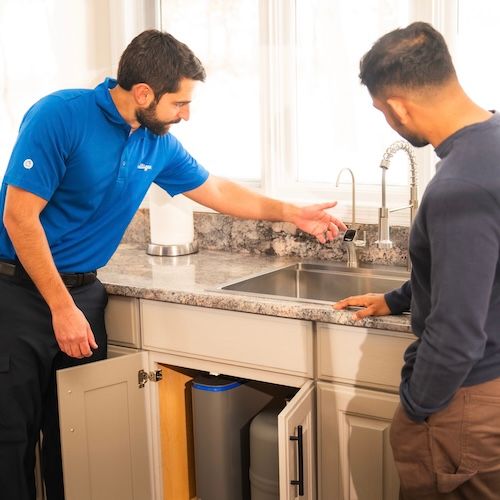
Get a free in-home test. Our technician measures hardness, iron, chlorine, pH and total dissolved solids at your tap in about 20 minutes and explains what each number means for your home. If a softener makes sense, we size it to your grain load and household instead of guessing. More on what we check is on our water testing page, and well owners can find more on well water solutions.
FAQs about Coldwater water hardness
How hard is Coldwater, Michigan water?
The most specific public figure is from USGS, which listed Coldwater’s city well water at 175 to 310 parts per million in 1968, roughly 10 to 18 grains per gallon. That is hard to very hard. The treatment added since then targets iron, not hardness. A home test gives your current number.
Does the Coldwater BPU soften the water?
No. Federal records list iron and manganese removal, chlorination, fluoridation and corrosion control at the plant. None of those removes calcium and magnesium, so softening happens at your house if you want it.
Is well water near Coldwater harder than city water?
Not necessarily. Both draw from the same glacial deposits, which USGS calls generally hard to very hard. The bigger difference is usually iron, which the city removes and a private well keeps unless you treat it.
Will hard water damage my water heater?
Over time, yes. Scale builds up in the tank or heat exchanger, makes the heater work harder and shortens its life. A softener stops new scale from forming.
Start with a free hard water test from Culligan of Coldwater
Culligan Water Conditioning of Coldwater has served Branch County for decades from our office on Marshall Road. Our technicians work on BPU city water, village systems in Bronson, Quincy and Union City and private wells from Tekonsha to Kinderhook, so we know where scale builds fastest and where iron is part of the picture. We test at your tap, explain the results plainly and, if a softener is the right answer, give you rental and purchase options with a written quote and salt delivery on our regular routes.
Ready for better water? Schedule your free in-home water test and consultation with Culligan Water Conditioning of Coldwater today.