Quick answer: Well water around Coldwater can be safe to drink, but no agency checks it for you. Branch County wells draw from glacial sand and gravel that the U.S. Geological Survey describes as generally hard to very hard and often high in iron, and the farm country around Quincy, Bronson and Union City makes nitrate worth watching. MDHHS recommends testing a private well every year for bacteria, nitrate and nitrite, every three to five years for arsenic and lead and at least once for PFAS. With results in hand, treatment is usually simple.
Michigan relies on private wells more than most states. MDHHS counts more than one million private residential wells serving over 2.6 million people, nearly 30 percent of the state’s residents. Around Coldwater, that includes farmhouses along the county roads, homes in Girard and Kinderhook, Sherwood and the townships south toward the state line, and cottages and year-round houses on Coldwater Lake and Marble Lake. If that is you, this guide explains where your water comes from, what tends to show up in it and how to check.
Where Coldwater-area well water comes from
The USGS study of Branch County water resources found that almost all water used in the county comes from wells in glacial drift, the layers of sand, gravel and clay the glaciers left across southern Michigan. Some wells reach fractures and sandy beds in the Coldwater Shale beneath. Thick drift in buried bedrock valleys can yield large quantities of water, while thin drift over tight bedrock in some moraine areas makes finding enough water harder.
The source shapes the quality. Water moving through glacial drift dissolves limestone fragments, which is why it is hard, and picks up iron from the sediments. Where bedrock is the main source, USGS notes that salty water becomes a problem. A shallow well in sand is more exposed to what happens at the surface, including fertilizer, manure and septic systems, while a deeper well screened below a clay layer is better protected.
Municipal water vs. private well water: what’s the difference?
Inside Coldwater, the Board of Public Utilities pumps from four city wells, removes iron and manganese at its plant, disinfects with chlorine, adds fluoride and a corrosion inhibitor and samples the system on a schedule set by Michigan EGLE. The city code generally prohibits private drinking water wells inside the city. Bronson, Quincy and Union City run similar groundwater systems on a smaller scale and publish annual reports.
A private well has none of that. Nobody tests it on a schedule, nobody treats it and nobody publishes a report. The Branch-Hillsdale-St. Joseph Community Health Agency issues permits for new wells and helps owners test, but the responsibility for what comes out of the tap belongs to the homeowner. The good news is that the same kinds of treatment the city uses at its plant are available in sizes that fit a basement.
Common well water quality issues near Coldwater
1. Iron
Iron is the most common complaint we hear from Branch County well owners. USGS calls county groundwater often high in iron, and its statewide review found 44 percent of iron results at or above the drinking-water standard. When the city still pumped untreated well water in 1968, USGS recorded 0.3 to 1.5 parts per million iron. Dissolved iron comes out of the tap clear and turns orange-brown once it meets air, leaving rust stains in toilets and sinks, on laundry and on siding hit by sprinklers. It can also give water a metallic taste and feed iron bacteria, which leave slimy deposits in toilet tanks. Iron-Cleer and Iron-OX5 filters remove it before it reaches the rest of the house.
2. Hard water
Most wells here are hard. The 1968 USGS figures for the city wells, 175 to 310 parts per million, or roughly 10 to 18 grains per gallon, give a sense of what the glacial aquifer carries, and private wells in the same deposits are similar. Hardness leaves scale in water heaters, spots on dishes and film on shower glass. A softener handles it, and where iron is present we pair the softener with an iron filter so the resin stays clean.
3. Nitrate
Nitrate comes from fertilizer, manure and septic systems, and USGS found that Michigan nitrate exceedances occur most often in areas of intensive agriculture. Bronson’s city wells, for one local example, showed nitrate at 6.3 parts per million in the 2025 water quality report, under the 10 ppm limit but well above zero. MSU Extension notes that shallow wells in sandy aquifers are especially vulnerable, that infants face the greatest risk and that boiling water concentrates nitrate rather than removing it. Reverse osmosis and the Nitrate Reduction Conditioner reduce it.
4. Bacteria
Coliform bacteria and E. coli can enter a well through a cracked casing, a loose or buried cap or surface water that pools around the wellhead. They have no taste or smell. That is why MDHHS puts bacteria first on the annual test list. UV disinfection provides continuous protection for wells that test positive more than once.
5. Hydrogen sulfide and odor
A rotten-egg smell, especially from hot water, points to hydrogen sulfide or to bacteria reacting with the water heater’s anode rod. It is not something we can quantify for the county from public data, so we treat it as a test-if-you-notice item. Sulfur-Cleer and Sulfur-OX3 systems handle it when it is present.
6. Arsenic
EGLE notes that a few areas in Michigan have naturally higher arsenic in groundwater and uses 10 parts per billion as the advisory level for private wells. Quincy regulates arsenic at its village plant and reported less than 1 part per billion, and Bronson’s report says its water contains low levels below the standard. Private wells are not covered by either. EGLE also cautions that water softeners and activated carbon filters do not reduce arsenic effectively; point-of-use reverse osmosis or adsorption media is the recommended treatment.
7. PFAS
The Michigan PFAS Action Response Team site list showed no Branch County site when we checked, with the nearest listings in Hillsdale and St. Joseph counties. MDHHS still recommends testing every private well for PFAS at least once. If a result comes back positive, the Whole Home PFAS Water Filter reduces PFAS by more than 99 percent, and Aquasential Smart Reverse Osmosis with Total Defense reduces total PFAS by more than 99.99 percent at the kitchen sink.
After floods and heavy rain
Spring melt and heavy storms can push surface water toward a wellhead, carrying bacteria and farm runoff with it. If floodwater reaches your well, do not drink the water until it is tested. The EPA flooded-well guidance lays out the steps: inspect the well and pump for damage, disinfect the well and then sample and test before using it again. The health agency can help with testing, and repeat problems are a sign the wellhead or casing needs attention.
How to check your well water quality
Follow the state schedule. Test every year for bacteria, nitrate and nitrite, every three to five years for arsenic and lead and at least once for PFAS, per MDHHS. Test sooner after flooding, well repairs or a change in taste, color or smell.
Use local labs. The Branch-Hillsdale-St. Joseph Community Health Agency, at 570 Marshall Road in Coldwater, offers General Water Analysis, Partial Chemistry and coliform testing, and it notes the Coldwater Water Department accepts samples for nitrate and bacteria. The EGLE private well testing guidance lists the standard parameters, from coliform and nitrate to hardness, iron, manganese, arsenic and uranium. Michigan has also run a no-cost well test kit program in recent years, so ask the health agency what is available.
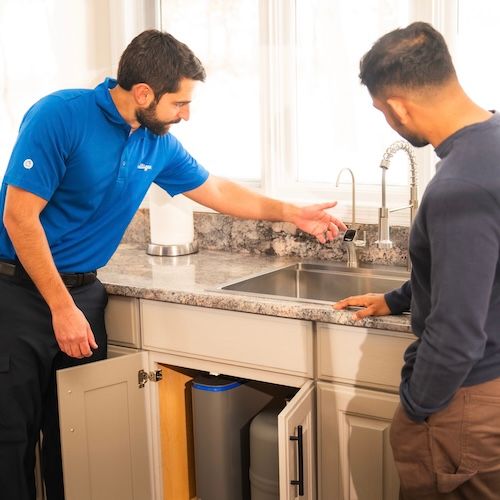
Get a free in-home screening. We test hardness, iron, pH, chlorine and total dissolved solids at your tap in about 20 minutes and can send a sample to a certified lab for bacteria, nitrate, lead, arsenic or PFAS. Our water testing page explains the process.
Choosing well water treatment
Most Branch County wells need two or three pieces of equipment working in order. An iron filter goes first when iron is high, a softener follows for hardness, and reverse osmosis at the kitchen sink handles nitrate, arsenic and taste. UV disinfection adds protection against bacteria where it is needed. Softener-Cleer can help keep softener resin clean in iron-heavy water. The right combination depends on your lab results, which is why we test before recommending anything. Details are on our well water solutions page and our water softeners page.
Frequently asked questions about private wells near Coldwater
Is well water safe to drink near Coldwater, Michigan?
It can be, once it is tested. Bacteria and nitrate have no taste or smell, so annual testing is the only way to know. Treatment is available for each common problem.
Why does my Branch County well water stain orange?
Iron. USGS describes county groundwater as often high in iron. It is clear from the tap and turns orange when it meets air. An Iron-Cleer or Iron-OX5 filter removes it.
How often should I test my well near Coldwater?
MDHHS recommends bacteria, nitrate and nitrite every year, arsenic and lead every three to five years and PFAS at least once, plus a test after any flooding or repair.
Where can I test my well water in Coldwater?
The Branch-Hillsdale-St. Joseph Community Health Agency at 570 Marshall Road offers well testing, and the Coldwater Water Department accepts nitrate and bacteria samples. We offer a free in-home screening and certified lab testing.
Does a water softener fix well water problems?
It handles hardness and small amounts of iron. It does not remove bacteria, nitrate or arsenic, so most wells need an iron filter, reverse osmosis or UV alongside it.
Get your well water tested by Culligan of Coldwater
Culligan Water Conditioning of Coldwater has worked on Branch County wells for decades, from lake cottages to working farms. We know how iron, hardness and nitrate show up here and how to treat them without overbuilding a system. A local specialist will test your water, explain the results and recommend only what your well needs, with rental and purchase options and salt delivery on our regular routes.
Ready for better water? Schedule your free in-home water test and consultation with Culligan Water Conditioning of Coldwater today.