Quick answer: Coldwater’s public water meets state and federal drinking water standards. The Coldwater Board of Public Utilities pumps groundwater from four wells, removes iron and manganese at its treatment plant and adds chlorine, fluoride and a corrosion inhibitor before distribution. EPA’s federal records list no violations for the system after 2021, and the one earlier entry was a monitoring and reporting item rather than a health-based violation. Twelve rounds of lead monitoring on file show 90th-percentile results from 2.6 to 8.5 parts per billion, all below the action level. That makes the water safe to drink by regulatory standards. It does not mean every home’s water tastes good or that your own plumbing adds nothing, and that is where testing at the tap comes in.
Most Coldwater residents never read the annual water quality report, and that is understandable. It is a compliance document full of abbreviations. But it answers a few questions people care about: where the water comes from, what the utility adds, what it found and whether anything went over a limit. This guide walks through those answers for Coldwater and its neighbors in Bronson, Quincy and Union City, explains what a utility report cannot tell you about your own kitchen tap and lays out the simplest ways to find out.
Where Coldwater’s water comes from
All of it is groundwater. EPA’s records list the city as a groundwater system serving about 13,800 people through 3,468 service connections, with Wells 3, 4, 5 and 6 active. The USGS study of Branch County water resources explains why wells work so well here: almost all water used in the county comes from glacial drift, and thick sand and gravel, especially in buried bedrock valleys, can yield large quantities of water. The same study notes that this groundwater is generally hard to very hard and often contains excessive iron.
That iron is why the treatment plant exists. Federal records list permanganate, cascade aeration and rapid sand filtration for iron and manganese removal, followed by chlorination for disinfection, fluoridation and an orthophosphate corrosion inhibitor. In 1968, a USGS summary recorded the city’s water at 0.3 to 1.5 parts per million iron and noted that it received no treatment. The water then moves to clearwells and a reservoir at the plant and on to elevated tanks on Bishop Avenue, Garfield Road and at Willowbrook, with booster stations on the Sauk River and Seeley Street lines.
Water and sewer operate as one combined system under the BPU, and the city code generally prohibits private drinking water wells inside the city. Properties with prohibited wells must connect, and existing wells have to be connected to city water when they fail. Outside the city, the picture changes. Bronson, Quincy and Union City run their own wells, and most township homes rely on private wells that no utility monitors.
What municipal water testing does, and does not, tell you
The BPU samples the system on a schedule set by Michigan EGLE and reports the results each year. Those samples tell you the water leaving the plant and moving through the mains met the standards. They are not taken at your faucet, and they do not reflect what happens between the street and your glass: the age of your service line, the solder in your copper pipes, a water heater that has not been flushed in a decade or a fixture with brass parts.
Federal standards also cover health-based contaminants, not everything people notice. Hardness and iron below health limits are aesthetic issues, so a system can be fully compliant while still sending water that scales fixtures or tastes faintly metallic after a hydrant flush. Here are the issues we see most often in Coldwater-area homes on public water.
1. Chlorine
Chlorine keeps bacteria from growing in miles of pipe between the plant and your house, and it does that job well. The trade-off is taste and smell. Some people notice it most in a glass of cold water or when filling a bath. Federal records show the Coldwater system uses chlorine rather than chloramine, and Bronson’s 2025 water quality report lists a chlorine running annual average of 0.37 parts per million, with readings from 0.11 to 0.85. Chlorine is one of the easiest things to remove at home: carbon filtration takes it out at the kitchen tap or for the whole house.
2. Lead from aging plumbing
Lead does not come from the wells. It comes from lead service lines, older solder and some brass fixtures, and it can dissolve into water that sits in those pipes. That is why the BPU adds an orthophosphate inhibitor, which builds a thin protective layer inside pipes. The system’s 90th-percentile lead results on file, 2.6 to 8.5 parts per billion across twelve monitoring rounds, show the program working at the system level. They cannot tell you about a specific house. Bronson’s 2025 report, for comparison, counts 579 lead service lines among 937 total, with a 90th-percentile lead result of 2 parts per billion in 2024. If your home is older, a certified lab test for lead is worth doing, and an Aquasential Smart Reverse Osmosis system, which reduces lead by 99.7 percent, protects drinking and cooking water while lines are replaced.
3. Iron and discolored water
The BPU removes iron at the plant, but small amounts can settle in mains over time. When crews flush hydrants or repair a break, that sediment gets stirred up and can tint water yellow or brown for a while. It is a nuisance more than a hazard, but it stains laundry and fixtures. Running cold water until it clears usually fixes it. If discoloration happens often at your house, a whole-house filter is worth considering.
4. Hardness
Coldwater’s water is hard. The 1968 USGS summary of Michigan groundwater data listed the city wells at 175 to 310 parts per million, roughly 10 to 18 grains per gallon, and iron removal does not change that. Hardness is not a health issue, but it is the source of most scale and spotting complaints. Our hard water guide and water softeners page cover the details.
5. Nitrate and other local considerations
Branch County is farm country, and nitrate is the contaminant to watch in shallow groundwater. Bronson’s 2025 report shows nitrate at 6.3 parts per million, below the 10 ppm limit but higher than many systems; Union City’s 2023 report lists 0.8 ppm. Quincy’s 2022 report notes that arsenic and fluoride are regulated at its plant, with arsenic under 1 part per billion and fluoride at 1.2 parts per million, and PFAS not detected in a 2021 sample. Each system is different, so read the report for the one that serves your address.
6. PFAS
PFAS are a family of long-lasting chemicals that Michigan has been tracking closely. The Michigan PFAS Action Response Team site list showed no Branch County site when we checked; the nearest listings are in Hillsdale and St. Joseph counties. If you want an extra margin of protection, the Aquasential Smart Reverse Osmosis system with Total Defense cartridges reduces total PFAS by more than 99.99 percent, and the Whole Home PFAS Water Filter reduces it by more than 99 percent at every tap.
Fluoride in Coldwater water
Federal treatment records list fluoridation at the Coldwater plant, and the BPU’s annual report gives the level measured each year. Bronson’s 2025 report shows fluoride at 0.59 parts per million, and Union City has fluoridated since 2004. Households that prefer less fluoride in drinking water can use reverse osmosis at the kitchen sink while leaving the rest of the house on treated city water.
How to check your home’s water quality
Read the annual report. Coldwater, Bronson, Quincy and Union City each publish one. It covers the system, not your house, but it is the right starting point.
Watch for changes. New taste, odor, color or staining is worth a test, as are plumbing renovations or a new baby in the house.
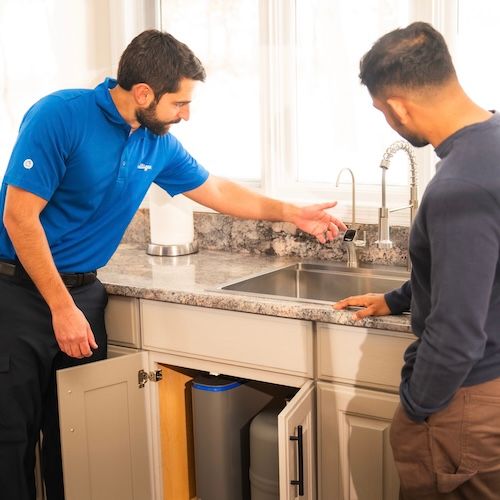
Schedule a free in-home test. Our technician measures hardness, chlorine, total dissolved solids, pH and iron at your tap in about 20 minutes and explains the results. For bacteria, nitrate, lead, arsenic or PFAS, we send a sample to a certified laboratory. See our water testing page for what is included.
Choose treatment to match. Chlorine taste calls for carbon. Lead, nitrate, PFAS or a broad mix of dissolved solids point toward reverse osmosis, such as the Aquasential Smart Reverse Osmosis system or the Aquasential Tankless RO. The Aquasential Smart HE Water Filter or a Select Series whole-house filter handles chlorine and sediment for every tap. Options are on our water filtration page. We also deliver bottled water and coolers if you would rather keep it simple.
Schedule your free water test with Culligan of Coldwater
Culligan Water Conditioning of Coldwater has worked on Branch County water for decades. We know the BPU system, the village supplies in Bronson, Quincy and Union City and the wells in between, and we can tell you plainly whether your water needs anything at all. A local specialist tests at your tap, walks you through the numbers and, if treatment makes sense, gives you a written quote with rental and purchase options.
Frequently asked questions about Coldwater tap water
Can I drink Coldwater tap water?
Yes. The system meets state and federal standards, and EPA’s records list no violations after 2021. Taste, hardness and what your home’s plumbing adds are separate questions that a tap test answers.
Does Coldwater use chlorine or chloramine?
Chlorine. Federal treatment records list chlorination for disinfection. A carbon filter removes the taste and smell.
Is there lead in Coldwater’s water?
The wells are not the source. Lead can come from service lines, solder and fixtures inside a home. The system’s 90th-percentile results on file range from 2.6 to 8.5 parts per billion, below the action level, but only a test at your tap measures your home.
Why is my Coldwater water discolored after hydrant flushing?
Flushing stirs up iron and sediment that settle in mains. Run cold water until it clears and avoid doing laundry until it does. Frequent discoloration is a reason to consider a whole-house filter.
Does reverse osmosis help with Coldwater water?
For drinking and cooking water, yes. Aquasential Smart Reverse Osmosis reduces lead by 99.7 percent and, with Total Defense, total PFAS by more than 99.99 percent, and it improves taste and reduces dissolved minerals.
Ready for better water? Schedule your free in-home water test and consultation with Culligan Water Conditioning of Coldwater today.