
A whole house filtration system treats water as it enters your home, so every tap provides cleaner water. These systems typically address a specific water issue, from nuisance concerns like chlorine or iron to contaminants like arsenic or PFAS. Because each system is designed around a particular problem, cost depends on your water concerns, how many systems you need and the features you choose.
This is why the national average cost of a whole house water filtration system ranges widely, generally from $1,500 to $10,000. For Culligan whole-home filtration systems, prices typically range from $1,999 to 5,399, though this can vary.*
The sections below cover what shapes system average costs, along with installation and ongoing upkeep. Because local labor rates and plumbing configurations differ, treat these figures as a helpful benchmark rather than a definitive listing.
How we estimated these costs
The general cost ranges throughout this article are U.S. national averages from Angi’s whole house water filtration cost data as of September 2026. Costs represent the broader market, including systems from many manufacturers and installers. Costs in Canada may differ.
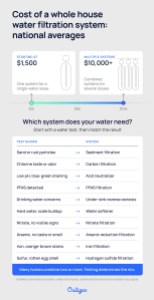
Cost by system type
Most whole house filtration systems target a specific water problem, which is part of the reason why costs vary widely by type. Some systems, like sediment filtration and acid neutralizers, help protect plumbing and fixtures. Others address aesthetic concerns like chlorine taste or sulfur odor, or protect against contaminants like PFAS or arsenic that can pose health risks.
Reverse osmosis (RO) systems, by contrast, focus specifically on drinking water. Many homes combine solutions based on their water quality and household needs, such as pairing a water softener for hard water with an under-sink RO system for drinking water.
Below are some of the most common whole house filtration systems, plus two related systems that often come up when homeowners research whole house treatment.

Explore whole house filtration solutions.
Sediment filtration
Cloudy tap water and gritty buildup around faucet aerators are common signs of sediment. Particles like rust, sand and silt can enter the water supply from aging water mains or from the soil and geology surrounding a private well.
Beyond affecting the water’s appearance, sediment can clog aerators and showerheads, reduce water flow and wear on the valves and seals inside single-lever faucets, shower controls and appliances. Over time, this grit can act like sandpaper inside your plumbing.
A sediment filtration system uses a physical barrier to trap debris before water reaches your fixtures. Because they help prevent clogs, these systems are often installed ahead of other water treatment equipment to help protect it. Costs can rise if your water has heavy sediment buildup or your home has high water usage, which may call for larger tank capacity or multi-stage filtration.
Activated carbon filtration
Municipal water supplies commonly disinfect tap water with chlorine or other chlorine-based compounds, which can leave an unpleasant taste and odor. A whole house carbon filtration system reduces chlorine, so water can taste and smell better throughout your home.
Cost depends on system size and the type of activated carbon needed for your local water supply. Conventional activated carbon is effective at reducing chlorine. However, if your water municipality disinfects with chloramine (a compound of chlorine and ammonia that’s more difficult to reduce), you’ll need one that uses specialized catalytic carbon, which typically costs more.
Acid neutralizers
Acidic water can occur naturally when rain and groundwater pass through surrounding soil and geology before reaching your water supply. This water has a low pH, meaning it measures below 7 on the pH scale. Over time, acidic water can corrode copper pipes and fixtures, which can leave blue-green stains in your sinks and tubs or a metallic taste in your tap water.
An acid neutralizer raises the water’s pH as it enters your home. For mild acidity, a standard neutralizing tank is typically the most affordable option. Water flows through a bed of mineral media, such as calcite, that gradually dissolves to raise the pH, and the media will need to be replenished over time.
Highly acidic water may require a chemical feed system that uses a small pump to inject a neutralizing solution into the water line, which generally costs more.
Iron and sulfur filtration
Iron and hydrogen sulfide are two of the most common water issues for private well owners, although they can also affect some municipal water supplies. Iron can leave reddish-brown stains on sinks, tubs and laundry, and can give water a metallic taste. Hydrogen sulfide, which can cause a rotten-egg odor, generally occurs naturally in groundwater or may develop in water heaters through harmless microbiological activity.
Iron and sulfur filtration systems typically convert dissolved iron or hydrogen sulfide into particles that the filtration media can capture, then periodically flush those particles from the system. Cost depends on the concentration of iron or hydrogen sulfide in your water, whether both are present and the potential presence of other minerals.
Arsenic and nitrate filtration
Arsenic and nitrate are more often found in private wells than in municipal water supplies. Arsenic can occur naturally in some rock and soil formations, while nitrate can enter groundwater from fertilizer, septic systems and animal waste. Neither can be detected by taste, odor or appearance, so laboratory testing is needed for identification.
Both are also regulated by the U.S. and Canada because they can pose potential health risks.
Whole house systems for both arsenic and nitrate contaminants** use specialized media designed for one specific issue. Cost depends on the contaminant level in your water, household water use, if multiple systems are needed and how often the media needs replacement.
PFAS filtration
Per- and polyfluoroalkyl substances (PFAS) are human-made chemicals used in products for their ability to resist water, heat and grease. They’re often called “forever chemicals” because they resist breaking down in the environment.
The U.S. Geological Survey estimates that at least 45% of U.S. tap water contains one or more types of PFAS, which can enter water supplies through industrial discharges, firefighting foam and waste sites. Federal drinking water standards limit two common PFAS, PFOA and PFOS, to four parts per trillion each in public water systems.
Health Canada reports that data suggests that PFAS are present in drinking water across the country. Levels are generally below its objective of 30 nanograms per litre for the combined total of 25 specific PFAS. In Canada, drinking water requirements are determined by provinces and territories, however they worked together with Health Canada on PFAS objectives.
Whole house PFAS filtration systems use specialized filtration media to reduce these chemicals as water enters your home.** Cost depends on the range of PFAS compounds a system is designed and certified to reduce, and the flow rate and volume of water required. Systems certified to reduce a broader range of PFAS can cost more.
Reverse osmosis
Rather than targeting one specific water issue throughout the house, a reverse osmosis (RO) system is designed to reduce a wide range of contaminants in the water you drink and cook with. Most homeowners install these units under the kitchen sink. Whole-home RO systems do exist, but they’re far less common and considerably more expensive due to their complex setup and ongoing maintenance.
RO systems use multiple stages of filtration, including a semipermeable membrane, to reduce contaminants that more basic filters can’t address. For example, Culligan’s Aquasential® Smart Reverse Osmosis System and Aquasential® Reverse Osmosis System are designed to reduce more than 90 contaminants.
Many homeowners pair an under-sink unit with whole house filtration to address multiple water quality issues, such as a whole house filter for iron reduction and an RO system for reduction of health-related contaminants and better taste.
The national average cost of a RO system ranges from $300 to $2,500+. However, the final price depends on system design, the number of filtration stages, third-party certifications and optional features like remineralization or smart monitoring.
Water softener systems
Water softeners aren’t filtration systems, they work differently by reducing hardness through a process called ion exchange. However, they treat water throughout your home and are often installed alongside whole house filtration systems.
Hard water occurs when groundwater moves through rock and soil, picking up high levels of calcium and magnesium. Over time, these minerals can create a scale buildup on surfaces and fixtures (think sinks, shower doors and faucets) and inside appliances like water heaters and dishwashers. A water softener removes these minerals before water reaches your faucets and appliances.
Nationally across manufacturers, water softeners average $700 to $3,000+. Price depends on the water softener’s capacity, which is sized to your water’s hardness and your household’s water use, along with features, system design, durability, efficiency and length of warranty.
You can also purchase systems that pair softening with filtration, like a water softener that also targets chlorine in municipal water. Because these are two-in-one solutions, they generally cost more than a standard water softener.
Installation costs
Installation is typically priced separately from the system itself. Whole house systems connect to the main water line where it enters your home, usually in a basement or utility room. Installation costs can vary widely depending on your plumbing setup, how many systems are installed and the work each one requires.
Single-stage systems are generally faster to install, while multi-tank systems or units requiring drain lines and electrical power can take longer. The condition and layout of your plumbing matter too. Older homes or homes with hard-to-reach water lines may require additional work, which can increase labor costs.
Professional installation helps ensure each system is sized and connected correctly, and your local Culligan water expert can provide professional installation and ongoing service after the system is in place.
Ongoing costs
Whole house filtration systems require regular maintenance to perform effectively over their full lifespan. On average, whole house systems typically cost $100 to $500 per year to maintain, depending on the system and how many are installed.
A single system may require only modest annual spending for periodic cartridge or media replacement, whereas running multiple systems alongside a water softener adds recurring costs for salt and service.
Most ongoing costs fall into a few categories:
- Filter media replacement: Many systems rely on filter media that is depleted over time, such as the media in carbon and PFAS filtration systems. Regular replacement helps the system continue to perform effectively.
- Refills: Some systems require ongoing supplies, such as salt for a water softener or neutralizing media for an acid neutralizer.
- Component replacement: Parts such as RO membranes and control valves eventually require replacement over the life of a system.
- Water testing: Periodic testing can help confirm your system is still performing as intended.
Many providers offer service plans that cover routine maintenance and system checkups, which can make these costs more predictable over time.
What affects whole house filtration pricing
No two homes need exactly the same water treatment, which is why whole house water filtration cost varies so widely. A water test is a common starting point to help identify issues. Those findings, along with your household’s preferences and the factors below, help determine what your home’s system will cost compared to national averages:
- Water source: Private wells don’t receive municipal treatment, so well owners are responsible for testing and treating their own water, which can call for more extensive systems. Municipal water is treated by a utility, though many homeowners still add filtration for taste, specific local concerns or broader overall protection.
- Types of contaminants: Some contaminants require more advanced filtration than others. Reducing contaminants like arsenic or PFAS or correcting heavy acidity typically costs more than filtering basic sediment or chlorine. If your water test reveals several different issues, you may also need to combine systems, which raises the total cost.
- Contaminant levels: Higher contaminant concentrations may require a larger-capacity system or cause filter media to wear out faster, which affects both upfront and ongoing costs.
- Household water use: Homes that use more water at once need a system with sufficient capacity and flow rate to maintain water pressure during peak use, typically requiring a larger, more expensive unit.
- Certification: Systems independently tested to NSF/ANSI standards can cost more because third-party labs verify their performance. Rather than relying on manufacturer claims, certification verifies that a system reduces the specific contaminants it’s certified for.
- Testing needs: Standard on-site testing can evaluate common issues like hardness, pH and chlorine, but uncovering complex contaminants like arsenic or PFAS requires specialized laboratory analysis. This is an important step for homeowners with specific safety and quality concerns, but it does add an upfront expense.
Is whole house filtration worth the cost?
A whole house system can be worth the cost when you have a specific water quality issue that affects daily water use across your home, from showering to laundry. That issue might be a nuisance like chlorine odor or sediment, or a contaminant like PFAS, arsenic or nitrate that can pose potential health risks.
Keep in mind that one system rarely addresses every issue. If your water has both hardness and other water quality concerns, you may need to pair multiple systems, which increases the total investment. A professional water test is a reliable first step to identify specific concerns, so you can invest in the solutions your home actually needs.
Get a quote from your local Culligan water expert
National average costs provide a helpful baseline, but an accurate quote reflects the specific system you choose, your unique water concerns and your home’s plumbing layout.
To help you find the right solution, a local Culligan water expert starts with a free in-home consultation to test your water, inspect your plumbing and discuss your needs and concerns. If your concerns call for testing for specific contaminants, your water expert can send a sample to Culligan’s IL EPA-certified lab, at an additional cost, before recommending a solution customized to your home.

Schedule your free water test.
FAQs
Learn more about whole house water filter cost below.
How long do whole house filtration systems last?
With regular maintenance, many whole house filtration systems can last up to 10 to 15 years.
Does a whole house filter soften water?
No, whole house filtration systems don’t soften water; this requires a separate water softener. Many homes with hard water choose to install a softener alongside their whole house filtration system.
How often do filters need to be replaced?
You may need to replace your filters or filtration media every few months to every few years, depending on the type of filter, your water quality and how much water your home uses.
Is a whole house filter cheaper than reverse osmosis?
No, an under-sink reverse osmosis system typically costs less than a whole house filtration system, though the two address different needs. However, prices can vary greatly depending on system type, features, configuration and more.
*Dealer pricing and availability of rental/financing options may vary.
**Contaminants may not be present in your water.