Quick answer: Yes, the water in Sylmar is hard, and how hard depends on which utility serves your street. LADWP’s 2025 Drinking Water Quality Report lists hardness of 103 to 140 mg/L across the three sources that supply the San Fernando Valley, roughly 6 to 8 grains per gallon, moderately hard to hard. The City of San Fernando’s wells deliver about 190 mg/L (11 gpg), Burbank reports 286 mg/L (16.7 gpg), Pasadena’s Raymond Basin groundwater averages 222 mg/L (13 gpg) and Santa Clarita Valley groundwater averages 334 mg/L, close to 19 gpg. Private wells in Acton, Agua Dulce and the canyons vary by property. A test at your own tap is the only way to know your number.
If you live in Sylmar, you have probably seen hard water without naming it: a white crust on the kitchen faucet, cloudy spots on glasses out of the dishwasher, a shower door that hazes over a day after you squeegee it, or skin that feels tight after a shower in August. Each of those is calcium and magnesium coming out of the water and staying behind.
What makes this corner of Los Angeles County unusual is how much hardness changes across a short drive. A Granada Hills home on LADWP water and a Burbank home five miles away can differ by 10 grains per gallon because the two systems pull from different sources. Here is what homeowners across the San Fernando, Santa Clarita and San Gabriel valleys should know about why, how to check your own level, and what a softener does about it.
Is municipal or well water harder in Sylmar?
Both are hard; the local groundwater is simply harder. LADWP’s water is a blend: in 2025 it was 44 percent Los Angeles Aqueduct water from the Owens Valley and Mono Basin, 52 percent imported Metropolitan Water District water from the State Water Project and the Colorado River, 3 percent recycled and 1 percent local groundwater. For the San Fernando Valley it is sampled at the Los Angeles Aqueduct Filtration Plant (103 mg/L), the Northern Combined Wells in the San Fernando Basin (115 mg/L, ranging 78 to 151 through the year) and MWD’s Jensen plant (140 mg/L). That seasonal swing is why the same house can see spotting come and go.
Step off LADWP’s system and the numbers climb. The City of San Fernando pumps four wells in the Sylmar basin and reports 190 mg/L. Glendale Water & Power’s 2024 report shows 350 mg/L (20.5 gpg) at the plant that treats its San Fernando Basin groundwater, against 148 mg/L for the MWD water it blends in. Pasadena gets about half its supply from the Raymond Basin and reports 12 to 15 gpg for that groundwater. SCV Water’s 2024 report puts Santa Clarita Valley groundwater from the Alluvial and Saugus Formation aquifers at 300 to 377 mg/L, roughly 17 to 22 gpg, while its State Water Project surface water runs about 160 mg/L. In the San Gabriel Valley, Arcadia’s wells averaged 210 mg/L.
None of these utilities soften the water. Hardness is not a health standard, so plants remove bacteria, solvents and regulated contaminants and leave the calcium and magnesium in.
Private wells in Acton, Agua Dulce and the canyons north of Sylmar are tested and treated by nobody but the owner. Public wells in the same ground hint at what to expect: Los Angeles County Waterworks District 37’s Acton wells showed hardness as high as 420 mg/L in 2022 and 2023. A private well a mile away can be higher or lower depending on depth and the alluvium it sits in.
Hard water problems Sylmar homeowners run into
Hard water will not make you sick. It will cost you money a little at a time. These are the three complaints we hear most across the valleys.
1. Scale inside water heaters and appliances
What homeowners notice: A water heater that rumbles or recovers slowly, a tankless unit that throws error codes and needs flushing, clogged dishwasher jets and weak showerheads.
What causes it: Heating hard water drives the dissolved calcium and magnesium out of solution, where they harden into scale. At Burbank’s 16.7 gpg or Santa Clarita’s 19 gpg that happens fast; at LADWP’s 6 to 8 gpg it adds up over years.
Why it matters: Scale on a heating element acts like insulation, so the heater burns more energy, and deposits shorten the life of water heaters, dishwashers and washing machines. Tankless heaters, common in newer Santa Clarita and Porter Ranch homes, are especially sensitive.
2. Spots, film and soap scum
What homeowners notice: Cloudy glassware, a white haze on shower glass and tile, chalky rings at faucet bases.
What causes it: Calcium and magnesium react with soap to make a sticky curd instead of a lather, and the same minerals are left behind wherever a drop dries.
Why it matters: Homes with hard water use noticeably more detergent, shampoo and dish soap, and dark fixtures and glass-tile showers show every spot.
3. Dry skin and dull hair
What homeowners notice: Skin that feels tight after bathing, especially during Santa Ana wind season, and hair that is dull or never quite rinsed.
What causes it: Soap and shampoo do not rinse cleanly in hard water, leaving a thin mineral-and-product film behind.
Why it matters: That film blocks moisture, which is why people often notice a difference within a couple of weeks of installing a softener.
A whole-home softener such as Culligan’s Aquasential® Smart High Efficiency Water Softener removes the calcium and magnesium where water enters the house, so every tap, shower and appliance gets soft water. Because LADWP, Burbank, Glendale and SCV Water all disinfect with chloramine, many of our customers pair the softener with a carbon stage that takes the chloramine taste out at the same time. You can see the options on our Sylmar water softeners page.
The Santa Clarita Valley softener ban
If you live in Santa Clarita, Valencia, Canyon Country, Saugus or Newhall, there is an important wrinkle. The Santa Clarita Valley Sanitation District prohibits residential self-regenerating water softeners. The Automatic Water Softener Ordinance took effect in 2003, voters approved Measure S in November 2008 to enact the Santa Clara River Chloride Reduction Ordinance, and all residential automatic softeners had to be removed by June 30, 2009. The reason is salt: softener brine goes to the Saugus and Valencia Water Reclamation Plants, which cannot remove chloride, and from there to the Santa Clara River, where the Regional Water Quality Control Board set a 100 mg/L chloride objective to protect avocado and strawberry growers downstream. The Sanitation District says more than 8,000 units have been removed, inspections continue, and discharging brine to the ground is illegal even with potassium chloride.
The Sanitation District’s own guidance lists the compliant alternative: a portable exchange tank softening service. Culligan of Sylmar delivers a sealed softener tank that treats your water exactly as a conventional softener would, then on a set schedule we swap it for a freshly regenerated tank and take the spent one back to our facility. No salt, brine or regeneration ever happens at your house. Filtration and reverse osmosis are also permitted alongside it. Outside the Santa Clarita Valley, in LADWP, Burbank, Glendale, Pasadena and San Gabriel Valley service areas, conventional softeners are allowed and we install them every day.
How to check your home’s water hardness in Sylmar
Read your utility’s report. LADWP publishes its Drinking Water Quality Report at ladwp.com with hardness listed by source. SCV Water, Burbank, Glendale, Pasadena and the City of San Fernando each post an annual report with a hardness line as well. These give the range for your system, not the value at your sink.
Look for the signs. Scale on the showerhead, spots that survive the dishwasher, soap that will not lather, a water heater that has gotten loud. Two of those together almost always mean hard water.
Test at your tap. This is the step that matters, because LADWP’s blend shifts through the year and the gap between a Van Nuys home and a Burbank home is wide enough to change what size softener you need. Culligan of Sylmar’s in-home test is free, takes about 20 minutes and measures hardness along with chlorine, total dissolved solids, pH and iron. Details are on our Sylmar water testing page.
FAQs about Sylmar water hardness
How hard is the water in Sylmar, CA?
LADWP’s 2025 report lists 103 to 140 mg/L across the three sources serving the San Fernando Valley, about 6 to 8 grains per gallon. The City of San Fernando’s wells run about 190 mg/L (11 gpg). Burbank, Glendale, Pasadena and Santa Clarita report 13 to 20 gpg on their local groundwater.
Will a water-filter pitcher soften hard water in Sylmar?
No. Pitcher filters address taste and certain drinking-water contaminants, not calcium and magnesium, and they treat only the water you pour through them. Scale in your water heater and spots on the shower door come from the rest of the water your home uses. Softening the house takes an ion-exchange softener or, in the Santa Clarita Valley, a portable exchange tank.
Does LADWP soften the water in Sylmar?
No. LADWP treats its water to meet drinking water standards, which do not include hardness, and leaves the calcium and magnesium in. The same is true of SCV Water, Burbank, Glendale, Pasadena and San Fernando.
Can I have a water softener in Santa Clarita?
Not a self-regenerating one. The Santa Clarita Valley Sanitation District’s chloride ordinance required their removal by June 2009 and still enforces it. Portable exchange tank service, which Culligan of Sylmar provides, is the compliant way to get soft water there.
Start with a free hard water test from Culligan of Sylmar
Culligan of Sylmar has been treating hard water for homes across Sylmar, San Fernando, Pacoima, Granada Hills, Northridge, Chatsworth, Van Nuys, Burbank, Glendale, Pasadena, Santa Clarita, Valencia, Canyon Country, Arcadia and Glendora for decades. Our technicians work on LADWP water, on the harder groundwater systems around it and on private wells in the canyons, so we know which neighborhoods need a bigger softener and where a portable exchange tank is the right answer.
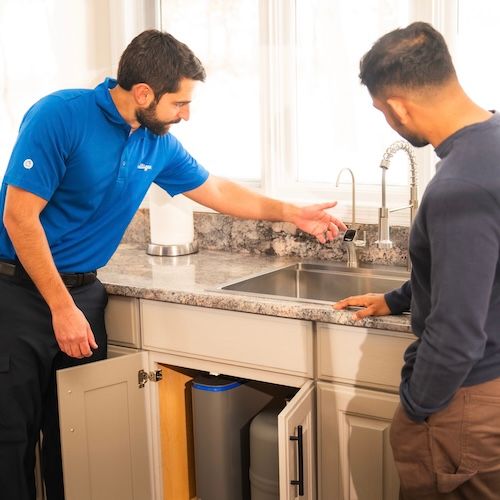
When you schedule a free in-home water test, a local specialist measures your water at the tap, explains the results in plain language and, if a softener or exchange tank makes sense, walks you through rental and purchase options with a written quote. No obligation.
Ready for better water? Schedule your free in-home water test and consultation with Culligan of Sylmar today.