Quick answer: Yes. LADWP’s 2025 Drinking Water Quality Report states that no substance was detected above a maximum contaminant level, and the City of San Fernando, Burbank, Glendale, Pasadena and SCV Water each report no violations in their latest annual reports. Meeting the standards is not the same as water with nothing in it. The same reports show chloramine residual, 6 to 20 grains per gallon of hardness depending on the system, low levels of chromium-6 and nitrate in local groundwater, naturally occurring arsenic in aqueduct water, and PFAS detections that have taken wells offline in Glendale and Santa Clarita. The utility measures the system; only a test at your tap measures your home.
If you live in Sylmar on LADWP water, your water is treated and tested constantly before it reaches the distribution system. Homeowners still ask what is actually in it, and the question is fair in a region where the groundwater under the San Fernando Valley has been a federal Superfund site since 1986 and the valley next door has spent two decades treating perchlorate out of its wells. Here is what people across the San Fernando, Santa Clarita and San Gabriel valleys should know.
What municipal testing does and does not tell you
The EPA regulates more than 90 contaminants in public drinking water, and California’s Division of Drinking Water adds standards and notification levels of its own. Every utility serving our area publishes an annual report showing how its water compared. Three limits are worth understanding.
First, a maximum contaminant level is a legal and economic standard, not a line between safe and unsafe. California also publishes public health goals, which are purely health-based and often far lower. Glendale’s report lists chromium-6 at 5.1 ppb at its treatment plant against a 10 ppb MCL and a 0.02 ppb public health goal. Both numbers are true; they answer different questions.
Second, utilities sample where water enters the system and at selected points within it, not at the pipe under your street in Pacoima or the fixtures in a 1950s Northridge ranch house.
Third, utilities treat for health. Hardness, chloramine taste and the musty note Santa Clarita residents sometimes smell in summer are not health issues and are not removed.
Municipal water vs. private well water
Private wells are uncommon in Los Angeles County and clustered in the unincorporated canyon and high-desert communities north and east of Sylmar: Acton, Agua Dulce, the Soledad Canyon corridor. Statewide, USGS estimates about 4 percent of Californians supply their own household water. A private well is not tested by LADWP or anyone else; Los Angeles County Public Health permits residential wells but does not monitor their water. Nearby public wells show what the geology can deliver: the Acton waterworks district’s wells reported nitrate between 6.2 and 8.3 mg/L in 2022 and 2023, hardness up to 420 mg/L and PFAS above a state notification level in two of three wells. Our well water page covers testing and treatment for those homes.
Where does Sylmar’s drinking water come from?
LADWP’s 2025 supply was 44 percent Los Angeles Aqueduct water from the Owens Valley and Mono Basin, 52 percent Metropolitan Water District water from the State Water Project and the Colorado River, 3 percent recycled water and 1 percent local groundwater. That groundwater share is small for a reason. The San Fernando Basin under the valley, which once supplied about 10 percent of the city’s water, has been part of the San Fernando Valley Area 1 Superfund site since 1986 because of trichloroethylene, perchloroethylene, hexavalent chromium and 1,4-dioxane from decades of aerospace and industrial activity in North Hollywood, Burbank and Glendale. LADWP can reliably operate only 41 of its 115 wells and is building three treatment complexes, North Hollywood West, North Hollywood Central and Tujunga, using UV advanced oxidation and granular activated carbon to bring basin water back into service. In September 2024 the EPA and Honeywell agreed to fund more treatment in the North Hollywood Operable Unit, enough for about 144,000 residents.
The City of San Fernando runs its own system from four wells in the Sylmar basin. Burbank and Glendale blend MWD water with treated San Fernando Basin groundwater. Pasadena draws about half its water from the Raymond Basin. SCV Water uses roughly three-quarters State Water Project water and one-quarter groundwater from the Alluvial and Saugus Formation aquifers. Arcadia and its San Gabriel Valley neighbors pump the Main San Gabriel Basin, where the San Gabriel Basin Water Quality Authority reports more than 130 billion gallons treated for solvents, perchlorate and other contaminants in the Baldwin Park area. Across all of that, these are the issues we encounter most often.
1. Chloramine taste and odor
What homeowners notice: A chemical or swimming-pool smell, strongest in a hot shower or a glass straight from the tap.
What causes it: LADWP, SCV Water, Burbank and Glendale disinfect with chloramine, a blend of chlorine and ammonia that persists longer in pipes than chlorine alone; SCV Water switched to it in 2005. LADWP’s citywide total chlorine residual averaged 1.7 mg/L in 2025, Burbank’s 2.1 mg/L.
Why it matters: Chloramine keeps water safe across miles of pipe, but it is noticeable, it must be neutralized for aquariums and dialysis, and the simple carbon pitchers that handle chlorine do not remove it well.
How to fix it: Culligan’s Aquasential® Smart Reverse Osmosis System removes it from drinking water; a whole-home carbon filter built for chloramine handles showers and laundry. See our Sylmar water filtration page.
2. Hard water
What homeowners notice: Spots on glassware, film on shower doors, scale on faucets and in the water heater, dry skin.
What causes it: Dissolved calcium and magnesium. LADWP’s San Fernando Valley sources run 103 to 140 mg/L, about 6 to 8 gpg. San Fernando’s wells deliver 190 mg/L (11 gpg), Pasadena’s groundwater 222 mg/L (13 gpg), Burbank’s blend 286 mg/L (16.7 gpg) and Santa Clarita’s groundwater 334 mg/L, about 19 gpg.
Why it matters: Not a health concern, but scale shortens appliance life and drives up soap and energy use.
How to fix it: An Aquasential® Smart High Efficiency Water Softener, or in the Santa Clarita Valley, where the Sanitation District bans self-regenerating softeners to control chloride, Culligan’s portable exchange tank service. Details on our Sylmar water softeners page.
3. Chromium-6 and legacy solvents in groundwater
What homeowners notice: Nothing. These have no taste or smell.
What causes it: Industrial discharges and natural deposits in the San Fernando Basin. LADWP’s Northern Combined Wells averaged 0.1 ppb chromium-6 in 2025. Systems that rely more on local groundwater show more: San Fernando’s wells 3.4 ppb, Burbank 4.5 ppb, Glendale’s treatment plant 5.1 ppb before blending, Pasadena 2.9 ppb, Arcadia 3.2 ppb. San Fernando also reports TCE and PCE at averages of 0.04 and 0.4 ppb, against a 5 ppb limit.
Why it matters: All of these are under the 10 ppb MCL, but California’s public health goal for chromium-6 is 0.02 ppb.
How to fix it: Reverse osmosis at the kitchen sink is the standard approach for dissolved metals and solvents in drinking water.
4. Nitrate
What homeowners notice: Nothing; nitrate is colorless and tasteless.
What causes it: Historic agriculture, septic systems and fertilizer reaching shallow groundwater. LADWP’s blended water averages under 0.4 mg/L, but Burbank’s report averages 5.0 mg/L (ND to 6.0) and carries an advisory for infants, San Fernando’s wells averaged 4.34 mg/L with a high of 9.2, Glendale’s plant 4.8 and Pasadena 4.6. The MCL is 10 mg/L.
Why it matters: Nitrate above the limit is a risk to infants under six months, and several of these systems note that levels over 5 mg/L warrant a conversation with a pediatrician about formula water.
How to fix it: The Aquasential® Smart Reverse Osmosis System reduces nitrate in drinking water, and the Nitrate Reduction Conditioner treats the whole home.
5. PFAS
What homeowners notice: Nothing detectable by taste, smell or appearance.
What causes it: Firefighting foam, industrial use and consumer products that reached groundwater. LADWP has run more than 1,000 groundwater PFAS samples since 2013 and reports no regulated PFAS at its distribution entry points. Glendale took its Verdugo Basin wells offline in April 2024 with PFOA at 11 to 13 ppt and PFOS at 13 ppt, against a 4 ppt federal MCL. SCV Water reported PFOS at 6.0 ng/L and PFOA at 5.4 ng/L in 2024, shut one well at 24 ng/L PFHxS and runs ion exchange on seven wells. Arcadia’s wells averaged 11 ng/L PFOS. Burbank and Pasadena report none above reporting limits.
Why it matters: PFAS break down extremely slowly, and treatment is still being built in several of these systems.
How to fix it: Culligan’s Aquasential® Smart Reverse Osmosis System with Total Defense is certified to reduce total PFAS by more than 99.99 percent, and the Whole Home PFAS Water Filter is certified to reduce total PFAS by more than 99 percent.
6. Lead from household plumbing
What homeowners notice: Nothing; lead cannot be seen or tasted.
What causes it: LADWP’s service line inventory, completed in October 2024, found no lead service lines. The risk is inside older homes: brass fixtures and lead solder in houses built before 1986 across Van Nuys, Pacoima, Burbank and Pasadena. LADWP’s 2023 tap sampling found a 90th percentile of 3.9 ppb, with three of 105 homes above the 15 ppb action level. San Fernando’s was 2.3 ppb; Burbank, Glendale, Pasadena and SCV Water reported no detection at the 90th percentile.
Why it matters: Lead affects infants and children at low doses, and a system-wide number says nothing about your own faucet.
How to fix it: Culligan’s Aquasential® Smart Reverse Osmosis System is certified to reduce lead by 99.7 percent.
How to check your home’s water quality in Sylmar
Read the annual report. LADWP posts its Drinking Water Quality Report at ladwp.com and staffs a hotline at 213-367-3182; SCV Water, San Fernando, Burbank, Glendale and Pasadena post theirs each summer. The report describes the system, not your tap. LADWP’s 2025 report also notes a significant deficiency found at Maclay Reservoir in Sylmar in October 2025 for roof openings; the reservoir was taken out of service in February 2026 for repairs.
Watch for signs. Spots and scale point to hardness; a pool smell to chloramine; cloudy water after main work to sediment; a musty taste in summer to algae in Castaic Lake if you are on SCV Water.
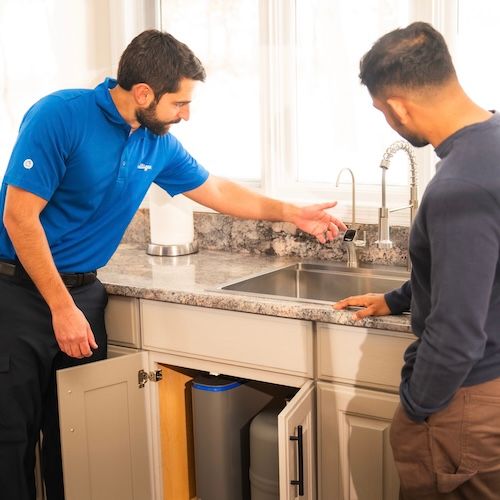
Test at the tap. Culligan of Sylmar’s free in-home test measures hardness, chlorine, total dissolved solids, pH and iron in about 20 minutes. For lead, nitrate, bacteria, arsenic, chromium-6 or PFAS we arrange certified laboratory testing. It matters most if your home predates 1986, if an infant or pregnant person drinks the water, if your water has changed, or if you are on a private well. Our Sylmar water testing page explains both options.
Frequently asked questions about Sylmar tap water
Is the tap water in Sylmar safe to drink straight from the tap?
Yes by regulatory standards. LADWP reports no substance above a maximum contaminant level in 2025, and the neighboring systems report no violations. The reports also show chloramine, hardness and low levels of chromium-6, nitrate and arsenic, which some households choose to reduce further at the kitchen sink.
Why does my tap water in Sylmar taste like chlorine?
LADWP disinfects with chloramine and reports a citywide residual averaging 1.7 mg/L. It lingers longer than chlorine, so the smell shows up in hot showers and in a glass left on the counter. A reverse osmosis system or a chloramine-rated carbon filter removes it.
Is there PFAS in Sylmar’s water?
Not at LADWP’s distribution entry points, according to its 2025 report. Nearby groundwater systems have found it: Glendale shut its Verdugo Basin wells in 2024 over PFOA and PFOS, and SCV Water treats seven wells with ion exchange. If your water comes from local wells, a Total Defense RO is a simple safeguard.
Is the Superfund site a problem for Sylmar drinking water?
Not for what reaches your tap. Contaminated San Fernando Basin wells are either shut down or treated before the water enters the system, which is why LADWP uses only 41 of its 115 wells and why local groundwater was just 1 percent of its 2025 supply. The cleanup’s purpose is to restore that local supply safely.
Schedule your free water test with Culligan of Sylmar
You should not have to guess about your water. Culligan of Sylmar has helped homeowners across Sylmar, San Fernando, Pacoima, Granada Hills, Northridge, Chatsworth, Van Nuys, Burbank, Glendale, Pasadena, Santa Clarita, Valencia, Canyon Country, Arcadia and Glendora understand and improve their water for decades. Our local experts test your water, explain the results in plain language and, if treatment makes sense, walk you through rental and purchase options so you can decide what fits your household.
Ready for better water? Schedule your free in-home water test with Culligan of Sylmar today.