Quick answer: Yes, the water in Santa Ana is hard. The City of Santa Ana’s 2025 water quality report puts total hardness in its groundwater at an average of 239 parts per million as calcium carbonate, about 14 grains per gallon, with individual wells ranging from 130 to 307 ppm (7.6 to 18 grains). The imported Metropolitan Water District water that makes up the rest of the supply tested at 236 ppm, also about 14 grains. On the standard scale, anything above 10.5 grains per gallon is “very hard,” and nearly every community in Orange County lands there. The only way to know your own home’s number is to test at the tap.
Most Santa Ana homeowners don’t need a lab to tell them the water is hard. The evidence is on the shower door in Floral Park, on the dishwasher glasses in South Coast Metro, in the crust on a faucet aerator in Downtown Santa Ana. White haze, chalky rings, soap that won’t rinse clean and stiff towels all trace back to calcium and magnesium dissolved in the water before it reached your meter. Here is what homeowners across Orange County should know about why the water is hard, how to check your own level and what a softener does about it.
Where Santa Ana’s hardness comes from
Santa Ana pumps about 85 percent of its drinking water from the Orange County Groundwater Basin through 21 city-owned wells; the other 15 percent is treated surface water from the Metropolitan Water District of Southern California (MWD), drawn from the Colorado River and the State Water Project. The Orange County Water District (OCWD) manages the basin and refills it with Santa Ana River flow, captured stormwater and purified recycled water. All of that water moves through sand, gravel and sediment that contain calcium and magnesium, and picks them up on the way. That is hardness.
The imported side is no better. MWD’s 2025 report lists hardness at its Diemer plant in Yorba Linda, which serves Orange County, at 235 to 305 ppm for 2024, roughly 14 to 18 grains per gallon. Colorado River water is naturally mineral-heavy, so in years when MWD delivers more of it, the blend gets harder. Whether your water came up from a well in Santa Ana or down the aqueduct, it arrives hard.
Is the water harder in Santa Ana or in the rest of Orange County?
The published numbers are closer together than most people expect:
Santa Ana: 239 ppm groundwater average (14 grains), range 7.6 to 18 grains across wells; MWD water 236 ppm (14 grains). City of Santa Ana 2025 report.
Fullerton: 246 ppm groundwater average (14 grains), with a range of 11 to 22 grains per gallon; imported water 236 ppm. City of Fullerton 2025 report.
Huntington Beach: 162 ppm groundwater average (10 grains) from its nine wells; imported water 236 ppm (14 grains). City of Huntington Beach 2025 report.
Irvine Ranch Water District (Irvine, parts of Tustin, Newport Beach, Lake Forest and Orange): 214 to 293 ppm (12.5 to 17.1 grains) across its treated sources in the 2026 report, with a system-wide distribution average of 236 ppm (13.8 grains).
South Orange County (Mission Viejo, Laguna Niguel, Aliso Viejo, Laguna Hills, Laguna Woods): essentially all imported. El Toro Water District’s 2026 report lists MWD water at 236 ppm (14 grains) and water from IRWD’s Baker plant at 293 ppm (17 grains, range 16 to 19). Moulton Niguel Water District’s most recent full report averaged 13.3 grains per gallon system-wide.
So Santa Ana is typical of the county: very hard, with the exact figure at your tap depending on which wells and imported connections feed your pressure zone that month. None of these utilities soften the water; hardness is not a health standard, so public systems are not required to remove it. Private wells are a footnote here; the few that remain in the canyons and on old agricultural parcels draw from the same mineral-rich sediments and are typically hard too.
Hard water problems Santa Ana homeowners deal with
Hard water isn’t a health risk. It is a maintenance cost that compounds quietly. Three complaints come up most.
1. Scale in water heaters, tankless units and appliances
What homeowners notice: A tankless water heater that throws an error code or needs descaling every year, a tank heater that pops and rumbles, slower hot-water recovery, a dishwasher with a white crust on the element, showerheads that spray sideways.
What causes it: When hard water is heated, dissolved calcium and magnesium drop out of solution and bond to hot surfaces as scale.
Why it matters: Scale insulates heating elements and narrows heat-exchanger passages, so the unit burns more energy and wears out sooner. Tankless heaters, common in newer Irvine and Tustin homes, are especially sensitive because their water channels are so narrow.
2. Spots, film and soap scum
What homeowners notice: Cloudy glassware, a white film on the shower enclosure, chalky deposits where the faucet meets the sink, grout that stays dingy.
What causes it: Calcium and magnesium react with soap to form a sticky curd instead of a lather, and evaporating hard water leaves the minerals behind as a deposit.
Why it matters: Hard-water homes use more detergent, dish soap and shampoo to get the same result, and glass shower doors etch permanently if the film is left in place.
3. Dry skin and hair
What homeowners notice: Skin that feels tight after a shower, dull hair, a sense that soap never fully rinses off.
What causes it: The same soap-and-mineral residue that films the shower door stays on skin and hair and blocks moisture.
Why it matters: Customers who install a softener in Santa Ana routinely tell us the shower is the first place they notice the difference.
A whole-home softener such as Culligan’s Aquasential® Smart High Efficiency Water Softener removes calcium and magnesium where water enters the house, so every fixture, the water heater and the laundry get softened water. Many Santa Ana customers pair it with a carbon filter to take out the chlorine taste at the same time. See the options on our Santa Ana water softeners page.
A note on softener rules in Irvine and IRWD’s service area
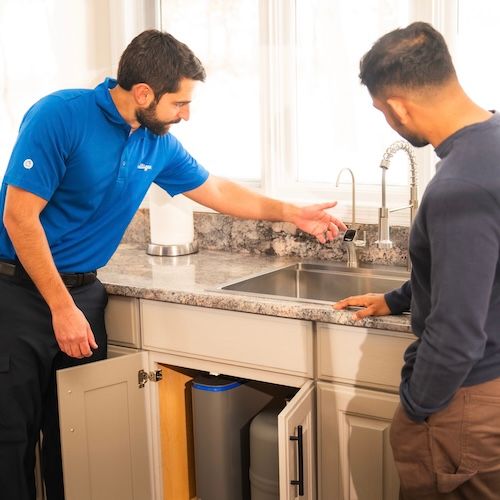
Irvine Ranch Water District prohibits self-regenerating (salt-based, drain-connected) water softeners in its service area to keep brine out of its recycled water system. If IRWD serves your home, which covers Irvine and parts of Tustin, Newport Beach, Lake Forest and Orange, the compliant answer is Culligan’s Portable Exchange Tank service: a softener tank with no brine discharge at the house, swapped on a schedule and regenerated at our facility. Santa Ana, Anaheim, Fullerton, Huntington Beach and the south county districts have no comparable restriction, and a conventional high-efficiency softener is the usual choice there. We confirm your district during the free visit.
How to check your home’s water hardness in Santa Ana
Three steps, from least to most precise.
Read your utility’s water quality report. Santa Ana’s annual Consumer Confidence Report at SantaAnaCCR.org lists hardness for both groundwater and imported water; Anaheim, Fullerton, Huntington Beach, IRWD, Mesa Water, El Toro and Moulton Niguel publish their own. The report gives the system-wide picture, not your tap.
Look for the signs. Scale on the showerhead, spotted glasses, a noisy or slow water heater, soap that won’t lather. Two or more together almost always mean hard water.
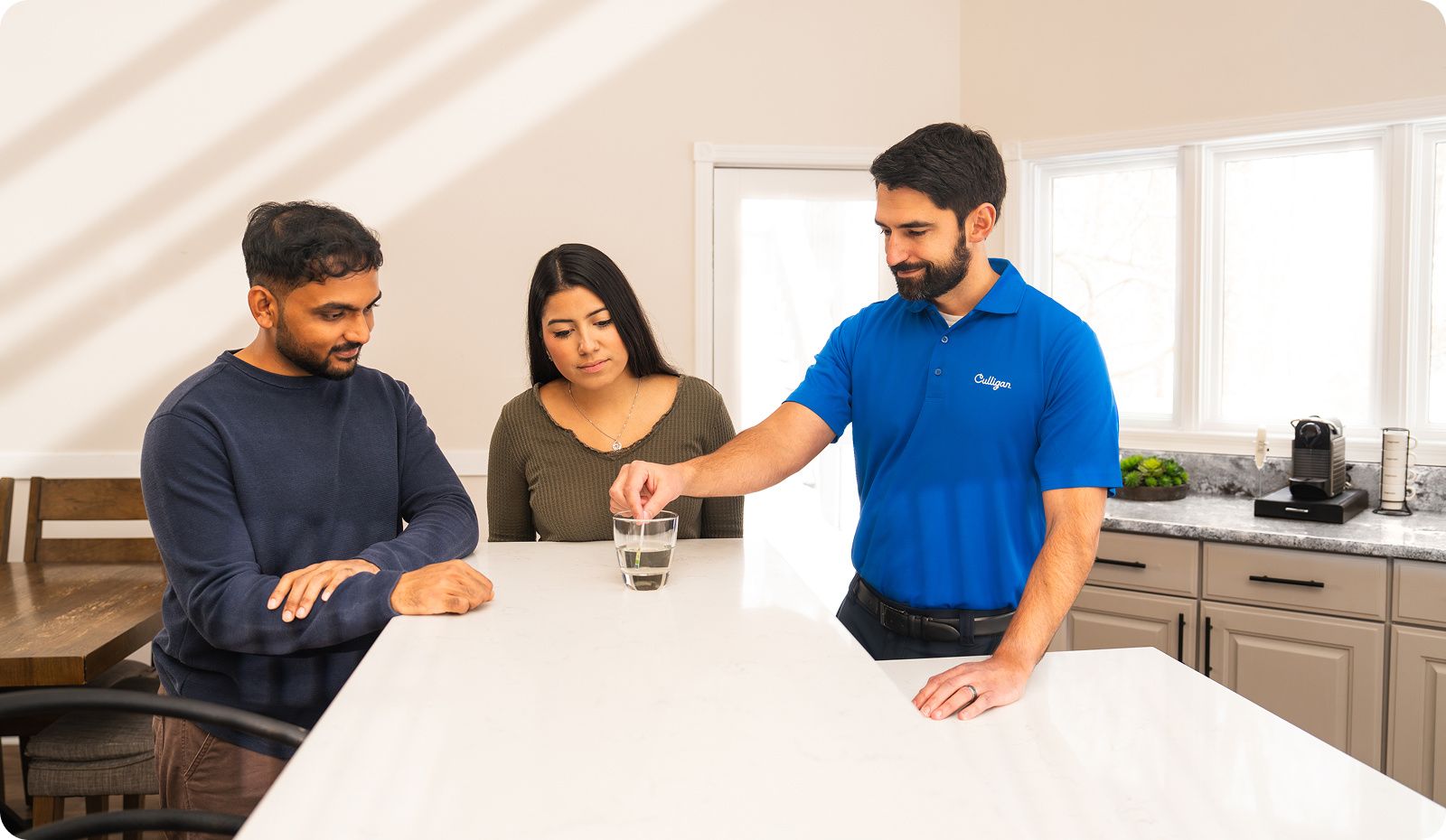
Test at your kitchen tap. This is the number that sizes your softener. Santa Ana’s wells range from 7.6 to 18 grains per gallon, so two homes on opposite sides of the city can test several grains apart. Culligan of Santa Ana’s in-home test is free, takes about 20 minutes and measures hardness, chlorine, iron, pH and total dissolved solids on the spot, with a written result you keep.
FAQs about Santa Ana water hardness
How hard is the water in Santa Ana, CA?
The City of Santa Ana’s 2025 water quality report lists groundwater hardness at an average of 239 ppm as calcium carbonate, about 14 grains per gallon, with a range of 7.6 to 18 grains across its wells. Imported MWD water was 236 ppm. Both figures fall in the “very hard” classification.
Does the City of Santa Ana soften the water?
No. The city disinfects its well water with chlorine and tests it continuously, but hardness is not a regulated contaminant and the city does not remove calcium or magnesium. Neither does any other Orange County utility. Softening happens, if at all, at the home.
Can I install a salt softener in Irvine?
Not a self-regenerating one. IRWD prohibits softeners that discharge brine to the sewer in its service area. Portable Exchange Tank service gives you softened water without any regeneration at the house, and that is what we install for IRWD customers.
Will a water-filter pitcher or fridge filter soften Santa Ana water?
No. Those filters target taste and specific drinking-water contaminants, not calcium and magnesium, and they only treat the water you pour through them. Scale on your water heater and shower door comes from the rest of the water your home uses, which takes an ion-exchange softener or exchange tank.
Start with a free hard water test from Culligan of Santa Ana
Culligan of Santa Ana has been treating Orange County Groundwater Basin water and imported MWD water for homes across Santa Ana, Anaheim, Fullerton, Irvine, Huntington Beach, Newport Beach, Costa Mesa, Orange, Tustin, Garden Grove, Westminster, Mission Viejo, Laguna Niguel and Laguna Beach for decades. Our technicians know which districts restrict salt softeners and what size system a given household needs. Schedule a free in-home water test and a local specialist will test at your tap, explain the results in plain language and, if a softener or exchange tank makes sense, lay out rental and purchase options with a written quote.
Ready for better water? Schedule your free in-home water test and consultation with Culligan of Santa Ana today.